
- Project: Waterhouse Residence
- Architect: o y a m a
- Location: Canada, Sutton, Quebec
- Year: 2024
- Area: 260 m2
- Photography: Alex Lesage
Three Volumes, One Landscape
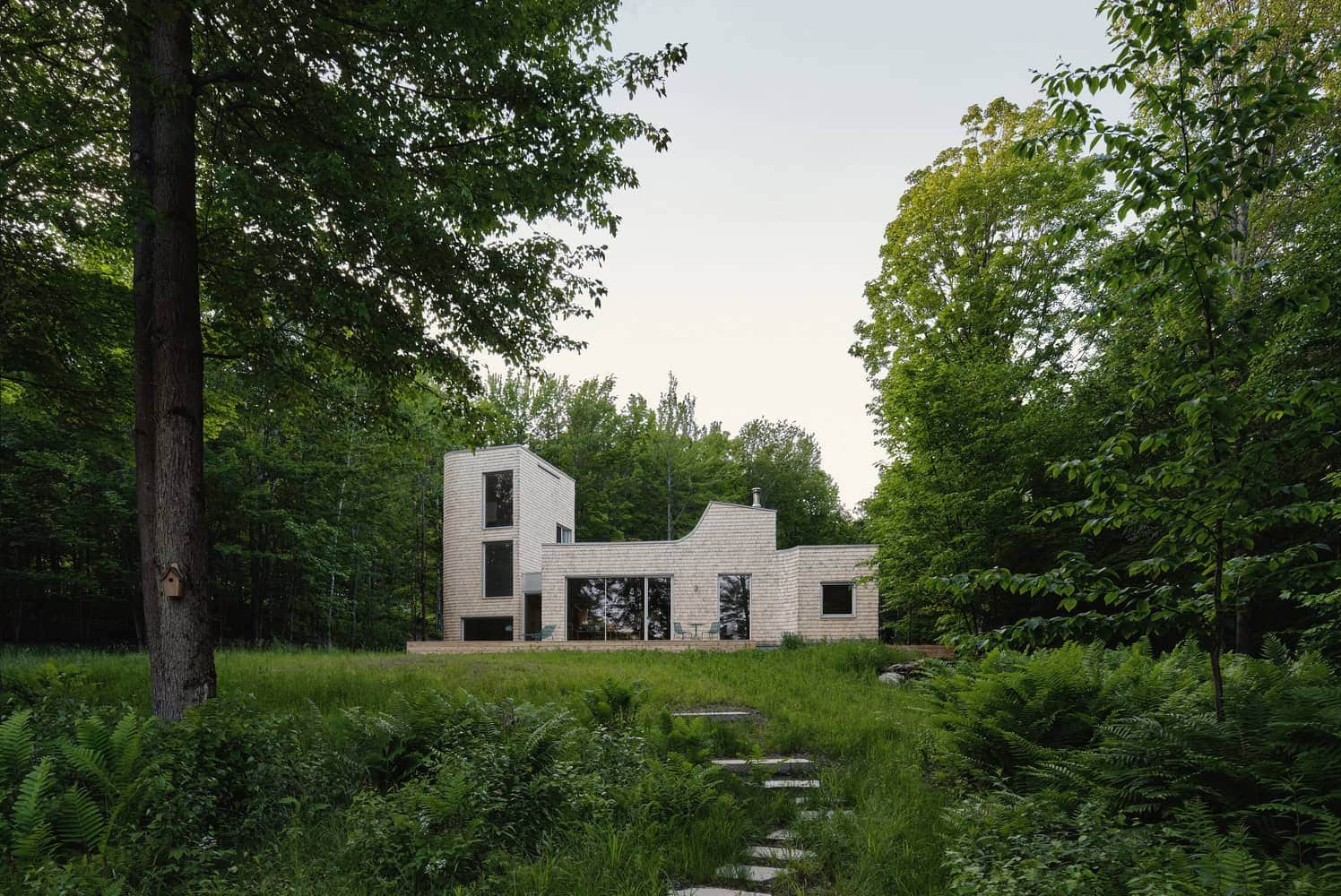
In the rolling landscape of Sutton, Quebec, Waterhouse Residence by o y a m a + Julia Manaças Architecte stands as a calm composition of three distinct wooden volumes — the Tower, the Atelier, and the Great Room. The architects sought to create a dwelling that blends into the forested site rather than dominating it, with each volume responding to light, view, and terrain in its own way.
The home sits at the edge of a clearing, surrounded by ponds and mature trees. Its form is both sculptural and grounded: three interlocking cedar-clad bodies that seem to rise naturally from the earth. The architecture captures stillness — a dialogue between density and void, built form and nature.
Concept and Composition
The project reimagines domestic life through fragmentation. Instead of a single mass, the program is divided into three interconnected parts, allowing the house to adapt to the slope, orient toward views, and modulate privacy.
-
The Tower houses the guest rooms, stacked vertically to capture elevated views of the landscape.
-
The Atelier serves as an entry and workspace — a place of making that grounds the ensemble.
-
The Great Room forms the heart of the home: an open living, dining, and kitchen area framed by glass and light.
Between these volumes, narrow courtyards and transitional patios invite daylight deep into the interiors, forming outdoor rooms that shift character with the seasons. The composition feels organic — as if the house were placed by the landscape itself.
Material and Atmosphere
Cedar shingles wrap each volume, unifying them through texture and tone. Over time, the wood will silver naturally, blending further into the surrounding forest. The architects favored materials that weather gracefully and express craft rather than perfection.
Inside, the palette is restrained — white oak floors, exposed timber, light plaster walls, and dark window frames — allowing natural light and the rhythm of the shingles to take center stage. The tactile warmth of the interior contrasts with the cool, filtered light of the forest beyond.
The architecture is minimal but not sterile: its beauty lies in proportion, shadow, and the interplay between solid and transparent.
Relationship to Site
The Waterhouse Residence follows the contours of the land, stepping down gently toward a pond at the lower end of the site. The architects preserved existing vegetation, threading the house through trees and boulders rather than clearing them away.
Large glazed openings in the Great Room frame specific vignettes of the landscape — a stand of birches, a pool of still water, a fragment of sky. The spaces between volumes become thresholds of microclimate: shaded breezeways in summer, sheltered pockets in winter.
From sunrise to dusk, the home’s cedar skin catches and reflects light differently — gold in morning, silver at midday, and deep amber by sunset.
The Interior Landscape
The interior flow is intuitive, centered around light and quiet. Circulation paths are short, framed by glimpses of the outdoors. The Great Room anchors family life, while more private volumes retreat into shade and silence.
The Tower’s upper bedroom feels like a lookout, with panoramic views of the valley. The Atelier below functions as both workshop and contemplative space — an architectural counterpoint to the natural stillness outside.
Furnishings are custom-built in wood and stone, complementing the raw material honesty of the structure. Every detail — from the handrail thickness to the window seat proportions — is fine-tuned to feel balanced and human.
Sustainability and Construction Logic
Simplicity drives both the design and environmental strategy. The cedar envelope provides natural insulation, while deep eaves and strategically placed openings regulate sunlight and thermal gain. Natural ventilation cools the house during summer; in winter, radiant floors and wood heat create ambient comfort.
Local materials and regional craftsmanship reduce the project’s carbon footprint, while its compact footprint minimizes disruption to the landscape. The three-volume plan also improves energy efficiency, isolating functions according to seasonal use and occupancy.
Architectural Philosophy
The Waterhouse Residence expresses a quiet philosophy: to build lightly and live attentively. It is a study in proportion, restraint, and sensory balance — a home that engages the elements rather than resisting them.
o y a m a + Julia Manaças Architecte treat architecture as a frame for living, where light, air, and sound are as carefully composed as wood and stone. The project proves that contemporary design in natural settings can be both rigorous and poetic, both modern and deeply human.
A Canadian Retreat with Global Clarity
Beyond its material refinement, the Waterhouse Residence embodies a new kind of rural architecture — one that rejects nostalgia for honest craft and mindful minimalism. It’s not a retreat from life but a place to reinhabit it more slowly, guided by the rhythm of water, wind, and light.
In the quiet of Sutton’s forest, the home becomes an instrument of observation — a sanctuary that listens as much as it shelters.


