
- Project: Hazamacho House
- Architect: Tatsuya Kawamoto
- Location: Japan
- Year: 2022
- Area: 193 m2
- Photography: Takashi Uemura
Architecture as a Frame for Rural Life
In the agricultural landscapes of Japan, Hazamacho House by Tatsuya Kawamoto + Associates stands as both a residence and a long-term agricultural infrastructure.
The one-story structure, designed for local farmers, embodies a vision of architecture that supports community and curbs disorderly urbanization, offering a model for sustainable land use in rural Japan.
Rather than a private home in the traditional sense, the project acts as a “frame” for living and working, one that will evolve over time from residence to agricultural facility — seamlessly integrating into the rhythm of the land.
A Rural Context Defined by Regulation and Restraint
Located in an urbanization control area, the site is surrounded by fields, mountains, and a river.
Municipal regulations require a building coverage ratio of at least 40%, a rule that typically leads to unnecessarily large houses — a contradiction for modest rural lifestyles.
Kawamoto’s approach subverts this condition. Instead of producing a massive, enclosed dwelling, he conceived a wide, lightweight roof structure that meets regulatory requirements while maintaining spatial openness and cost efficiency.
The result is a building that visually anchors the site without disrupting its agrarian character.
Design Strategy: The Roof as a Landscape
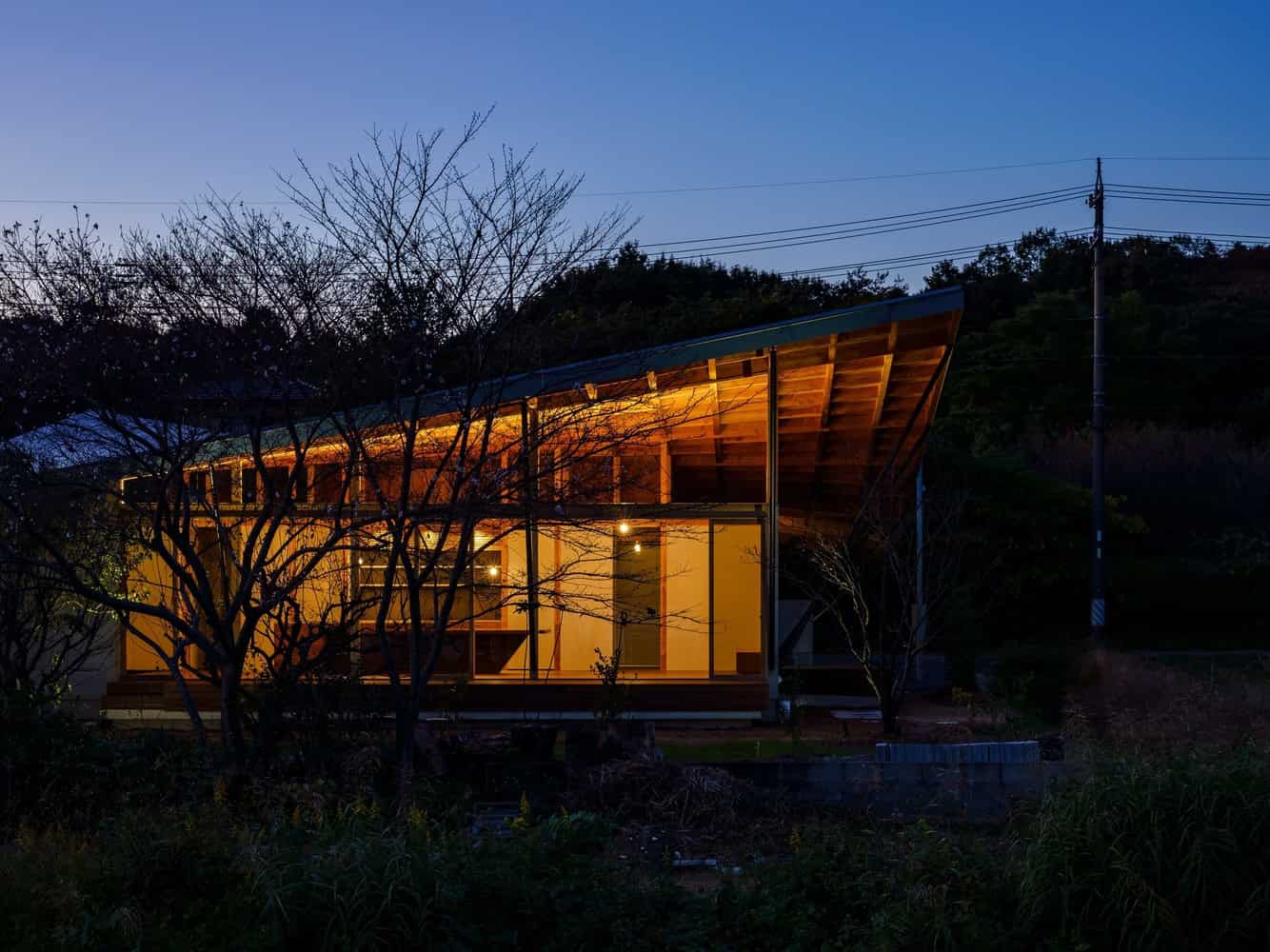
The architectural concept revolves around a large, dynamic roof plane — a unifying element that “jumps” in multiple directions.
This roof not only defines the form but also becomes the primary instrument of environmental response, connecting the architecture to the surrounding mountain ridges.
-
Eaves on the east rise toward the nearby mountains, inviting views and light.
-
Eaves on the south are lowered to mitigate summer solar gain, forming a gentle hyperbolic parabola created entirely with straight timber beams.
-
The roof’s cantilevered edges are stabilized with slender iron tension rods, producing an elegant, floating ridgeline that mirrors the horizon.
This careful manipulation of geometry and structure creates an architecture that feels light, rooted, and responsive to nature.
Spatial Composition: Central Core and Open Periphery
The plan organizes load-bearing walls compactly at the building’s center, freeing the perimeter for flexible use.
These central walls fold and bend to define zones for crop storage, tools, and daily activities, while the outer ring of space remains adaptable — able to shift from living quarters to agricultural workspace as needed.
The arrangement encourages access from all sides, linking the building to the surrounding fields.
Wide eaves create shaded thresholds that blur boundaries between interior and exterior, offering areas for crop drying, resting, or community gathering.
Adaptive Architecture and Future Transformation
While the building currently serves as a farmer’s home, it was conceived from the outset as a flexible, long-term agricultural framework.
Over time, as residential needs diminish, the structure will naturally transform into sheds and workspaces for surrounding farmers, ensuring continued use of the land without redevelopment pressure.
In this way, Hazamacho House operates as a catalyst for sustainable rural growth — a physical and symbolic buffer against uncontrolled suburban sprawl.
Preserving Farmland Through Design
By focusing on simplicity, adaptability, and ecological integration, Tatsuya Kawamoto + Associates demonstrate how thoughtful architecture can support not just individuals, but entire communities.
Through its generous roof, modular layout, and environmental awareness, Hazamacho House reinforces the essential dialogue between human habitation and agricultural continuity — creating a form of architecture that protects the land as much as it inhabits it.


