
- Project: Yuecheng·Yanyuan
- Architect: Jinhe Design
- Location: China, Xingtai, Hebei
- Year: 2023
- Area: 2000 m2
- Photography: Zheng Yan
A New Vision for Entrepreneurial Space in the Post-Pandemic Era
In 2023, JINHE DESIGN completed Yuecheng·Yanyuan, a visionary business reception and lifestyle venue for Yuesheng Group in Xingtai, Hebei. More than just a corporate hospitality center, the project redefines the modern workplace as a third place—a fluid, hybrid environment that fuses professional, social, and cultural life.
Replacing traditional enclosed walls and rigid functional zoning, the design introduces open, interconnected spaces that encourage communication, collaboration, and creative energy. Here, architecture transcends conventional office typologies to become an expression of empathy, innovation, and human connection.
Layered Spatial Narratives
JINHE DESIGN draws inspiration from the sociological concept of the “third place”, described by Ray Oldenburg as a social realm between home and work. Yuecheng·Yanyuan embodies this principle, offering an adaptive environment that supports dialogue, comfort, and informal interaction.
The original irregular site was reimagined as a series of six spatial clusters—a Western dining area, Chinese dining area, lounge, office, salon, and tea room. Each zone maintains a distinct identity while remaining visually and spatially connected. Sliding walls, intersecting partitions, and transitional furnishings define fluid boundaries that shift with the users’ activities.
This layered organization creates a rhythm of openness and intimacy, with spaces flowing seamlessly along both east–west and north–south axes. The absence of fixed walls allows for dynamic use and continuous reconfiguration, transforming the environment from a meeting hub into a social landscape.
Materiality and Atmosphere
The material palette and lighting strategy at Yuecheng·Yanyuan embody a refined sense of artful restraint. Curved internal walls soften the space, while controlled tilts and subtle rotations introduce movement and rhythm. Natural light floods in through south-facing full-height glazing, animating the interiors with shifting patterns of light and shadow throughout the day.
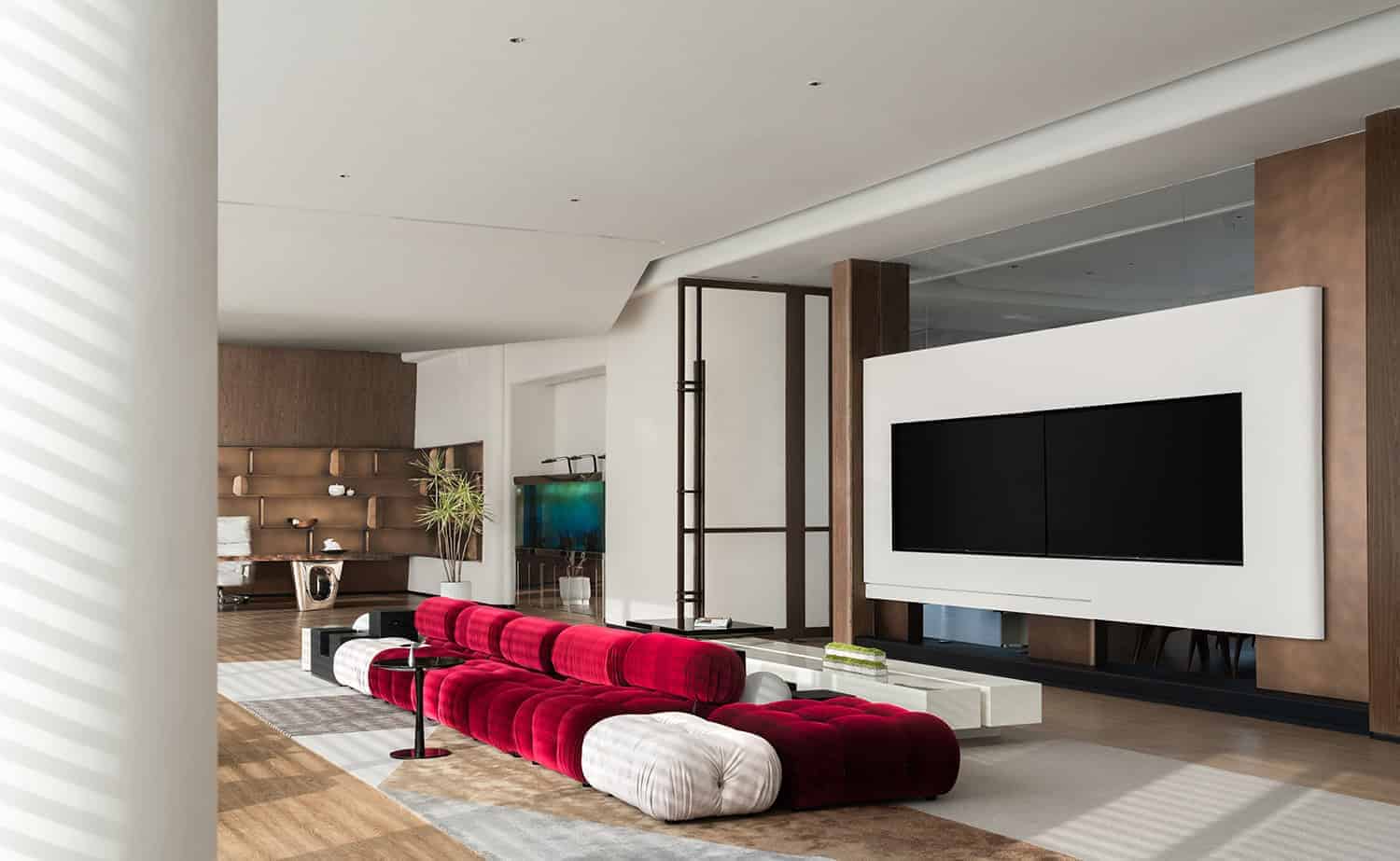
Art installations and sculptural furniture add visual depth—such as the modular 360-degree sofa in the salon, the suspended luminaires over the dining area, and the reflective surfaces that diffuse light across textured materials. The result is an interior that feels at once vibrant, tactile, and contemplative.
A Dialogue Between Function and Art
Every design element serves a dual purpose—functional yet poetic. From the frozen escalator installation that acts as a sculptural focal point, to the collaged deconstructivist walls that define circulation routes, the entire space blurs the line between architecture and art.
The Western and Chinese dining zones foster a sense of hospitality and ceremony, while the tea and salon areas promote social intimacy and dialogue. The overlapping of these functions transforms the reception center into a living organism of interactions, mirroring the fluid dynamics of modern entrepreneurship.
Reimagining the Entrepreneurial Spirit
Yuecheng·Yanyuan is more than a business space—it is a manifesto for contemporary work culture. It encourages innovation, empathy, and holistic well-being, positioning the entrepreneur’s environment as a catalyst for creativity and urban vitality.
Through its open framework, rich textures, and sensitivity to human behavior, JINHE DESIGN has crafted a space that reflects the evolving relationship between people, business, and the city. Yuecheng·Yanyuan stands as a symbol of care, progress, and cultural intelligence—a place where art, architecture, and entrepreneurship converge.

Spatial Groups: Breaking Physical Boundaries
JINDESIGN has resegmented the irregular original site into six independent yet interconnected open spaces—Western dining area, Chinese dining area, lounge area, office area, salon area, and tea area. Without physical walls, these areas are connected yet maintain their independence, visually forming multiple spatial groups along east-west and north-south dimensions.
Once interconnected, each independent space has a clear function, with circulation paths linking different functional modules, expanding into multiple composite spaces. They overlap and are used together. The office area, lounge area, and tea area make up a narrow space group along the windows. The Western dining area, Chinese dining area, and lounge area are situated on the northern side in opposition. North and south spatial groups are interconnected through intersecting walls, sliding doors, low TV walls, and electronic fireplaces, facilitating an internal network of multi-use, and versatile space organization.
Breaking physical boundaries allows for freer movement and behavior among individuals, with connections between areas becoming more flexible as they are used, offering the utmost potential in spatial utilization.

Spatial Details: Letting Art Happen Naturally
Material forms, color rhythms, and lighting arrangements are intricately woven into the details of the space, where vibrant artistic experiences further dissolve the boundaries of traditional activity scenes into a fluid, free experience.
The internal wall structures softly bend and wrap, sometimes tilting and rotating, sometimes blocking and then continuing. They strive to depict coherence, openness, and change, thereby generating unique and rich spatial details that are also mysteriously vague and thrillingly outlined.
The communication area is a collage of deconstructivism against a modern backdrop; frozen escalators and artworks create a cohesive visual language; the salon area’s 360-degree modular sofas with bright colors activate the atmosphere of continuous scenes; the dining area’s suspended lighting fixtures resonate internally, seamlessly blending function with art.
The space connects with the city through the south-facing floor-to-ceiling windows, with natural light generously embracing the interior, casting all-day flowing light and shadows under multiple reflections. Between stillness and movement, light and dark, compact and spacious, functional and blank, the entire place is teeming with life.

Value Exploration: The Spirit of Entrepreneurial Space
The layered entrepreneurial spaces within Yuecheng·Yanyuan act as nodes for urban public life and business reception, evolving into independent, organic ecological spaces with a composite modernity. They serve as power engines for driving micro-scale innovations in the city, creating unprecedented commercial value.
At the same time, the era demands designers to generalize and integrate complex space types more broadly, making places like Yuecheng·Yanyuan’s reception areas more humanized and modern.
Merging the entrepreneurial spirit with creative thinking to provide an inspiring composite space is central to JINDESIGN philosophy. The care and progressive thinking embedded in their designs align seamlessly with the entrepreneurial spirit called for in this era.


