
- Project: Cranberry Pond House
- Architect: Bryce de Reynier
- Location: United States, New York
- Year: 2022
- Area: 107 m2
- Photography: Bryce de Reynier
A Sculptural Retreat Rooted in Nature
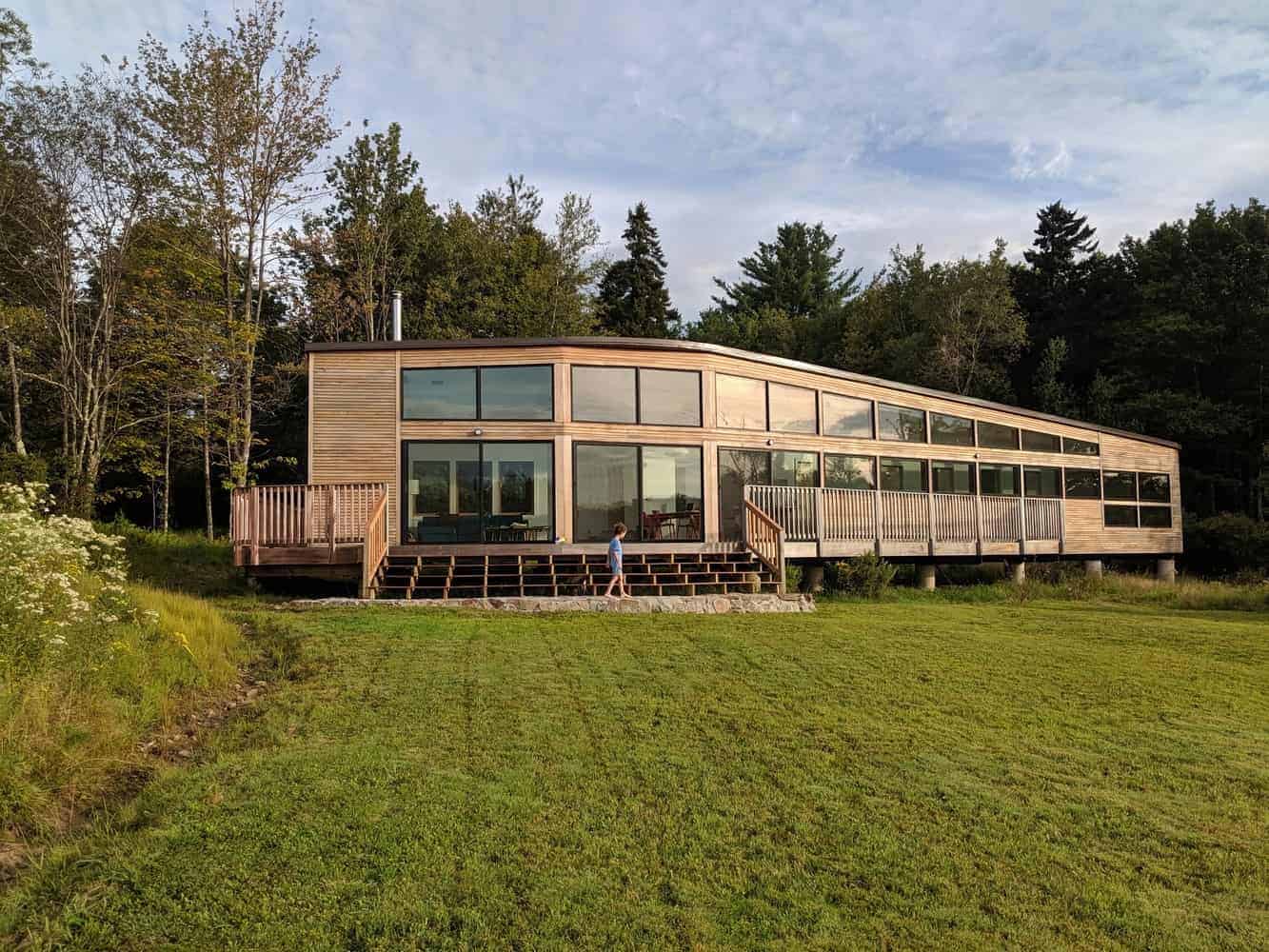
Tucked within a forest clearing at the edge of a spring-fed pond in upstate New York, Cranberry Pond House by Bryce de Reynier is a masterclass in restraint, proportion, and ecological harmony. Designed as a personal retreat, the home hovers lightly above the terrain, letting water, air, and vegetation flow freely around and beneath it. Every gesture of the building — from its elevated linear form to its careful siting — expresses a deep respect for the land and its natural rhythms.


Concept & Volumetric Strategy
The architecture follows a simple linear plan aligned with the slope of the site and the reflective surface of the pond. The form bends slightly, echoing the natural curve of the shoreline. This gentle movement organizes the spaces within — public zones toward the panoramic view and private rooms tucked discreetly behind.
The design plays on the timeless architectural duality of prospect and refuge: openness toward the pond, enclosure toward the woods. Expansive glazing pulls the landscape inside, while a solid rear wall grounds the home and shields it from cold northern winds. This careful balance gives the house a feeling of both protection and liberation.


Site, Orientation & Environmental Integration
The site lies within the Catskills foothills, surrounded by mixed deciduous forest and wetland ecosystems. The building sits slightly elevated above grade, supported by discreet structural piers, allowing natural water flow and vegetation to continue undisturbed beneath the structure.
Orientation is tuned to optimize passive solar performance. The long glass façade faces southeast, capturing low winter sun while deep roof overhangs prevent summer overheating. Sliding glass panels provide natural cross-ventilation, eliminating the need for heavy mechanical systems. A compact footprint and minimal site intervention preserve natural drainage and topsoil — the house treads lightly.


Materials & Craftsmanship
The palette is elemental: wood, glass, and steel. Vertical cedar siding blends with surrounding trunks and bark. Inside, exposed structural timber and natural finishes provide tactility and warmth. Polished concrete floors act as thermal mass, while a standing-seam metal roof reflects sunlight and sheds snow efficiently.
Every specification is chosen for durability, low maintenance, and environmental responsibility; restrained details — concealed gutters, minimal trim — reinforce the sculptural clarity.


Program & Daily Life
Despite its modest size, the open plan and lofty ceilings make the house feel expansive. The southern end hosts the social zone — kitchen, dining, and living — opening through sliders to a broad deck over the pond. Private rooms line the quieter northern stretch, separated by subtle level changes rather than solid partitions. Clerestories bring soft light while preserving privacy; compact service cores keep the linear plan flowing.
Daily life tracks the site’s rhythms: morning sun in the kitchen, midday reflections shimmering into the living area, evening treelines mirrored on glass — architecture as a prompt for stillness and connection.


Light, Reflection & Seasonal Character
Light is the primary material here: as the sun arcs, it orchestrates a shifting interplay of brightness and shadow. The glass façade becomes a living canvas, mirroring clouds, ripples, and foliage. Low winter sun penetrates deep to warm the concrete; in summer, shaded overhangs create a luminous, glare-free interior — a quiet, meditative rhythm in tune with the site.
Sustainability & Performance
The project privileges passive strategies over tech-heavy systems:
- Passive solar heating via orientation and glazing.
- Cross-ventilation through operable openings and a slender floorplate.
- Thermal mass in concrete floors and selected stone surfaces.
- Elevated construction protecting on-site hydrology and biodiversity.
- Locally sourced timber for reduced embodied carbon and regional continuity.
Comfort is achieved while minimizing energy demand and preserving the site’s ecological character.

Why It Matters
Cranberry Pond House shows how architecture can disappear into nature while heightening our experience of it. Disciplined geometry, tactile materials, and environmentally attuned detailing build an ethos of humility and clarity. Rather than imposing itself, the house frames the landscape — a contemplative, light-footed structure that turns simple living into quiet celebration.
