
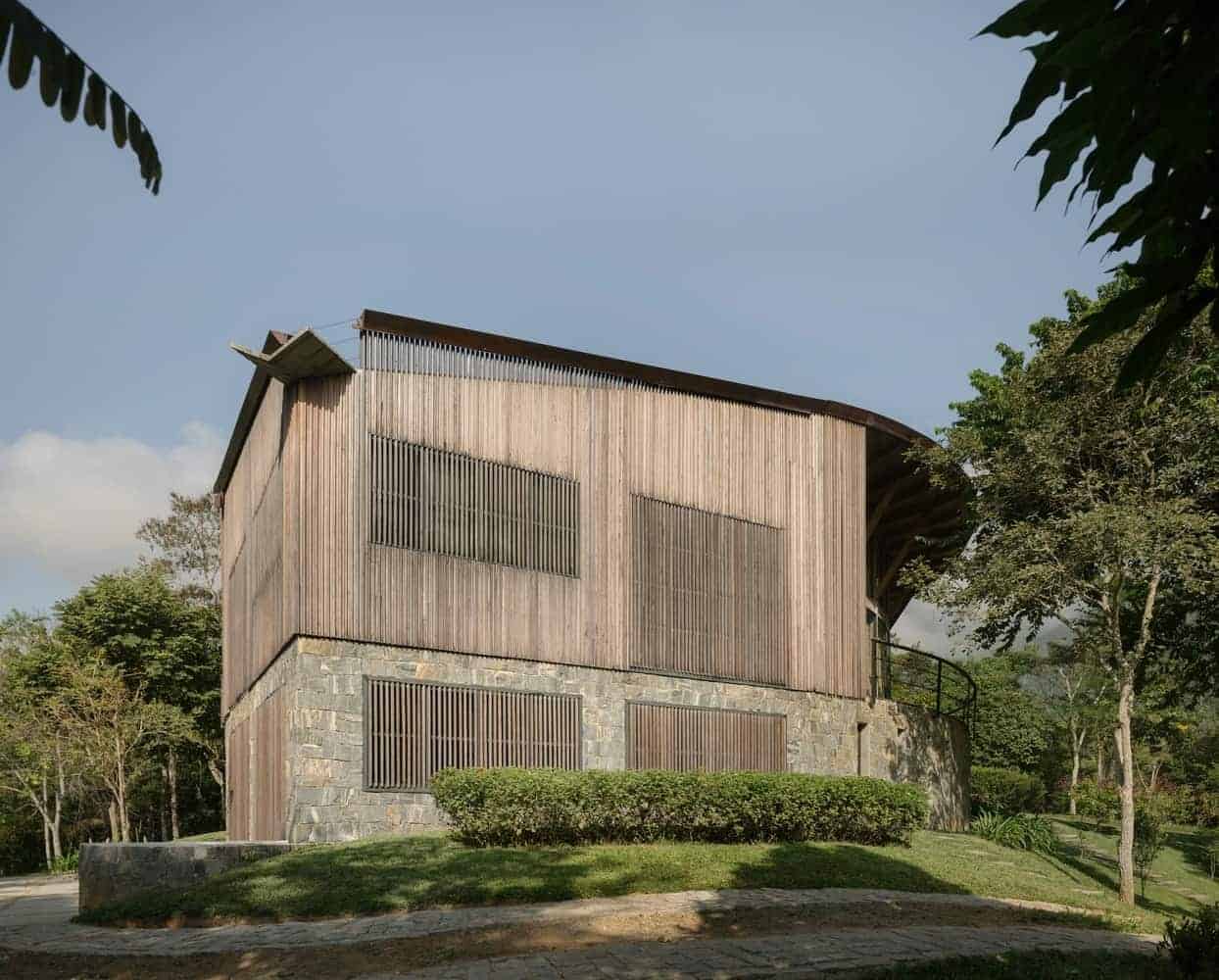
- Project: House in Bocaina
- Architect: Ana Altberg Arquiteturas
- Location: Brazil, Bananal, São Paulo
- Year: 2021
- Area: 306 m2
- Photography: Federico Cairoli
Embracing the Landscape of the Atlantic Forest
In the remote mountains of Serra da Bocaina, on the border of São Paulo and Rio de Janeiro states, House in Bocaina by Ana Altberg and Cesar Jordão unfolds as a living dialogue between architecture and the Atlantic Forest. Designed for a site of extraordinary ecological sensitivity, the residence demonstrates how form, material, and sustainability can converge to honor nature rather than impose upon it.
Its semi-elliptical geometry, inspired by the organic contours of the terrain, creates an immersive experience of the surrounding landscape. The structure’s earthy palette and natural materials allow the home to age gracefully into its environment, achieving harmony through subtlety, restraint, and environmental intelligence.
Concept & Form: The Curved House in the Forest
From the first encounter with the site, both architects and client were captivated by the intensity of Serra da Bocaina’s wilderness. The design brief was simple yet profound — to create a house that embraces the landscape.
The resulting form is a semi-elliptical composition — two rotated square volumes connected by sweeping curves that define the home’s radial organization. Within this form, private and communal spaces coexist seamlessly:
-
Two square wings accommodate four bedroom suites, accessed from the outer balcony.
-
The curved central volume houses the communal core — an open-plan living room, kitchen, and a monumental fireplace crafted by artist Lew French using locally sourced stone.
This sculptural hearth acts as both the physical and emotional nucleus of the home, anchoring the architecture while symbolizing warmth, gathering, and continuity.
Architecture & Light
The design’s curvature orchestrates a panoramic embrace of the forest, where interior and exterior boundaries blur. An inverted roof profile funnels views of the surrounding mountain peaks while introducing indirect daylight into the interior.
Three terraces aligned along an east–west axis extend from the central core, serving as open-air observatories for both sunrise and starlight. During the day, their white stone floors reflect sunlight, reducing heat gain; at night, they glow under moonlight, forming a luminous dialogue with the surrounding canopy.
The architecture’s diagonal geometries create dynamic patterns of light that shift through the day, choreographing a living play of shadows across the timber walls.
Environmental Integration & Permaculture Systems
Sustainability guided every decision — from material sourcing to ecological footprint.
-
A 45,000-liter cistern embedded beneath the house captures and stores rainwater from over 300 m² of roof surface.
-
The home’s sanitation system follows permaculture principles, including an evapotranspiration bed (ET bed) and banana circle filtration, ensuring that all wastewater is naturally processed into nutrients.
-
Soft, low-level lighting is used to minimize disruption to nocturnal wildlife, aligning architecture with ecological rhythms.
In tropical storms, the house’s roof transforms into a spectacle of water and sound, as its mirrored gutters channel rain into cascading waterfalls on both ends of the structure — a dramatic yet natural performance that reinforces the home’s connection to elemental forces.
Materiality: Wood, Stone, and Time
Material selection was both poetic and ethical. The structure combines reinforced concrete, steel, and certified sustainable wood, integrating local craft traditions with environmental responsibility.
-
The facades and roof structure are crafted from Itaúba wood, a species prized for durability and expressive grain. In the indigenous Tupi language, Itaúba fuses the words stone and wood, symbolizing resilience and transformation.
-
Over time, the wood’s natural resin hardens under sunlight, gradually turning the exterior silver-gray — a self-sealing patina that reinforces the metaphor of aging architecture as living organism.
-
All woodwork and carpentry are produced from reclaimed materials, while natural fiber curtains soften interiors and filter daylight.
This aging process — the slow graying of Itaúba — transforms the facade into a protective shell around the home’s warm interior, embodying the relationship between permanence and impermanence.
Living with the Forest
The architects sought not to dominate the site but to listen to it. The house sits lightly on its foundation, following the natural topography to minimize soil disturbance. The open terraces and balcony corridors invite continuous interaction with nature, while the interior remains shielded from the forest’s humidity and wildlife.
Inside, the architecture fosters a contemplative rhythm: by day, the house opens toward the forest; by night, it closes inward, glowing softly around its central fire. The experience is immersive — one feels both sheltered and exposed, part of the landscape yet distinctly human within it.
A House that Breathes with Time
House in Bocaina represents a rare architectural balance — between modern design discipline and environmental humility. It is a home that absorbs, adapts, and ages; a piece of architecture that grows more integrated with its ecosystem as years pass.
Through its semi-elliptical form, sustainable structure, and sensitivity to light and time, Altberg and Jordão have crafted a house that embodies a deeper ideal:
Architecture not as object, but as ecosystem.


