
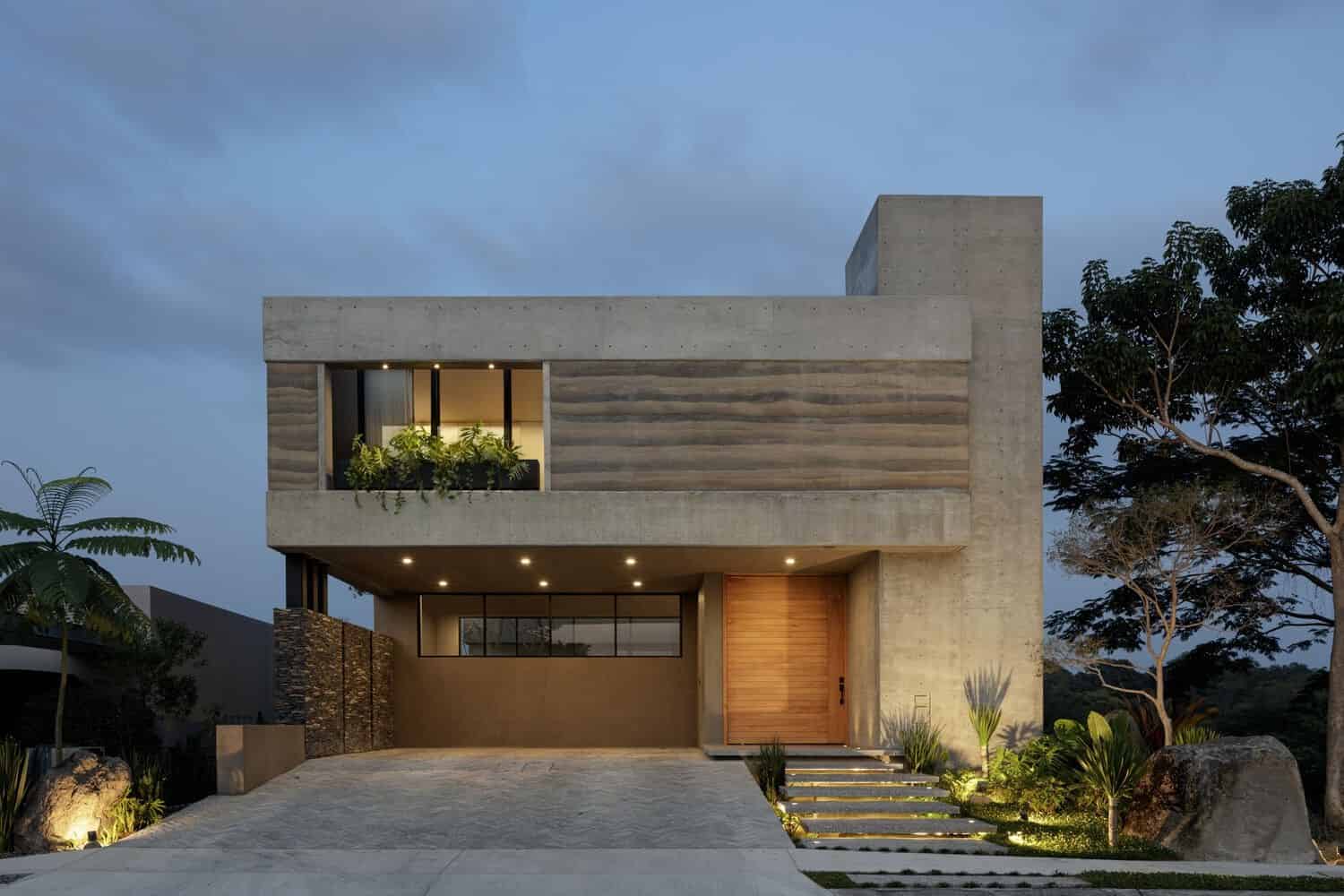
- Project: Nomah House
- Architect: Di Frenna Arquitectos
- Location: Mexico, Cuauhtémoc, Colima
- Year: 2023
- Area: 575 m2
- Photography: Lorena Darquea
A Dialogue Between Earth and Architecture
In the volcanic landscapes of Colima, Nomah House by Di Frenna Arquitectos rises as a poetic response to nature’s raw topography. Perched on uneven terrain with a privileged view of the nearby volcano, the home fuses modern architectural expression with ancestral materiality, embodying harmony between structure, land, and light.
“It is a house born from the earth — shaped by its colors, textures, and topography,” explains Di Frenna Arquitectos.
Concept: Architecture Rooted in Terrain
The steep natural slope became both challenge and inspiration. Instead of resisting the landscape, the design embraces it — cascading in volumes that adapt to the contours of the site. The structure emerges as a series of sculptural planes and voids, forming a visual symphony of lightness against the dense, earthen backdrop.
At its heart lies the project’s guiding principle: integration through material and light. Rammed earth walls, stone cladding, and microcement surfaces echo the hues of Colima’s volcanic soil, allowing the house to blend into its environment while asserting a quiet modern presence.
Form, Space & Light
Nomah House is conceived as an interplay of volumes and heights. The design avoids rigid symmetry in favor of organic fluidity — spaces shift and flow, united by continuous sightlines toward the volcano and central courtyard.
Horizontal planes are punctuated by vertical structural elements, creating suspended living zones that feel light and open. The architecture cultivates visual porosity, allowing natural light to cascade through perforations, openings, and latticework that animate surfaces throughout the day.
Light becomes a building material:
-
Morning light filters gently through rammed earth textures.
-
Afternoon glow deepens the tones of wood and concrete.
-
Evening shadows trace the geometry of walls, transforming architecture into art.
Materials: Earth, Stone, and Soul
The project’s material palette is drawn directly from its context. Every texture, color, and finish contributes to a dialogue between the man-made and the natural.
-
Rammed earth composes the upper volume, reinforcing a tactile bond with the volcanic ground.
-
Cement, stone, and microcement define the main structure, grounding the house both physically and aesthetically.
-
Wood adds human warmth — in ceiling beams, railings, and furniture — softening the bold geometry.
-
Black ironwork introduces tension and rhythm, acting as a counterpoint to the earthy tones.
Each element is selected not just for function but for its emotional resonance — reflecting the rugged elegance of Colima’s volcanic terrain.
The Courtyard as Heart and Breath
At the core of Nomah House lies a central courtyard, an architectural pause where water, vegetation, and rock coexist in perfect equilibrium. A parotilla tree, preserved from the site’s original landscape, becomes the centerpiece — a living axis around which the home’s life unfolds.
Stepped water features weave between volcanic rocks, echoing the natural flow of streams that once shaped the land. These pools create movement, sound, and reflection — a meditative dialogue between stillness and motion.
The courtyard is not merely ornamental but experiential: it connects the interior and exterior, mediating climate, light, and mood. The result is a constant awareness of the landscape — nature as both backdrop and inhabitant.
Spatial Program
Through split-level circulation, the design enhances connection to the landscape:
-
Lower Level: kitchen, dining room, terrace, and guest suite — all oriented toward the garden and volcano for an intimate bond with nature.
-
Upper Volumes: private family spaces, living areas, and balconies that frame expansive views.
The transitions between levels are fluid, with intermediate landings and terraces that reveal new perspectives of the surrounding mountains and sky.
An Architecture of Balance
Nomah House stands as a testament to Di Frenna Arquitectos’ mastery of contextual modernism — an architecture that respects the land while exploring formal innovation.
Through a delicate equilibrium of weight and lightness, solidity and air, the residence becomes more than shelter — it becomes a living instrument of reflection, serenity, and connection.


