
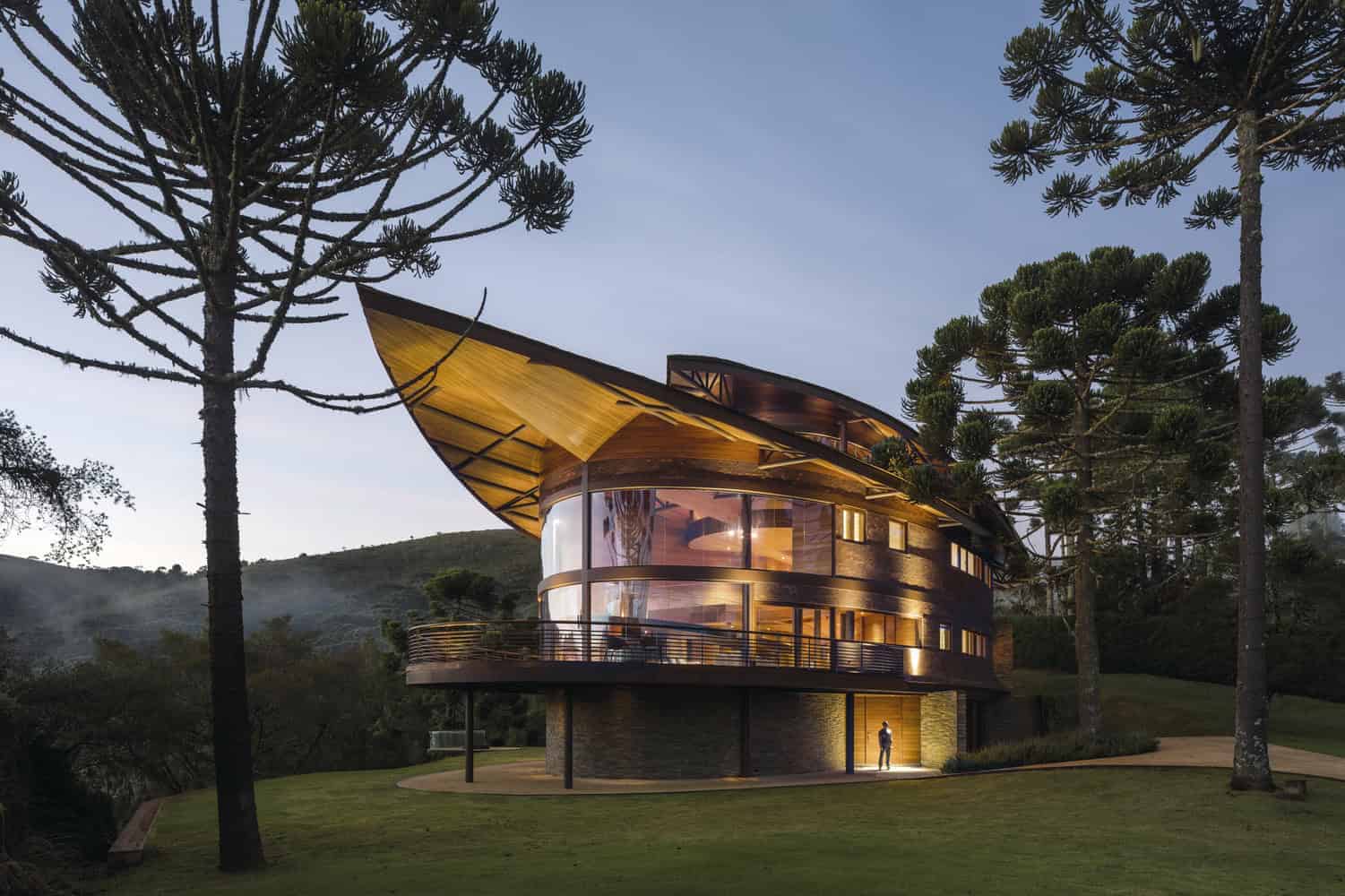
- Project: Pinhao House
- Architect: Mareines Arquitetura
- Location: Brazil, Campos do Jordao, Sao Paulo
- Year: 2016
- Area: 1300 m2
- Photography: Leonardo Finotti
The Pinhão House is one of the most ambitious examples of contemporary Brazilian residential design. Set high in the mountains of Campos do Jordão, a region known as the “Brazilian Switzerland,” the 13,993 sq ft villa rejects the Alpine clichés common in the area and instead embraces the natural spirit of its context.
Designed by Mareines Arquitetura in collaboration with Patalano Arquitetura, the home takes inspiration from the Araucaria pine and its distinctive seed, the pinhão. This organic reference shaped the sinuous geometry of the building and gave it a name rooted in local culture. The result is a house that flows with the land, weaving ramps, curves, and natural materials into a residence that is as much landscape as architecture.
Inspiration: From Araucaria Pines to Architectural Form
Campos do Jordão is blanketed by Araucaria trees, whose seeds—pinhões—are both food and symbol of the region. Instead of drawing on European models, the architects used this native geometry as the seed of the design.
-
The roof folds into a complex curved form echoing the shell of the pinhão.
-
The house plan follows an elliptical, seed-like layout, expanding and compressing as one moves through it.
-
Circulation is designed as ramps instead of stairs, creating a flowing, uninterrupted architectural promenade.
This biomimetic approach allows the building to feel grown, not placed—a structure that appears to sprout naturally from the mountain slope.
Circulation as Experience: Ramps, Light, and Spatial Drama
Where most houses separate floors with staircases, Pinhão House uses curved ramps that turn movement into sensorial storytelling.
-
Descent to introspection: Visitors descend into a dimly lit wine cellar, a compressed and contemplative space.
-
Ascent to light: The entry ramp leads upward, gradually revealing expansive views of the valley and mountains.
-
Fluid transitions: Social and private zones are woven by ramps and curved corridors, eliminating rigid separations.
This processional quality elevates daily living into an experience of unfolding light, scale, and landscape.
Spatial Organization
The villa is divided into three principal levels:
-
Lower level → wine cellar, service zones, and transitional ramps.
-
Social level → elliptical plan containing living and dining rooms, an indoor spa with pool and sauna, and large terraces.
-
Private level → four suites and a home office, each with panoramic glazing offering 180° views of Araucaria forests.
The spaces are arranged not as boxes but as continuous, sculpted interiors—compression and expansion replace corridors and walls.
Materiality: Craft and Nature in Harmony
One of the defining features of Pinhão House is its material honesty.
-
Stone and brick → provide thermal mass and connect the house to the mountain’s geology.
-
Wood → locally sourced timber creates warmth, acoustic softness, and artisanal texture.
-
Curved glazing → expansive custom-made glass panels follow the sinuous geometry, framing forest views.
-
Roofing system → the folded organic shell functions as both symbolic gesture and environmental filter.
Mareines Arquitetura collaborated with local artisans, turning the house into a stage for regional craftsmanship. Each detail, from custom joinery to curved masonry, reflects the talents of Campos do Jordão’s builders.
Climate and Sustainability
At 1,600 meters above sea level, Campos do Jordão has a cold, dry climate unusual for Brazil. Pinhão House responds through:
-
Thermal mass walls that stabilize interior temperatures.
-
Overhangs and brises that shade in summer yet allow winter sun.
-
Cross ventilation achieved by the fluid plan and operable curved glazing.
-
Integration with vegetation, reducing wind exposure and creating natural microclimates.
The design not only reduces energy needs but also ensures year-round comfort without relying heavily on mechanical systems.
Lifestyle and Luxury
Beyond technical brilliance, Pinhão House is a luxury residence tailored for both retreat and entertainment.
-
The indoor spa with pool and sauna makes it a year-round wellness retreat.
-
Expansive terraces connect seamlessly to the mountain landscape.
-
The wine cellar celebrates ritual and tradition.
-
The master suite with its panoramic balcony offers one of the most dramatic mountain views in Brazil.
This combination of organic design and luxury living sets Pinhão House apart from typical high-end villas, making it a global reference point for contemporary mountain architecture.
Connection to Mareines’ Architectural Philosophy
Pinhão House extends Mareines Arquitetura’s lineage of organic Brazilian architecture, visible in projects like the Leaf House in Angra dos Reis and the Passive House in São Paulo. Across these works, Mareines develops a philosophy of:
-
Integration with landscape rather than domination.
-
Biomorphic forms inspired by seeds, leaves, and natural rhythms.
-
Material authenticity, highlighting wood, stone, and glass.
-
Experiential circulation, where ramps, curves, and light choreograph movement.
Pinhão House stands as one of the studio’s clearest manifestos—architecture as living organism.


