
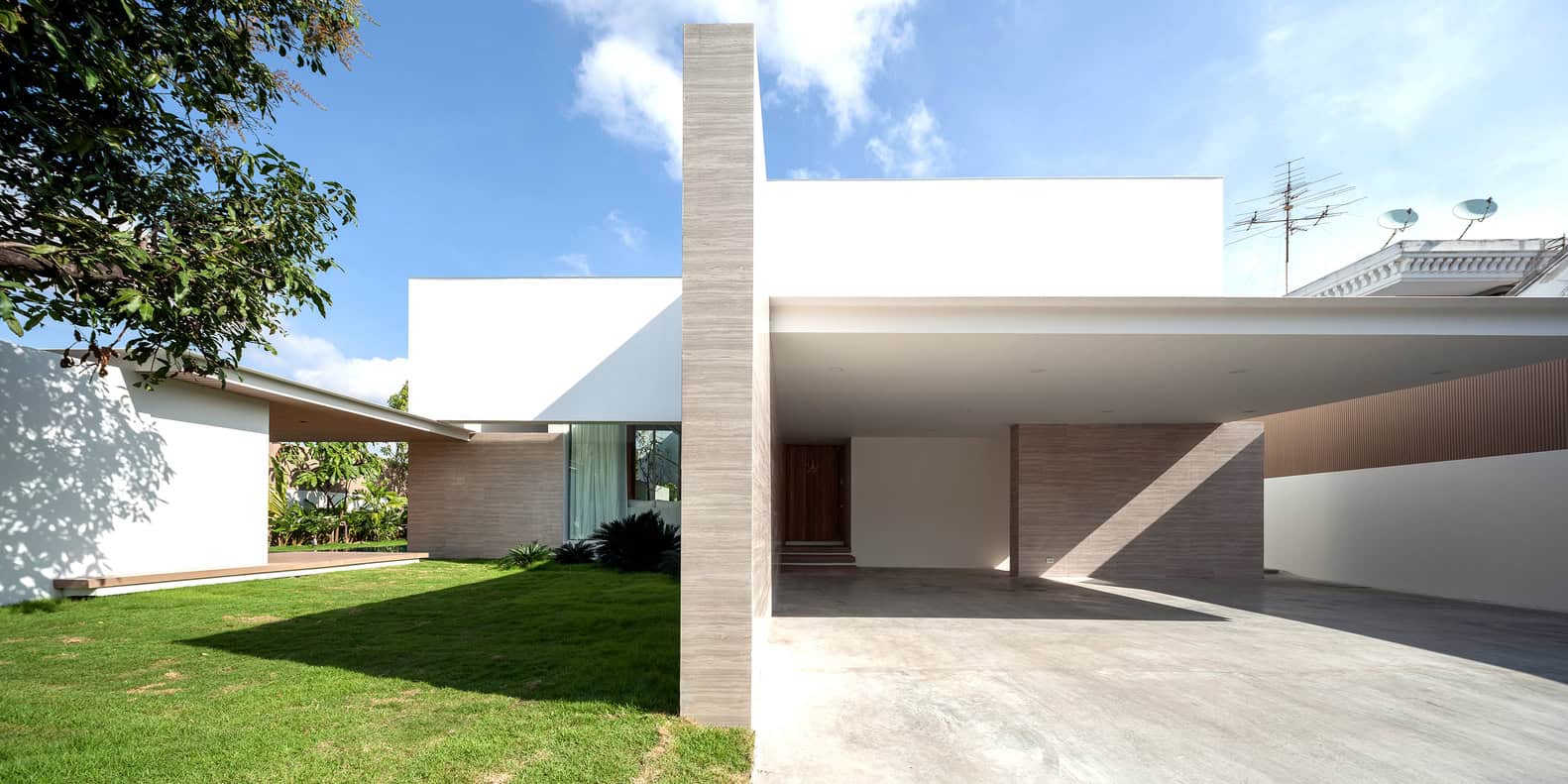
- Project: PA House
- Architect: IDIN Architects
- Location: Thailand, Bangkok
- Year: 2017
- Area: 530 m2
- Photography: Ketsiree Wongwan
A Private Home Reimagined for Family and Urban Edge
PA House by IDIN Architects is a refined architectural response to the dual demands of urban living and private family life in Bangkok. Located in a dense city context, the residence is conceived for a young family seeking both generous communal space and discrete retreat. Through subtle manoeuvres of form, plane and material, the architects sculpt volume and void to create an environment that is open yet protected.
The house centres on three bedrooms—including a master suite and two future-proofed guest/child rooms—while privileging a large, fluid common area for living and dining where the owners frequently entertain and connect. Privacy was equally a key directive: the surrounding buildings necessitated an inward-facing orientation, screen walls and thoughtful zoning.
Architectural Concept: Screening, Framing & Flow
In order to reconcile openness with enclosure, the design begins with “wall planes” that act both as screens and spatial definers. These wall planes serve to shield views from the outside-in, while simultaneously opening the inside-out to the garden, pool and landscape beyond. This layering of planes establishes a rich architectural tension: you feel protected within, yet expansively connected outward.
The core – the living/dining and pool zone – is deliberately oriented for a 180-degree green view, emphasising the horizontal while the planes subtly define thresholds, shade and privacy. As IDIN note: “Each wall plane is intentionally designed to float … to define the house’s view and shade out the sunlight.”
Materials are restrained yet warm: concrete, timber, glass — employed to bring calm and clarity within a busy urban fabric. The design refrains from ornament, letting form and texture create presence.
Spatial Experience & Landscape Integration
Inside PA House, the movement from public to private flows seamlessly. The pool and garden act as central axes, connecting spaces visually and physically. Sliding glass walls dissolve the boundary between interior and exterior; the floating ceiling planes and careful material transitions assist in guiding light, view and circulation.
Even in the urban context, a sense of calm is achieved. The common space opens to the garden and pool, yet the bedrooms tuck away behind the screening walls. This spatial choreography allows the house to feel compressed in plan but generous in experience—an effective strategy for modern living in Bangkok.
Urban Intelligence & Residential Performance
PA House shows how residential architecture in dense city contexts can balance luxury, privacy and connectivity. By anchoring the house around a central garden/pool axis, the architects mitigate external constraints (adjacent buildings, limited views) and turn them into design advantages.
The screening strategy performs climate and comfort roles as well: it shades and filters daylight, while enabling connection to the outdoors—a particularly relevant approach in tropical urban environments. The choice of materials and the spatial layout also reflect a commitment to quality of life without excess.
Why PA House Stands Out
For architecture enthusiasts and professionals, PA House offers a compelling study in:
-
Responsive context design: Treating adjacent buildings and site pressures not as obstacles but as guiding conditions.
-
Wall-plane strategy: Using planar elements to define space, view and daylight rather than relying on isolated volumes.
-
Urban-garden synthesis: Demonstrating how a house can feel generously connected to landscape even within a dense city lot.
-
Material restraint and spatial richness: Minimal material palette but maximal spatial effect.
In summary, PA House is a clear exemplar of modern Thai residential architecture that combines elegant minimalism with refined spatial experience and urban savvy.


