
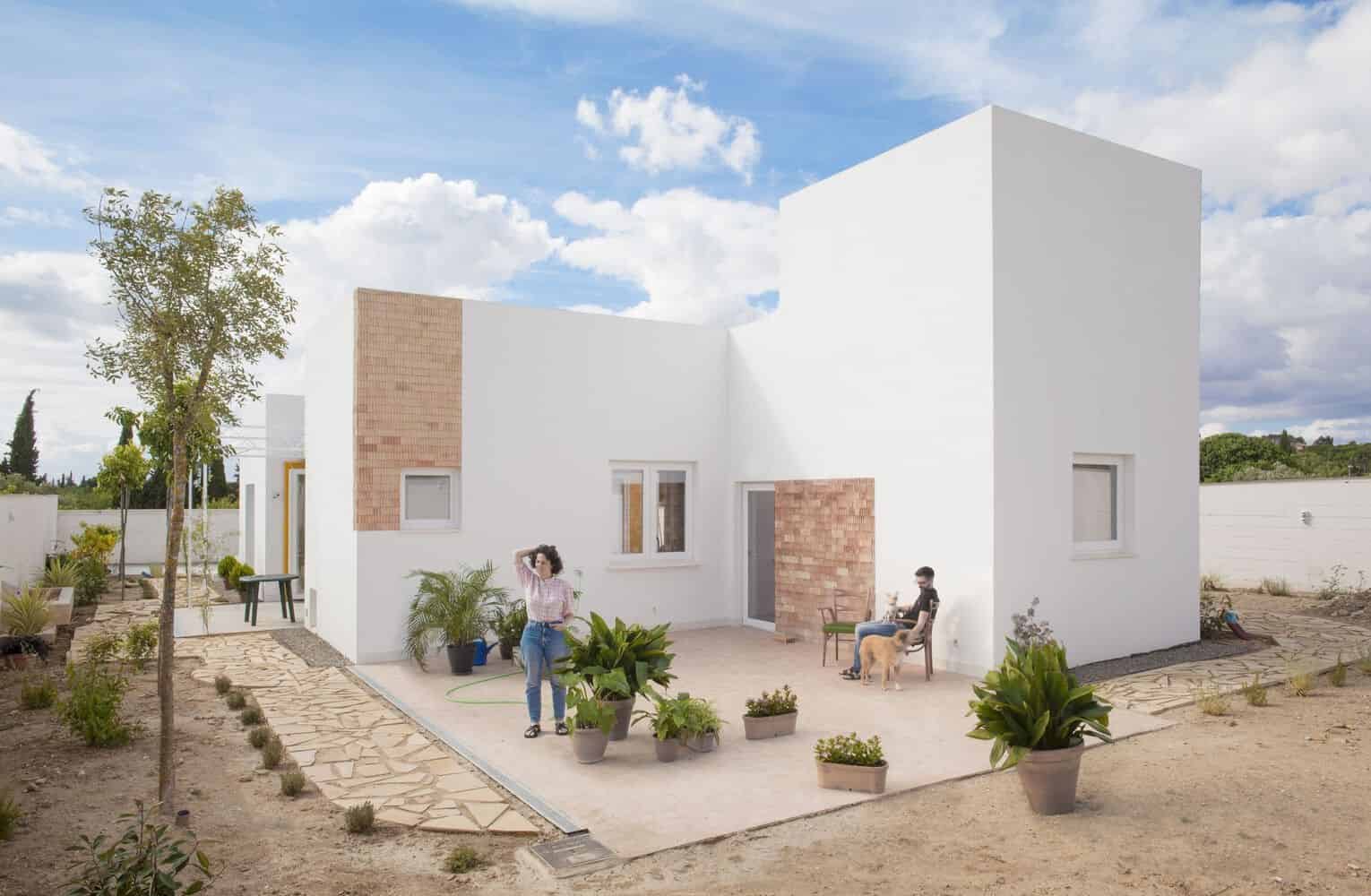
- Project: House for a Family of Cats and Dogs
- Architect: AFAB Architecture
- Location: Spain, Baeza
- Year: 2023
- Area: 125 m2
- Photography: AFAB Architecture
A Home for Humans, Animals, and the Landscape
With the House for a Family of Cats and Dogs, AFAB Architecture redefines what it means to design for coexistence. This 125 m² residence in Baeza, Jaén, is not merely a domestic structure — it is a cohabitation ecosystem, created for two humans, six dogs, six cats, and even a Roomba.
Beyond its playful premise, the project carries profound architectural and ecological implications. It challenges the urban zoning paradigm by seeking to restore the site’s original landscape biodiversity, rather than conform to the conventional metrics of plot, area, and occupancy.
“Architecture should not just house people,” the architects explain, “but all beings who share the environment — living or artificial, human or non-human.”
Restoring the Land Before Building
The first guiding principle of the project was to reverse the tabula rasa condition imposed by modern development. The team began with a bioregional study of the site and nearby mountains, identifying the native flora and fauna that define Baeza’s Mediterranean landscape.
The design sought to recreate the ecological patterns of the area: wild aromatic plants, resilient native vegetation, and minimal maintenance ecosystems. These strategies reduced environmental impact and transformed the site into a micro-habitat, reconnecting it to its pre-urban natural state.
This landscape-first approach turns the house into an act of environmental restoration, not disruption — architecture as a frame for biodiversity rather than a replacement for it.
Architecture of Coexistence: Humans, Cats, Dogs, and a Roomba
The second design premise revolved around the shared domestic life of the home’s residents: humans Alex and Lurdes, and their twelve animal companions.
During the design process, AFAB Architects discovered a fascinating behavioral parallel:
-
Alex and the cats favored elevated, quiet spaces — contemplative, detached, and isolated.
-
Lurdes and the dogs preferred open, active zones — fluid and social, centered around the garden.
This insight shaped the project’s spatial logic. The ground floor became an open, adaptable playground for dogs — dynamic, airy, and flexible. The cats, on the other hand, inhabit a network of elevated decks and mezzanines — connected yet secluded, forming a series of “vertical sanctuaries” with varying degrees of privacy.
The Roomba, the home’s mechanical resident, was also given design consideration. Circulation patterns, flooring transitions, and thresholds were planned to accommodate its autonomous movements, integrating technology as another “species” within the domestic ecosystem.
Ecological Systems and Passive Strategies
In keeping with its sustainable philosophy, the House for a Family of Cats and Dogs employs a holistic environmental design approach:
-
Water systems: separate gray and rainwater networks allow for reuse and irrigation.
-
Passive climate control: cross ventilation, thermal massing, and shading reduce mechanical needs.
-
Renewable energy: solar systems support part of the house’s daily operations.
-
Natural materials: locally sourced and minimally processed materials reduce embodied energy.
These systems work in tandem to create a low-impact, self-sustaining dwelling, where environmental awareness and daily life are inseparable.
Reimagining Domestic Space
The project questions anthropocentric design conventions by embracing the idea that architecture belongs equally to all its inhabitants. The home is not hierarchically divided but ecologically layered, acknowledging the spatial needs of different species — human, animal, and robotic.
By doing so, AFAB Architecture transforms the domestic typology into a multispecies habitat:
-
Dogs enjoy the freedom of the ground plane and garden.
-
Cats explore elevated decks and isolated perches.
-
Humans occupy both, navigating a continuum of shared and separate zones.
-
The Roomba maintains the space, linking digital intelligence to the ecosystem.
This choreography of beings, behaviors, and environments embodies a new paradigm of architectural empathy — one where cohabitation, ecology, and technology coexist in balance.
Toward a New Architectural Ethic
More than an experimental dwelling, House for a Family of Cats and Dogs is a manifesto for coexistence. It envisions architecture as a field of voluntary association — a shared framework where species, technologies, and environments interact symbiotically.
By honoring the site’s natural history and recognizing every inhabitant’s right to space, AFAB Architecture demonstrates that the future of domestic design lies not in separation, but in integration — of nature, culture, and all forms of life.


