
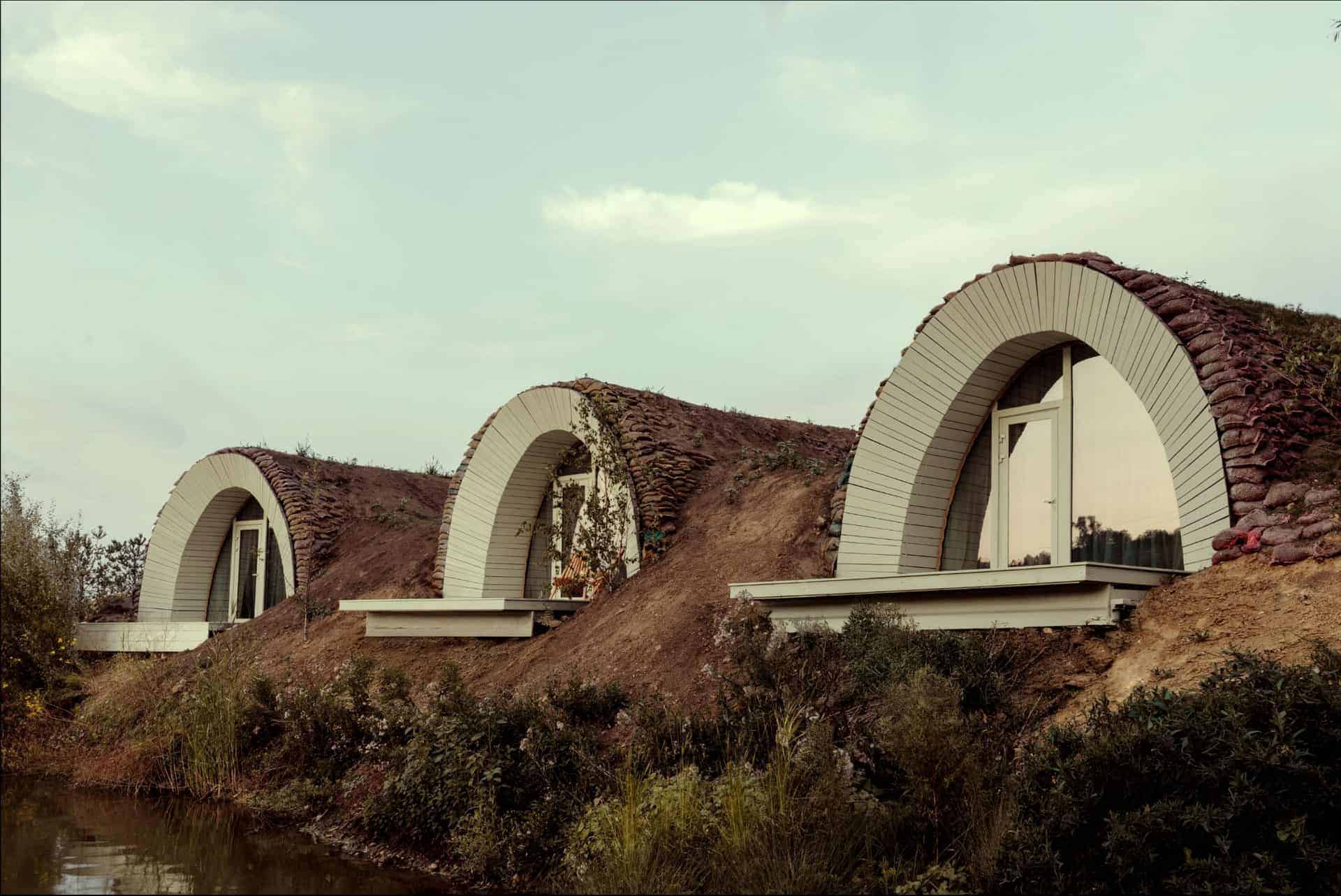
- Project: Hobbit Wake Houses
- Architect: lh47arch
- Location: Moldova, Panăşești village,
- Year: 2025
- Area: 26 m2
- Photography: George Omen
Reimagining Lakeside Living
On the shores of a quiet Moldovan lake, LH47 ARCH has unveiled Hobbit Wake Houses—a trio of earth-sheltered cabins inspired by myth and rooted in sustainable tradition. Conceived as rental retreats within Moldova’s first wake park near Panăşești, the project transforms underused land into a landscape where architecture merges seamlessly with nature.
Taking cues from the archetypal “hobbit dwellings,” each cabin is semi-buried, crowned with a living green roof, and shaped into gentle domes that echo the surrounding terrain. Far from novelty, this design improves thermal stability, reduces energy loss, and restores the site visually—allowing the cabins to disappear into the land.
Heritage Craft Meets Ecological Design
At the project’s heart lies a revival of nearly forgotten rural techniques. Instead of synthetic insulation, the walls are filled with straw bales, once ubiquitous in Moldovan villages, and finished with clay-and-straw plaster protected by lime wash. These low-tech methods generate a self-regulating microclimate:
-
Clay absorbs humidity and releases it in drier air,
-
Straw provides natural insulation,
-
Lime ensures durability.
The timber frames, crafted by local specialists, lower the carbon footprint compared to steel or concrete. Roofs are layered with soil and secured using a custom mesh system designed by LH47, enabling grasses to colonize the structures and blend them back into the landscape.
Construction Challenges and Innovations
Founder Serghei Mirza notes that working with clay, straw, and timber required rediscovering knowledge no longer widespread. Prefabricated floor and foundation sections were assembled on-site, streamlining the process but demanding precision. The green roofs posed the greatest challenge—nets were specially engineered to hold soil and allow grass to grow naturally over time, gradually transforming the cabins into “living mounds.”
Interiors: Crafted Uniqueness
Inside, each cabin celebrates vernacular craft and individuality.
-
Beds, kitchens, and fittings were hand-made by Lemnaria, a local workshop.
-
Ceramic artist Eugenia Burlacenco created bespoke lighting and decorative accents.
-
No two interiors are identical—mirrors, shelving, and kitchen details vary, evoking the improvisational spirit of traditional craftsmanship.
From within, the cabins feel both protective and open—warm havens with panoramic glazing that frames the lake’s reflective waters.
A Cultural and Architectural Statement
For LH47, Hobbit Wake Houses are more than small-scale architecture—they are an experiment in heritage, ecology, and contemporary living. By proving that low-tech methods and traditional materials can meet modern needs, the project suggests a blueprint for sustainable hospitality and small-scale housing.
“This project shows how heritage craft, ecological principles, and modern design can converge into something lasting and deeply rooted in place,” says Mirza.

Photography © George Omen


