
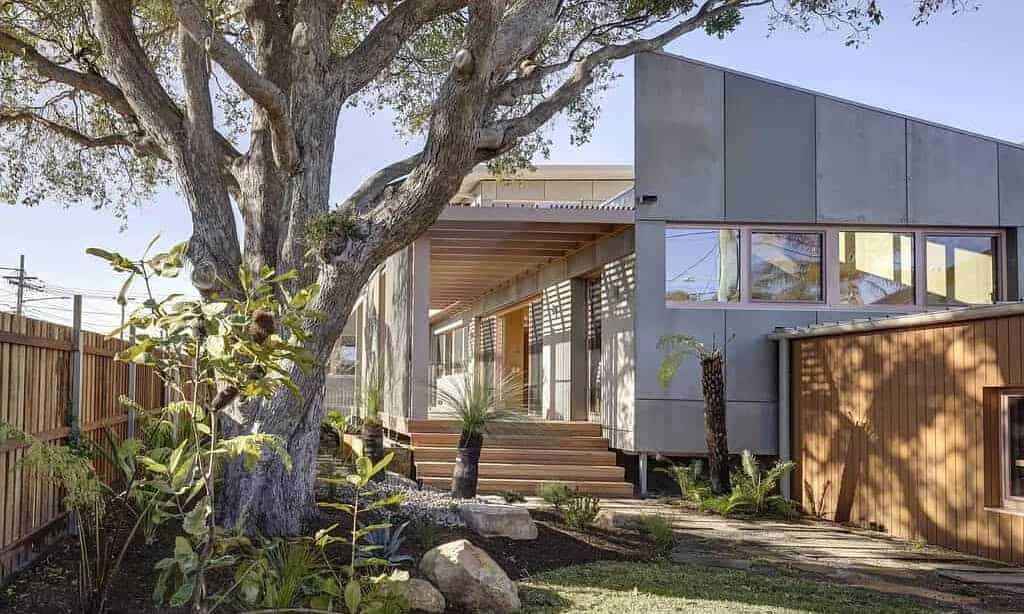
- Project: Canopy CLT House
- Architect: Still Space Architecture
- Location: Australia, Putney, New South Wales
- Year: 2024
- Area: 261 m2
- Photography: Brett Boardman
A Harmonious Blend of Sustainability and Serenity
Located in the leafy riverside suburb of Putney, near Sydney, the Canopy CLT House by Still Space Architecture is a warm, tactile, and energy-efficient family retreat that beautifully integrates Nordic minimalism with Japanese sensibility.
Designed and realized under the direction of Nina Still, the project embodies the principles of Passive House design, offering a tranquil balance between craftsmanship, comfort, and environmental performance.
A Vision Rooted in Nordic and Japanese Design
For homeowners Susan and Louis, the goal was clear: to create a light-filled, sustainable home that reflected their shared love of Scandinavian simplicity and Japanese restraint.
“The brief was for a warm, crafty, and tactile family home,” recalls architect Nina Still. “It needed to accommodate extended family and include communal areas for creativity and music.”
While energy performance wasn’t an initial driver, the decision to pursue Passive House certification came organically after the clients experienced living in one — realizing the transformative impact of healthy air, consistent temperature, and reduced energy use.
The result is a house that feels crafted, not constructed — blending functional rigor with poetic sensitivity to light, texture, and the rhythms of family life.
Embracing Nature and Site
At the heart of the project lies a mature Lillipilli tree, once marked for removal but ultimately preserved and celebrated. Its canopy became the home’s organizing principle, shaping views and anchoring the design.
“The tree connects every level of the home to the landscape,” explains Nina. “Its presence defines the experience of living here — a daily reminder of nature’s permanence.”
The west-facing orientation posed environmental challenges that the design cleverly mitigates through a ventilated cavity façade system, maintaining interior comfort in Australia’s warm climate while preventing condensation. Entry unfolds through a tranquil courtyard and pond, setting a meditative tone that resonates throughout the interior.
Spatial Design with a Sustainable Core
The interior layout reflects both pragmatism and poetry. Natural light floods the spaces through skylights and clerestories, while angled roofs and double-height voids create dynamic compositions of light and shadow.
-
The ground floor accommodates communal zones — living, dining, and children’s wing — aligned along the home’s linear spine.
-
The upper level serves as a private retreat, with the master suite, study, and a roof terrace overlooking the pool and landscaped garden.
-
Circulation is enriched by sculptural stairs and vertical connections that invite the eye upward to the skylit ceilings.
The structure’s defining material — Cross-Laminated Timber (CLT) — functions as both structure and interior finish. Exposed CLT panels create a warm, monolithic envelope, complemented by built-in plywood joinery and cork flooring that enhance the home’s tactile quality.
“The CLT allows for a thin, efficient structure and a sense of calm through its natural tone and texture,” says Nina.
Energy Efficiency and Passive Performance
As a certified Passive House, the Canopy CLT House integrates multiple sustainability strategies without compromising its elegance:
-
Continuous insulation and airtight construction ensure minimal heat loss.
-
High-performance triple-glazed windows maximize daylight while regulating temperature.
-
A mechanical ventilation heat recovery system (MVHR) provides constant fresh air while controlling humidity.
-
Strategic shading and controlled daylighting reduce glare and overheating.
-
Renewable and low-VOC materials promote long-term environmental and occupant health.
The combination of CLT construction and Passive House principles results in exceptional thermal comfort and energy efficiency, even in Sydney’s humid subtropical climate.
Overcoming Challenges, Building Collaboratively
Despite logistical hurdles — including pandemic-era shipping delays for the imported CLT panels — the project was completed within 18 months, a testament to close coordination between architect, builder, and clients.
The collaboration with M J Minard Constructions and Outdoor Establishments ensured the architectural vision extended seamlessly into construction and landscaping, emphasizing craftsmanship, precision, and durability.
A Home for the Future
The Canopy CLT House stands as a forward-looking model for sustainable residential architecture in Australia’s warmer climates.
“It’s a privilege to live here,” shares homeowner Susan. “The house feels calm and warm — every corner invites you to slow down. It has space for everyone while keeping us connected.”
Beyond its energy performance, the project illustrates how architecture can nurture well-being, family connection, and environmental stewardship — principles central to Still Space Architecture’s ethos.


