
- Project: Apartment in a Heritage Building at Patriarch’s Ponds
- Architect: Andrey Agamirov
- Location: Russia, Presnensky District (Patriarch’s Ponds), Moscow
- Year: 2025
- Area: 60 m2
- Photography: Sergey Krasyuk
Moscow History, Modern Discipline
In a 19th-century apartment house near Patriarch’s Ponds, designer Andrey Agamirov crafted his own 60 m² residence — a study in quiet precision, material tactility, and contextual respect. The brief he set himself was deceptively simple: preserve the soul of the old building while creating an interior suited to contemporary living.
The result is a dialogue between eras: lofty ceilings, original plaster, and worn brick coexist with steel, oak, and glass in a palette that privileges tone and texture over ornament. Every junction has been reconsidered to honor the old while expressing the new.
Concept and Spatial Logic
Agamirov began by stripping the space back to structure, exposing brick vaults and timber beams before re-planning around the rhythm of light and load-bearing walls. The layout follows a three-room logic — entrance / kitchen, living / dining salon, and a cocooned bedroom — unified by sightlines and long axial views toward the original arched windows.
The furniture layout mirrors the discipline of the architecture: few pieces, generous breathing room. Built-ins absorb storage, keeping surfaces clear and proportions legible. The apartment feels expansive, despite its modest size.


Material Palette: Depth through Restraint
The design language is rooted in tactile minimalism. Agamirov chose materials that age beautifully and carry the patina of use:
-
Walls: mineral plaster tinted in gray-blue and ash tones
-
Floors: oiled oak boards with warm undertone
-
Metalwork: patinated steel and brushed nickel
-
Stone: honed basalt and limestone
-
Textiles: wool, linen, and velvet in muted hues
These surfaces interact with the soft northern light of Moscow, creating a mutable atmosphere that changes by hour and season.
Living Salon
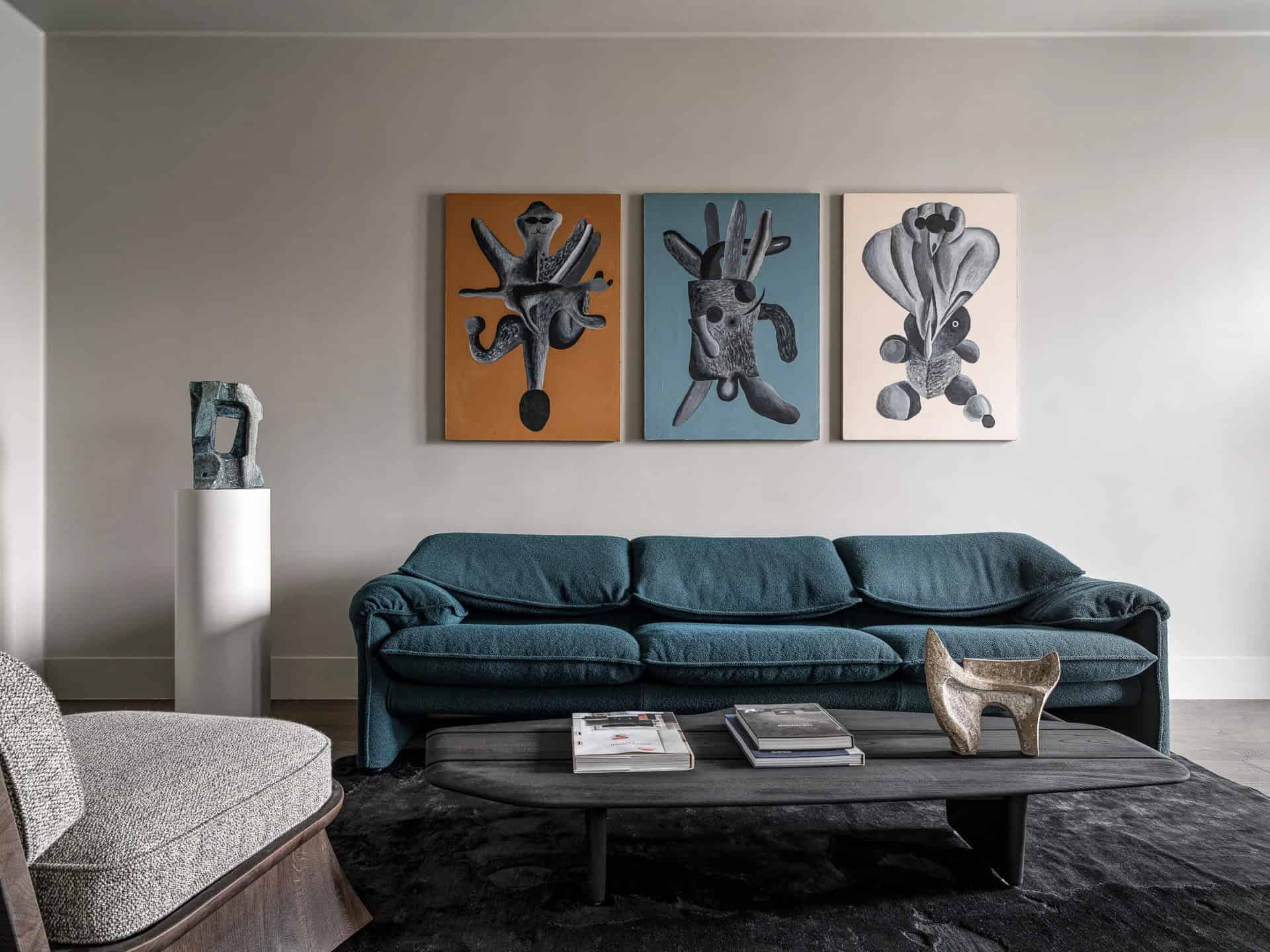
The main living area is simultaneously gallery and refuge. A low Cassina sofa anchors the space, paired with a Modenature armchair and an Atelier Areti lamp — each selected for sculptural clarity rather than brand prestige. Sculptures by Konstantin Stanovov introduce a human scale and expressive counterpoint to the restrained geometry.
A single large rug defines the seating island, while walls remain open for rotating artwork and photography from Agamirov’s own collection. The salon functions as a working studio, exhibition space, and home — all in one seamless composition.


Kitchen: Metallic Precision
The kitchen, faced in brushed metal, reads as a monolithic installation rather than a domestic zone. Cabinets are handle-less; appliances sit flush; the island serves equally as workspace and informal dining spot. Reflective yet muted, the surfaces amplify light without drawing attention, turning the kitchen into a calm instrument of living.


Bedroom: A Darker Interval
In deliberate contrast, the bedroom is moody and enveloping — a space for withdrawal. Walls are painted in deep graphite, textiles soften acoustics, and lighting is low and dim-to-warm. A Loffi Lab bed and minimal Modenature side tables maintain visual stillness, while artworks rest directly on the floor, leaning casually against the wall.
Here, color recedes and material speaks: wood grain, textile nap, the faint sheen of waxed plaster.


Bathroom and Utility Details
The bathroom continues the material honesty: honed stone slabs, matte fixtures, and indirect lighting to sculpt surfaces rather than illuminate them flatly. Storage is fully integrated; mirror cabinets disappear into wall planes. The aesthetic extends even to unseen zones — laundry, hallway — where finishes remain consistent, ensuring the apartment reads as a single continuous gesture.


Design Philosophy: The Architecture of Editing
Agamirov describes his process as “editing rather than designing.” By removing clutter, he amplifies atmosphere. Every object has a reason to exist; every joinery line respects proportion. This discipline allows the historic shell to breathe and the new interventions to read as precise insertions rather than overwrites.
The apartment embodies quiet confidence — no spectacle, only craft and clarity.
The Mood of Patriarch’s Ponds
Set within one of Moscow’s most storied neighborhoods, the project channels the area’s mix of literary nostalgia and contemporary creativity. The home captures that tension: old bones and new rigor, heritage and experiment. It is both a personal statement and a portrait of modern Moscow refinement.
