
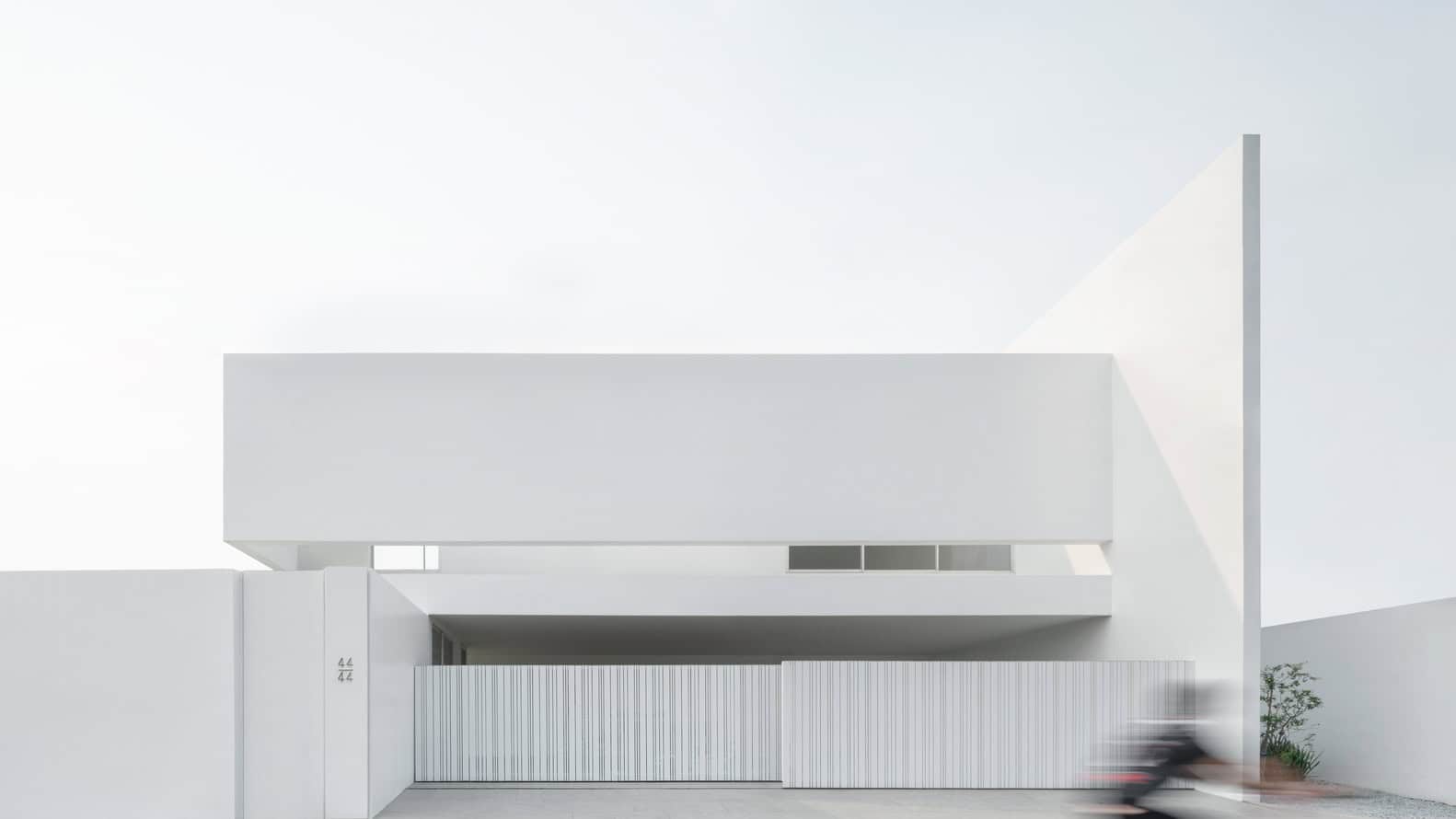
- Project: Lucent House
- Architect: CORE Cluster
- Location: Thailand, Pak Nam
- Year: 2025
- Area: 500 m2
- Photography: Sofography | Chalermwat Wongchompoo
Dualities in Design: Simplicity & Vibrancy
Lucent House by CORE Cluster is a striking contemporary home that seeks to balance two contrasting — yet complementary — states: simplicity and plainness on one side; complexity and vibrancy on the other.
The underlying concept gives the house flexibility for the future: the “plainness” allows for eventual personalization and decorative changes over time, while the “vibrant complexity” caters to immediate life — daily use, family interaction, and evolving living patterns. This duality makes Lucent House not just a static project but a living structure that grows with its inhabitants.


Spatial Organization & Family-Centric Living
Lucent House is designed to accommodate an extended family, emphasising spatial diversity rather than uniformity. This enables a variety of living modes — communal gatherings, private retreats, flexible uses — all under one roof.
A central raised living room — glazed on multiple sides — creates visual connections with the surrounding garden and greenery, enabling light-filled interior spaces while maintaining privacy.
The double-height spaces and open-plan layout encourage flexibility: rooms and circulation areas are interconnected, promoting interaction between family members while giving freedom for adaptation as needs change.
In plan drawings, one sees that the layout carefully organizes public, semi-public and private zones, balancing openness with seclusion in a thoughtful spatial choreography.


Material & Aesthetic Approach: A Gentle Canvas
Rather than resorting to expressive, attention-grabbing materials, Lucent House often opts for restraint — a gentle, neutral canvas that can host life, change, decoration, memory. This approach underlines the “simplicity + adaptability” half of the design concept.
At the same time, careful detailing, glass volumes, open connections to garden/greenery, and structural clarity give the house a calm sophistication. The architecture doesn’t force itself on the site; it slips in gently, offering comfort, light, and continuity rather than drama.


Contextual Sensitivity: Living with Nature & Flexibility
Set in Pak Nam, Lucent House demonstrates how residential architecture in Thailand can adapt to climate, context, and evolving family needs. By combining open living zones, green-facing glazing, and flexible interior layouts, the project anticipates that the needs of the family — and the way they live — will evolve over time.
The architects treat the house not as a final, fixed object but as a base for life to unfold — a quality increasingly rare in highly specific, “show-home” architecture.


Why Lucent House Matters
-
Adaptive residential design: The dual character — simplicity + vibrancy — makes the house capable of evolving with the family’s changing needs, tastes, and lifestyle.
-
Spatial diversity for extended living: The layout accommodates large-family living while preserving privacy, flexibility, and quality of shared spaces.
-
Calm material and light strategy: Rather than flashy materials, the house embraces restraint — letting light, proportion and space define the experience.
-
Model for contemporary homes in Thailand: Lucent House shows how modern homes can combine flexibility, context-responsiveness, and thoughtful design in tropical climates.
Lucent House by CORE Cluster stands out not because it shouts — but because it listens: to people, to place, to future change.


