
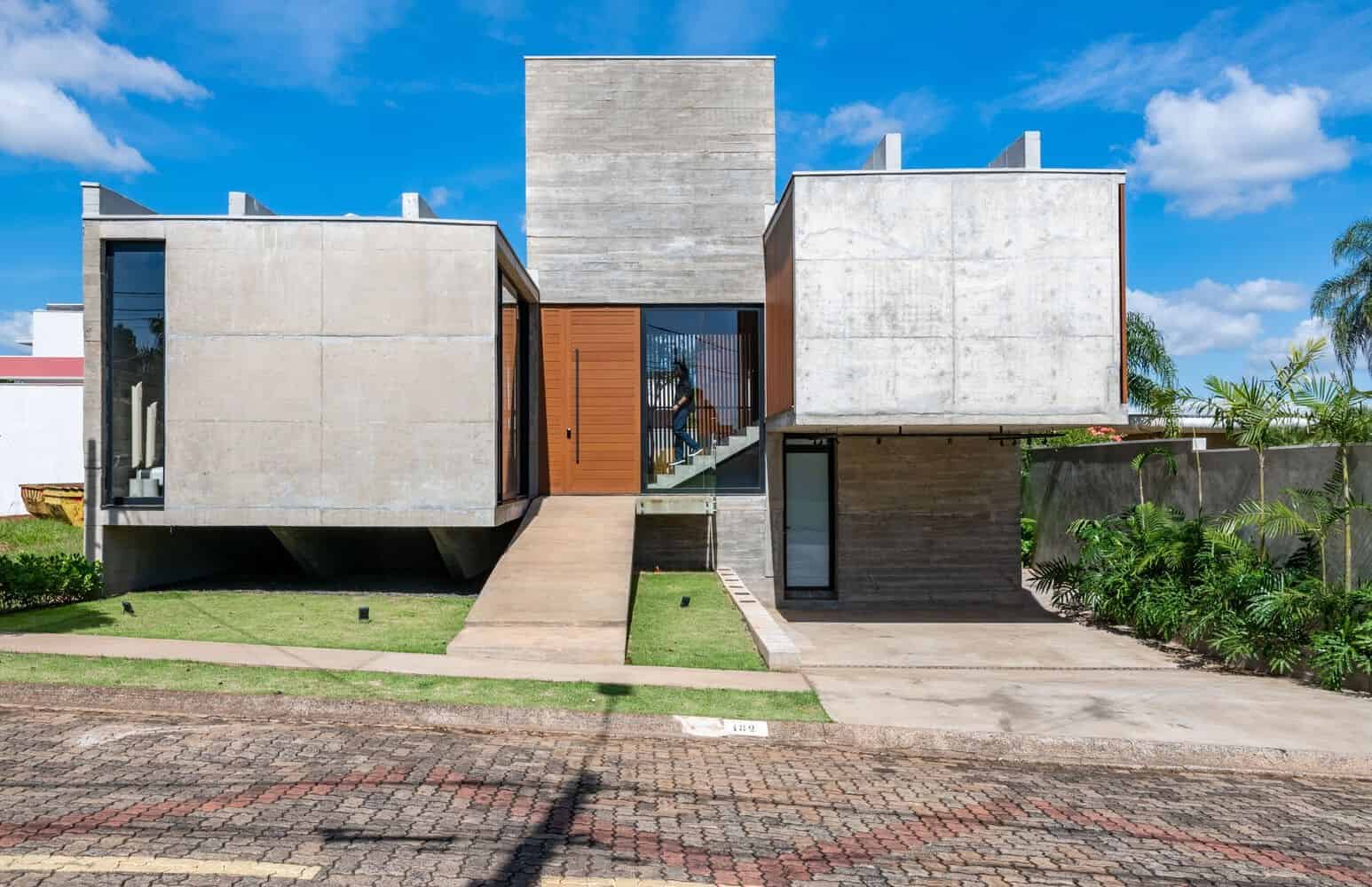
- Project: Patio House
- Architect: Caio Persighini Arquitetura
- Location: Brazil, Araraquara
- Year: 2022
- Area: 268 m2
- Photography: Favaro Jr
A Dialogue Between Concrete, Landscape, and Light
Patio House, designed by Caio Persighini Arquitetura in Araraquara, Brazil, is a sculptural residence born from the topography of its site. More than an architectural composition, it is a reflection of trust between architect and client — a freedom of creation that allowed the terrain itself to shape the design.
The house is a poetic interplay of levels, textures, and light, where concrete acts as both structure and expression. Surrounded by woodland and free from direct neighbors, the home invites openness while maintaining intimacy through thoughtful spatial layering and the rhythmic play of brises.
“The moment we stopped seeing the site as a flat plot and started reading it as landscape,” says architect Caio Persighini, “the architecture revealed itself.”
Terrain as Concept
Initially conceived as a two-story home, the design evolved as the architect began reading the gentle slope and generous width of the terrain as defining elements. Instead of flattening the site, Persighini allowed it to guide the architecture — organizing the program across three interrelated levels:
-
a semi-basement for service and leisure areas,
-
a social ground floor connecting directly to the patio and pool, and
-
an upper level housing the private suites.
This sectional play gives the house a dynamic sense of movement, turning circulation into a spatial experience rather than a functional necessity. The result is a fluid sequence of perspectives, where one moves up, down, and across — always discovering new relationships between space, light, and nature.
Material Essence: The Honesty of Concrete
Concrete is the protagonist of the Patio House. Cast in place, its raw texture and structural honesty define both the architecture’s aesthetic and its logic. The slabs and planes interlock to form an expressive yet restrained composition.
Externally, glass and wooden brises soften the concrete’s rigidity, allowing the home to breathe. Internally, the palette remains minimal and tactile, emphasizing material authenticity and the interplay of light across surfaces.
The use of concrete was not merely stylistic — it was a conscious structural and environmental decision. The material’s thermal mass moderates interior temperature, while the cast-in-place construction ensured fluidity and precision in realizing the design’s complex geometries.
Brises and the Art of Privacy
Located within a wooded area of a private condominium, the home enjoys natural seclusion. Yet Persighini enhanced privacy through the strategic use of brises — vertical wooden screens that reinterpret the traditional muxarabi shading technique.
These elements act as filters of light and vision, allowing residents to gaze outward without being seen from outside. The master suite exemplifies this strategy: a nearly 180-degree panoramic view opens toward the surrounding trees, yet the brises preserve intimacy while shaping a delicate play of shadow and reflection.
The result is a series of “double atmospheres” — spaces that feel simultaneously open and enclosed, transparent and private.
The Patio as Soul of the House
At the heart of the composition lies the patio — a luminous void framed by two parallel concrete volumes. A white ipê tree and a reflective pool define this inner landscape, transforming the patio into a contemplative nucleus.
From the entrance hall, the patio unfolds as the home’s visual and spatial anchor. The hall itself serves as a vertical connector, linking the semi-basement, ground floor, and first floor while maintaining constant visual contact with the central courtyard.
This orchestration of views, levels, and voids creates a constant awareness of the house as a living organism — breathing, opening, and closing according to the rhythm of daily life.
Architecture of Sensations
The Patio House is not defined by rooms, but by experiences. Circulation paths double as observatories; the slight elevation of the bedroom level offers a commanding view of the pool and garden, while the social areas dissolve into the landscape through fully retractable glazing.
From every vantage point, the home evokes a different mood — serenity from above, immersion from within, and dynamism when in motion. Persighini’s design transforms simple movement into an act of discovery, making architecture not only seen but felt.
“A house must evoke sensations, perceptions, and feelings,” Persighini explains. “Only then does it become a true home.”
An Architecture of Freedom and Trust
Patio House is a manifestation of collaborative trust — an architect given the liberty to interpret the landscape, and clients willing to embrace the unexpected. The result is a fluid, introspective, and profoundly Brazilian home, where material, light, and topography coexist in harmony.
In Caio Persighini’s hands, concrete becomes poetic; a symbol of permanence, shaped not to dominate the land, but to listen to it.


