
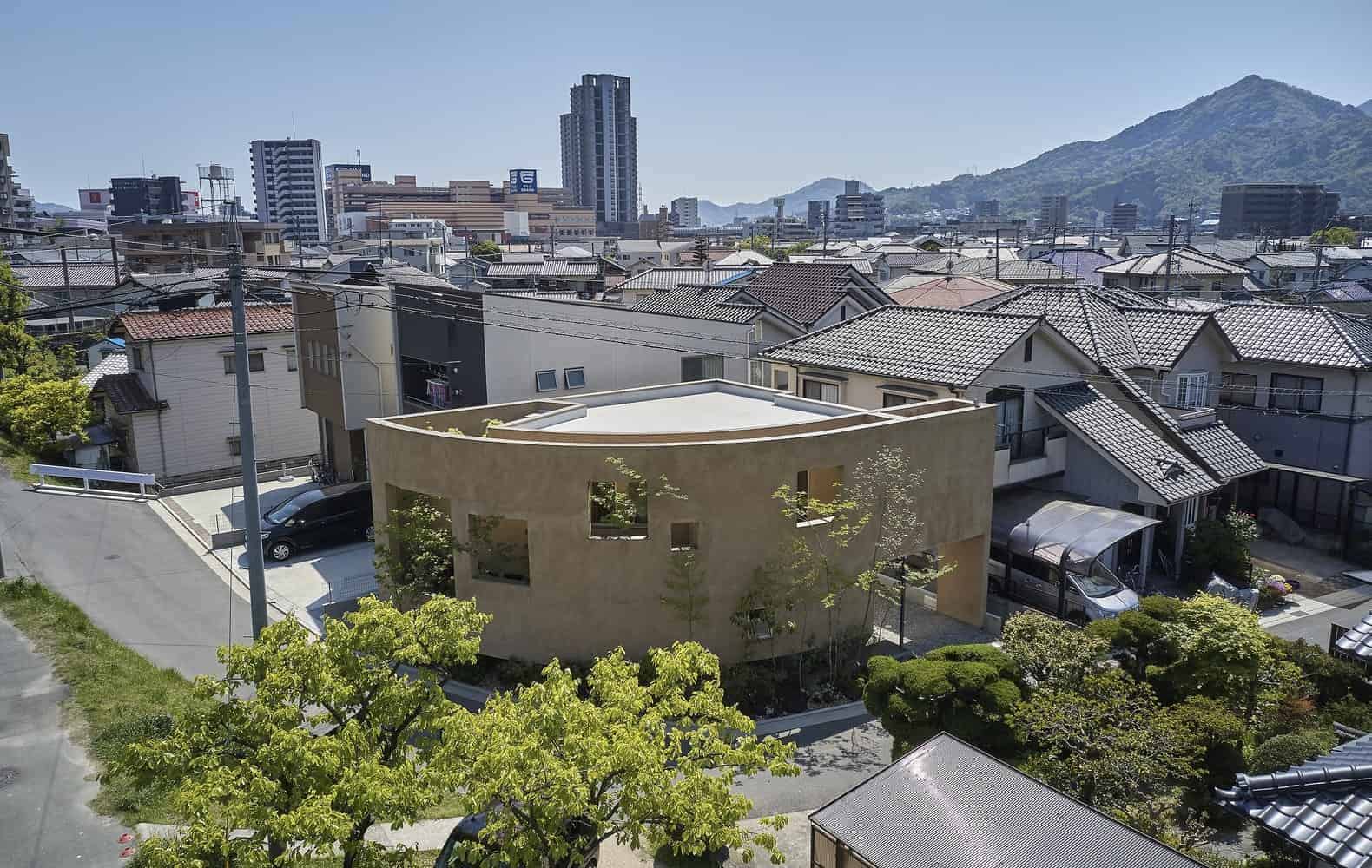
- Project: PeacoQ House
- Architect: UID Architects
- Location: Japan, Hiroshima
- Year: 2020
- Area: 101 m2
- Photography: Koji Fujii / TOREAL
In Hiroshima, PeacoQ House by UID Architects redefines compact residential design with a bold use of concentric curved walls and seamless integration between interior and exterior. Built for a family of three, the home transforms a unique, fan-shaped corner plot into an intimate yet expansive dwelling.
Site and Spatial Strategy
The house is situated on a gently tiered residential site, open on its northeastern side to the street while bordered on the southwest by neighboring houses. This duality of enclosure and openness became central to the design approach. UID Architects conceived the plan as a series of expanding curved spaces, radiating from the southwestern edge and extending outward toward the street.
By treating the surrounding green areas as an extension of the home, the architects dissolved conventional boundaries. The structure reaches the very edges of the setback line, maximizing the available footprint while allowing the landscape to flow into the design.
The Floating Arc Wall
Defining the project is a large arc-shaped mud-plastered wall that runs along the site perimeter. Floating 700 millimeters above ground, this sculptural wall blurs the line between inside and outside. It shields the home from the street, creating a private garden while acting as a transitional buffer. Its few openings filter light and views, creating moments of surprise and intimacy.
This wall is both monumental and delicate, simultaneously ensuring privacy and extending the sense of interior space outward. By lifting it off the ground, UID Architects created a sheltered, semi-exterior zone that encourages interaction and enhances the perception of openness.
Light, Views, and Interior Atmosphere
Natural light plays a vital role in the design. Sunlight from the south projects onto the northeast wall, animating the interiors with a shifting play of light and shadow throughout the day. Every room benefits from this choreography of light, enriching daily life with subtle variations.
Inside, the compact 1,087-square-foot residence unfolds as a three-dimensional landscape, where walls, floors, and volumes overlap to create depth and connection. The concentric planning ensures fluid circulation while framing views of the garden and surrounding greenery.
A Compact Home with Expansive Spirit
Though modest in scale, PeacoQ House achieves a sense of spaciousness through careful layering of space, light, and boundary. By blurring the threshold between house and landscape, UID Architects created a vibrant environment that satisfies the family’s practical needs while offering a wider scope of interaction with the neighborhood and nature.
A Contemporary Japanese Expression
PeacoQ House exemplifies UID Architects’ sensitivity to site and scale. With its curved geometries, floating mud-plastered arc, and integrated outdoor space, the house embodies a contemporary Japanese architectural ethos—compact, inventive, and deeply connected to its context.


