
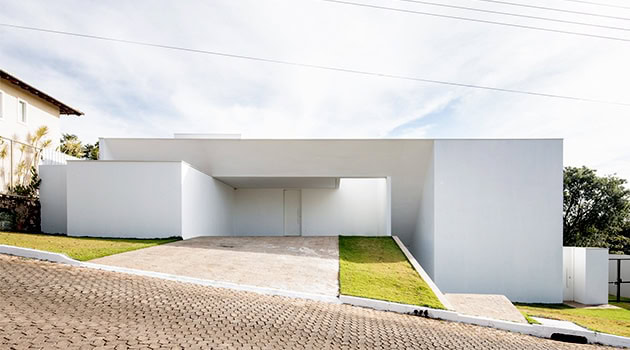
- Project: Cora House
- Architect: BLOCO Arquitetos
- Location: Brazil, Brasilia
- Year: 2018
- Area: 290 m2
- Photography: Joana Franca
A Sculptural Cube Set in Slope: Form, Light & Landscape
In the rolling terrain of Brasília’s suburban hills, the Cora House by BLOCO Arquitetos emerges as a quiet yet powerful architectural gesture: a white, minimalist volume that negotiates slope, view, light and shelter with precision. The design treats the house less as a typical dwelling and more as a curated sequence of spatial experiences — an architecture that both reveals and conceals.
Faced with a steep downward slope toward the rear of the site, the architects responded with a strategy of compression and expansion: at the front, the volume appears restrained, even introverted. As one moves toward the back, the roof tilts, the ceilings lift, the openings widen, and the landscape opens out. The body of the building orchestrates movement, framing views to treetops, valley edges and sky-lines.
Design Strategy & Topographical Dialogue
The core concept of the project begins with the lot’s topography: instead of fighting the slope, the design embraces it. The maximum permissible height at the perimeter was respected; within this constraint the lower roof plane tilts gently to follow the terrain, “compressing” ceiling heights at the front and “expanding” them toward the backyard woodland.
The front façade presents a solid white wall with minimal apertures, ensuring privacy and focus. The rear façade opens into large glass walls under a generous eave, oriented toward garden and sky. Circulation becomes architecture: a ramp and path guide visitors through entrance, into double-height living space, and out toward garden vista. The house becomes a device for intensifying the perception of context: slope, light, trees, view.
Materiality, Light & Atmosphere
The choice of white render over the main volume lends the house an abstract purity—like a sculptural object sitting in nature. Inside, minimal detailing and expansive glazing allow daylight to animate surfaces and volumes. Interiors are shaped by the structure: ceiling heights vary, roof slopes inform interior pitches, and generous overhangs filter Brazilian sun while opening views.
The contrast of closed and open, solid and transparent, night and day, becomes part of the living experience. The architecture isn’t about decoration—it is about orchestration of light, shadow, space and perception.
Living Experience: Quiet Presence, Open-Ended Use
Rather than imposing a fixed definition of how the space should be inhabited, Cora House gives room to inhabitant choice. The open living volume, the modulated sections of roof and view, the dual orientation toward street and garden: all allow different rhythms of life. The house offers both refuge and gaze outward, both silence and expansion.
The scheme exemplifies how high-quality residential architecture can combine modest footprint (~290 m²) with a refined spatial experience: generous volumes, strong connections to landscape, and attentiveness to human scale.
Why This Project Matters
-
Topographic intelligence: The architecture adapts to terrain with subtlety, rather than flattening or dominating the site.
-
Material and formal clarity: The white volume, the tilted roof, the transparent rear facade—each element communicates through its clarity and restraint.
-
Spatial richness at moderate scale: At under 300 m², the house demonstrates that spatial generosity is about sequencing, view and light—not simply size.
-
Integration of architecture and environment: The house frames the garden and woodland; structure, roof, wall and site collaborate rather than contend.
Cora House stands as an elegant example of contemporary Brazilian domestic architecture: bold in concept, refined in execution, receptive to its site and gentle in presence.


