
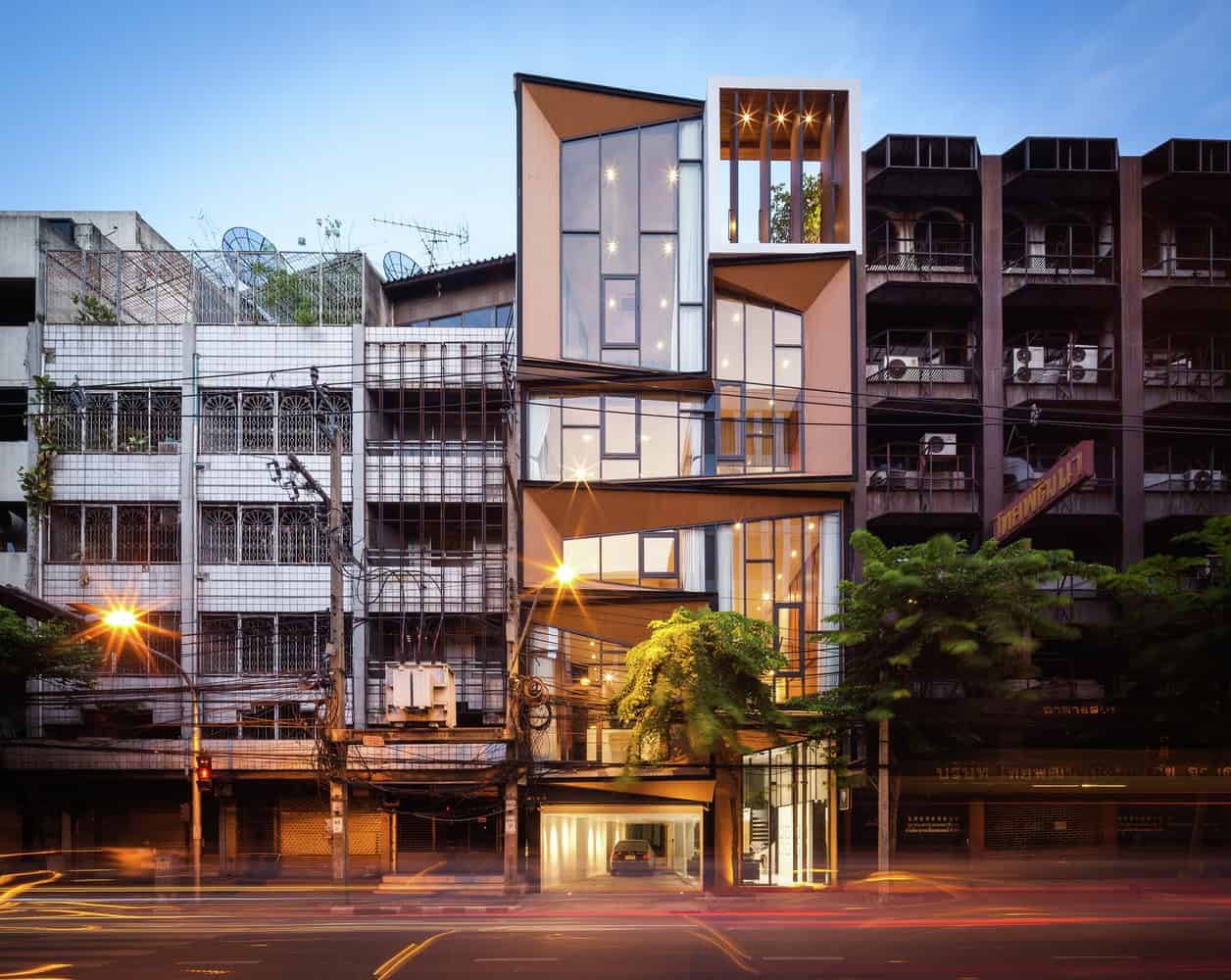
- Project: Siri House
- Architect: IDIN Architects
- Location: Thailand, Bangkok
- Year: 2015
- Area: 800 m2
- Photography: Spaceshift
A Bold Conversion: Commercial to Collective Home
Siri House is a striking example of transformation in dense urban Bangkok, where commercial building stock is re-imagined as multi-generational domestic space. With architecture by IDIN Architects, the project converts two identical existing commercial buildings into a hybrid home and workplace: orienting the ground floor as a jewelry office for one sister, and the upper levels as private units for a large family of siblings and future generations.
What makes Siri House compelling is its spatial strategy: within a deep, narrow urban lot, the architects use a central light well, visual interconnection and a “puzzle game” rhythm of units to turn vertical-stacked spaces into a thoughtfully layered residence. Rather than imposing a generic floor layout, the design maps each sibling’s living unit separately, accessed via an elevator at the rear, with the shared family living and dining located at the top level overlooking the internal courtyard.
Spatial Strategy & Programmatic Clarity
The site begins as two narrow commercial volumes; IDIN transforms them by inserting a central void—an open “core” that becomes the heart of the building. This core brings daylight deep into the plan and grants visual connectivity between levels and family members.
Each sibling’s unit is double-levelled and accessed separately, ensuring a sense of autonomy. Yet the architecture retains family togetherness: the large shared living/dining at the top becomes a communal space with views across the internal void and the city beyond. Ground floor remains commercial, middle floors private, top floor collective—a functional hierarchy embedded in design.
Materials and detailing speak urban refinement: reflective exterior surfaces that echo the internal organization, an elevator tucked behind the units, and a tree planted inside to bring nature into the urban fabric.
Light, Connection, and Urban Domesticity
Inside Siri House, there is an ever-present sense of flux: movement of people, change of light, layering of levels. The light well serves more than daylighting—it becomes the heart of family presence. Members can see each other’s movement throughout the day, even when in separate units.
The double-level units allow variety: living-rooms elevated above bedrooms, granularity of spaces, separation of functions. The raised top floor hosts large communal spaces with panoramic views, while the units themselves balance privacy and belonging. The architecture mediates between urban constraint and domestic aspiration.
Because the building was once commercial, the conversion required tact and clarity: circulation had to be re-thought, access reconfigured, services reorganized. IDIN Architects treated it not as a retrofit but as a reinterpretation: rather than cover over the old, they let the old inform the new—embedding advertisement-scale façade memory, narrow plan rhythm, and deep lot proportion into a new domestic logic.
Why Siri House Matters
For architecture journalists, designers and aficionados, Siri House is important because:
-
It demonstrates how to convert deep-lot commercial stock into socially rich, multi-family domestic architecture in a dense city context.
-
It employs programmatic clarity (office + units + shared spaces) while maintaining architectural coherence and sophistication.
-
It uses the concept of “seeing one another” not just visually but spatially—creating architecture that fosters family presence without forcing sameness.
-
It shows how light, voids and spatial sequencing can turn restrictive urban geometry into generative domestic experience.
In short, Siri House is more than a renovation: it is a domestic redesign tailored to changing family rhythms, urban densification, and layered function. IDIN Architects have crafted a house that is simultaneously urban, familial, adaptive and elegant.


