
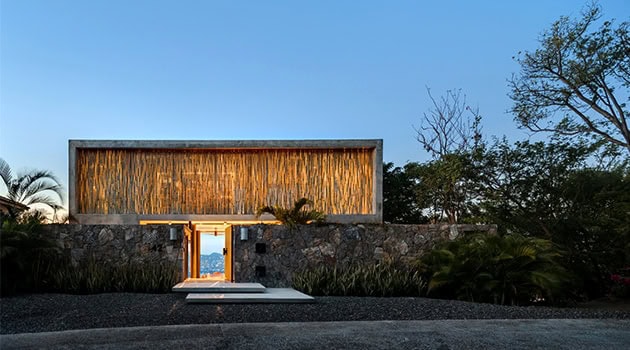
- Project: Z House
- Architect: Zozaya Arquitectos
- Location: Mexico, Zihuatanejo, Guerrero
- Year: 2023
- Area: 450 m2
- Photography: Rafael Gamo
Cliffside calm, Pacific horizon
Z House occupies a steep ocean-facing parcel in Zihuatanejo where jungle meets rock and the sound of surf is constant. Rather than impose a singular object, Zozaya Arquitectos staged a sequence of open-air rooms, terraces, and water planes that cascade with the topography. The result is a house that feels inevitable on the site—cut from the cliff, tempered by wind and salt, and tuned to daily cycles of sun and shade.
Brief & strategy: live to the view, breathe with the climate
The clients asked for a year-round retreat that privileges outdoor living, minimizes mechanical cooling, and keeps maintenance straightforward in a humid, saline environment. Zozaya’s strategy hinged on four moves:
-
Step the program along the slope so every space sees the horizon, not the neighbor.
-
Keep volumes porous—big openings, deep overhangs, screened edges—so the building ventilates itself.
-
Use honest, resilient materials (cast concrete, local stone, parota timber) that age well on the coast.
-
Make shade and water the main “systems”: verandas, palapa roofs, pools, and planted courts that cool the air before it reaches interiors.
Plan and section: a house of platforms
Z House is organized as a procession of platforms linked by open stairs and breezeways.
-
Arrival court (topmost): A stony forecourt compresses scale and sightlines. A low wall edits the view until you cross the threshold.
-
Living pavilion: The primary social space—kitchen, dining, lounge—sits one level down under a long, ventilated roof. Glazing pockets away completely so the room performs like a shaded terrace. An infinity edge pool aligns with the bay, doubling the horizon.
-
Private wing: Bedrooms step downward with the terrain, each with a private terrace, outdoor shower, and framed sea view. Sliding timber screens control glare and privacy without blocking air.
-
Lowest platform: A quiet wellness/relax deck near vegetation—hammocks, yoga, and a small plunge pool—hosts the most sheltered rituals.
The circulation is deliberately outdoors; moving through sun and shadow becomes part of the daily rhythm and reduces conditioned floor area.
Structure & envelope: rugged outside, refined inside
Structure. A cast-in-place concrete frame anchors to the rock with short spans and shear walls cleverly doubled as cabinetry or headboard backers. Where longer openings were required, concealed steel lintels keep profiles thin. The structure’s mass provides thermal inertia, evening out diurnal swings.
Envelope. Walls are a mix of concrete, lime-plastered block, and local stone. Roofs combine palapa (palm-thatch) over ventilated substrates for living areas and insulated concrete slabs where water tanks, solar hot water, or PV readiness are planned. Overhangs and pergolas extend 1.5–2.0 m to block high sun and monsoon rain.
Openings. Marine-grade hardware and parota (a dense, stable hardwood) are used for sliding panels and pivot doors. Insect screens and wood lattice panels introduce a second breathable layer, enabling the house to stay open at night without inviting pests.
Climate logic: passive first
-
Orientation & breeze: Primary openings face prevailing sea breezes; high and low vents promote stack effect.
-
Shading: Deep eaves, operable screens, and palapa eaves cut direct gain while preserving views.
-
Water as microclimate: The pool and small rills add evaporative cooling; planted planters at edges temper sun-exposed masonry.
-
Material temperature: Bare feet and hands meet surfaces chosen for feel as much as durability—polished concrete floors stay cool; timber rails remain touch-safe in sun.
The house relies on natural air for most hours; ceiling fans supplement gently. Bedrooms can be closed and conditioned during peak humidity, but the ambition is comfort without constant AC.
Materials & craft: tactile, repairable, local
Zozaya’s palette privileges texture over finish:
-
Concrete: Left with formwork grain visible—honest, easily patched, and beautiful under raking coastal light.
-
Stone: Local volcanic and river stone in retaining walls and plinths ties the building to the cliff.
-
Timber: Parota for ceilings, doors, and built-ins; treated for salt air, oiled rather than varnished so pieces can be renewed without full refinishing.
-
Ceramics & lime plasters: Breathable wall finishes resist mildew and allow vapor to pass.
Details are robust, not precious: replaceable screen panels, removable shade cloths, and accessible gutters acknowledge the realities of sea wind and tropical storms.
Interior atmosphere: shade, echo, and horizon
Inside the living pavilion, a single roof plane hovers over a continuous floor that drifts outdoors. Furniture is low and linear to preserve sightlines; built-in benches and deep sills act as thermal mass and extra seating when the house fills up. Sound is moderated by the thatch, fabric, and timber so conversation competes with waves rather than echoes.
Lighting leans warm and indirect—coves and concealed strips graze rough plaster; tiny shielded downlights mark steps without polluting the starscape. At night the house reads as a soft lantern, not a beacon.
Landscape & water stewardship
Planting is coastal native—salt-tolerant grasses, plumeria, palms, and vines—so irrigation demand is low once established. The pool backwash and showers feed a constructed planter bed before percolation. Rainwater from slab roofs is diverted to cisterns for landscape use; overflow is slowed by gravel swales to protect the slope.
Durability & maintenance: designed for the long haul
-
Hardware: Stainless fasteners and hinges throughout; bronze where exposure is extreme.
-
Finishes: No synthetic membranes exposed to UV; roofs detail drips and sacrificial edges to avoid staining.
-
Operations: The house can be set to “away mode”—screens latched, shutters cracked for ventilation, pumps on timers—so it survives months unoccupied.
Construction & making
The project pairs local concrete craftsmanship with joinery from regional workshops. Tolerances are put where they matter—sliding tracks, door reveals—while masonry accepts the slight irregularity that lends character. Many elements are modular (repeatable screen bays, stair treads, lighting niches) to control cost without aesthetic compromise.
Why it resonates
-
Economy of means: Comfort via shade, air, and mass—not gadgetry.
-
Contextual clarity: A plan that makes the site legible—from arrival compression to horizon release.
-
Tactile modernism: Minimal but never sterile; every surface invites touch.
-
Resilient beauty: Materials and details that don’t fear weathering—they depend on it.
Z House is a persuasive template for Pacific-coast living: build less enclosure, add more room for climate, and let structure, air, and water do the heavy lifting.


