
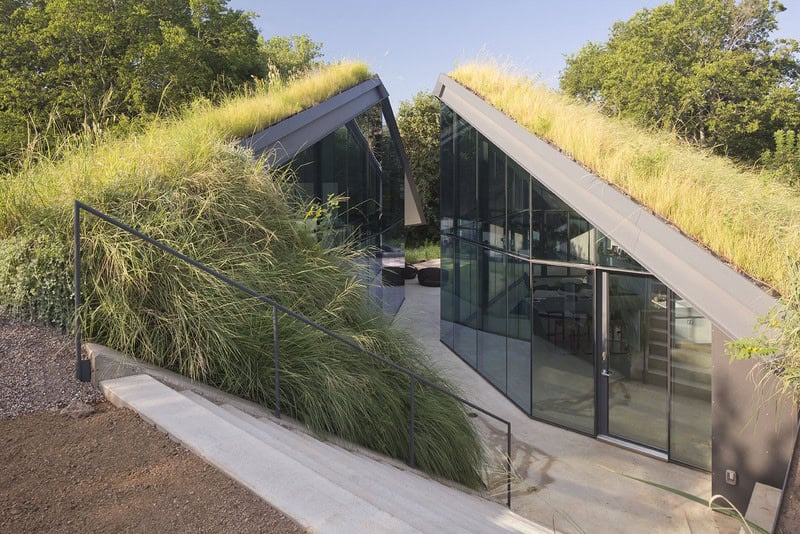
- Project: Edgeland House
- Architect: Bercy Chen Studio
- Location: United States, Austin, Texas
- Year: 2012
- Area: 130 m2
- Photography: Paul Bardagjy
Reimagining Ancient Dwelling for Modern Sustainability
Situated on a rehabilitated brownfield site along the Colorado River in Austin, Texas, Edgeland House by Bercy Chen Studio is a contemporary reinterpretation of the Native American pit house. This ancient dwelling typology, typically sunken into the earth, utilizes the earth’s thermal mass to maintain comfortable indoor temperatures year-round. Edgeland House adopts this principle by embedding the structure seven feet into the ground, complemented by an insulating green roof, to achieve natural temperature regulation.
The home’s design not only pays homage to historical architecture but also addresses modern sustainability concerns. By integrating the house into the landscape, the design minimizes environmental impact and promotes energy efficiency. The use of a green roof and earth-sheltered construction reduces heating and cooling demands, aligning with sustainable building practices.
Architectural Design: Integration with the Landscape
Edgeland House is composed of two separate pavilions—one for living and one for sleeping—separated by an open-air courtyard. This layout requires occupants to engage with the outdoor environment when moving between spaces, fostering a deeper connection with nature. The linear courtyard not only facilitates natural ventilation but also serves as a habitat for local wildlife, including hummingbirds and monarch butterflies .
The structure’s angular design and green roof blend seamlessly with the surrounding landscape, making the house nearly invisible from certain vantage points. This approach restores the site’s natural topography and promotes biodiversity by reintroducing over 40 native plant species in collaboration with the Lady Bird Johnson Wildflower Center .
Sustainable Systems and Materials
Edgeland House incorporates several high-performance systems to enhance its sustainability. A hydronic HVAC system provides efficient heating and cooling by circulating water through pipes embedded in the floors and walls. The green roof not only offers insulation but also manages stormwater runoff and reduces the urban heat island effect.
Materials were carefully selected to minimize environmental impact. The structure utilizes a steel frame with double-glazed, low-emissivity glass to maximize energy efficiency. Exposed concrete retaining walls serve both structural and aesthetic purposes, while interior finishes are chosen for durability and low environmental footprint .
Recognition and Impact
Edgeland House has been recognized for its innovative approach to sustainable residential design. By transforming a previously contaminated industrial site into a harmonious living space, the project demonstrates the potential of architecture to heal and rejuvenate the environment. The house serves as a model for integrating ancient building techniques with modern technology to create energy-efficient, environmentally responsible homes.

Photography © Paul Bardagjy

Photography © Paul Bardagjy

Photography © Paul Bardagjy

Photography © Paul Bardagjy

Photography © Paul Bardagjy

Photography © Paul Bardagjy

Photography © Paul Bardagjy

Photography © Paul Bardagjy
