
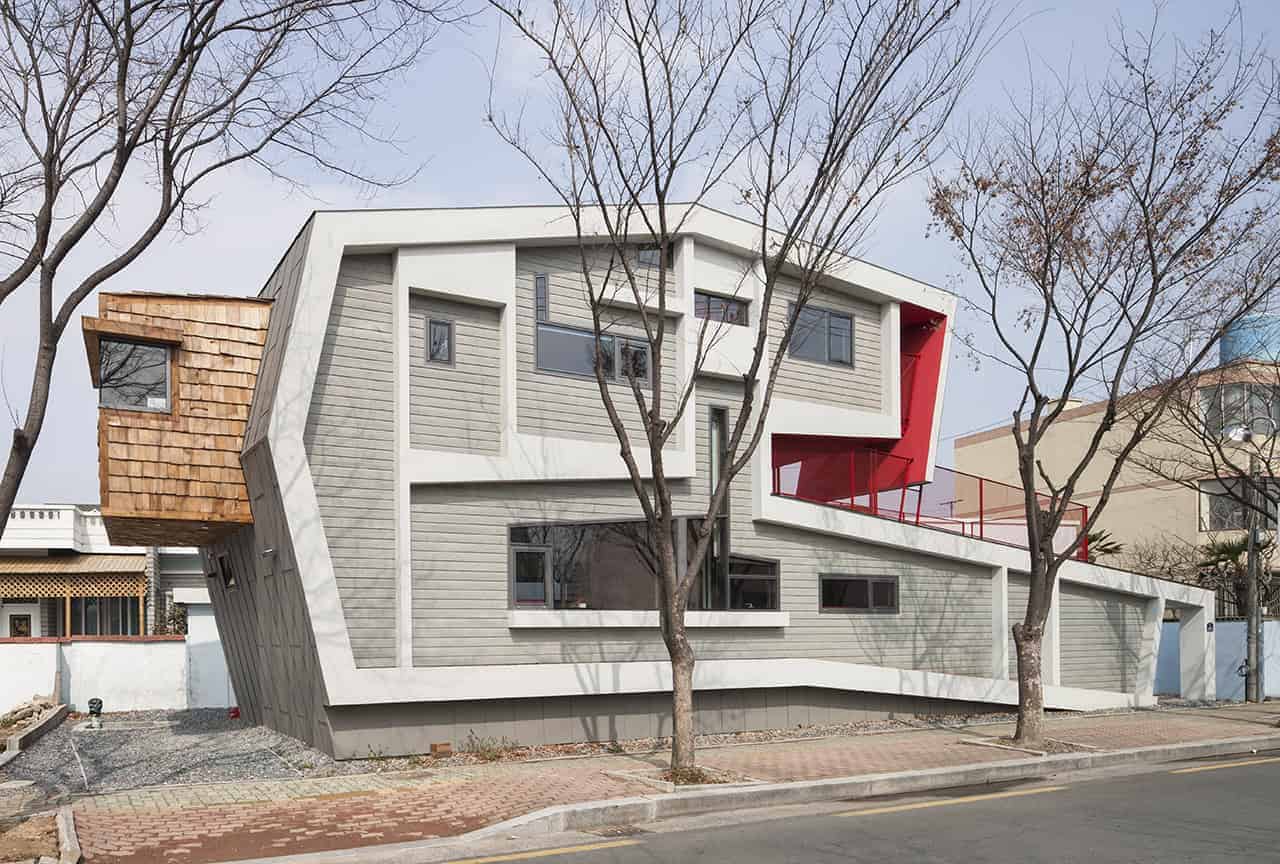
- Project: Roll House
- Architect: Moon Hoon
- Location: South Korea, Miryang
- Year: 2013
- Area: 99 m2
- Photography: Nam Goong Sun
An Urban Drama on a Slender Site
Roll House begins with a singular challenge: a long, narrow plot — “slender like a sword,” as described by the firm — yet the ambition was to produce a home that feels generous, layered and theatrical.
Rather than fight the site constraints, Moon Hoon leveraged them. The house’s massive, monolithic concrete frontage and sculptural facade create a presence that belies the modest 99 m² footprint. False walls in front exaggerate scale and hint at interior depth, giving the structure a sense of volume and mystery even before entering.
Inside, the plan unfolds not as a simple linear box but as a vertical and horizontal sequence of shifting levels — a spatial choreography rather than a conventional stacked plan.
Spatial Strategy: Levels, Sequence & Surprise
From the entrance, one steps through a narrow corridor into a living room, followed by a dining area and kitchen — each “room” distinguished not by walls but by ascending floor levels. This design gives rhythm and depth to what could otherwise feel constrained.
To the left of the corridor is a recessed space — left open-ended for future flexibility. To the right lies a child’s room with an attic above it, accessed via a steel staircase hidden behind a red false wall that doubles as a display surface.
Above, a rooftop garden balances vertical density with a touch of greenery: a small patch of grass and gravel, offering a view over the city — a private open space tucked above the bustle.
Thus, Roll House transforms narrowness into experiential richness: vertical shifts, hidden corners, unexpected transitions — every movement reveals a spatial surprise.
Materiality & Atmosphere
The exterior is heavy and concrete — imposing yet minimal. Inside, Moon Hoon plays with contrast: heavy structure softened by strategic voids, light directed through windows of varying geometry, and a sense of layering created by level changes rather than partitions.
This approach is consistent with the architect’s broader sensibility: to treat architecture as sculptural narrative, where form, material, and spatial sequencing evoke emotion, memory, and identity.
Why Roll House Matters
-
Design as solution to constraint: The narrow site becomes a catalyst, not a limitation. Rather than flatten or spread, the house unfolds in height and depth, offering a rich spatial experience within a small footprint.
-
Spatial layering without walls: By using floor-level changes instead of walls, Roll House achieves openness, permeability, and flexibility — blurring boundaries between rooms and functions.
-
Balance of monumentality and intimacy: The heavy concrete shell gives presence; the interior sequence offers human-scale comfort, discovery, and surprise.
-
Playful yet considered architecture: Roll House embodies Moon Hoon’s philosophy of architecture as an act of imagination — creating drama, narrative, and personality in everyday living.
In the context of modern Korean urban housing, Roll House stands out as a testament to how creativity, boldness, and sensitivity to site can transform constraints into character.


© Moon Hoon
Interior


