
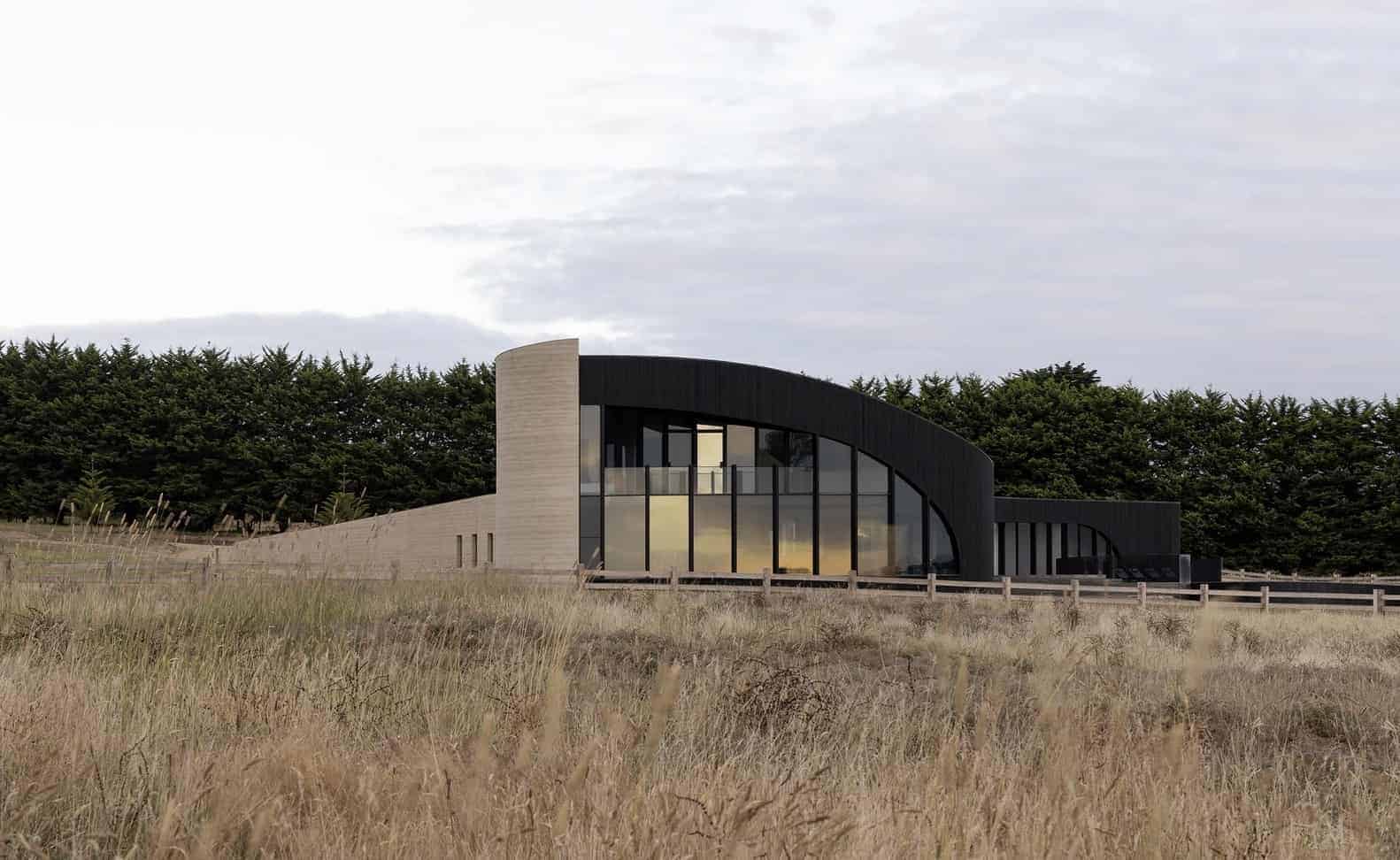
- Project: Peninsula House
- Architect: Wood Marsh
- Location: Australia, Flinders, Victoria
- Year: 2023
- Area: 550 m2
- Photography: Timothy Kaye
A Sculptural Coastal Retreat
Rising gently from the rugged coastal ridge of Flinders, Peninsula House by Wood Marsh Architecture is a bold, sculptural retreat that blurs the boundary between architecture and landscape. Defined by its monolithic rammed earth ribbon, the house reads like a geological formation—carved by wind, light, and time—anchoring itself into the site with a sense of permanence and calm.
The residence is both a refuge and a stage for the coastal panorama. Its curved walls guide movement, protect against prevailing winds, and open discreetly toward the horizon, creating a continuous spatial flow between interior and landscape.


Concept & Spatial Organization
The architectural concept stems from fluidity and enclosure. A single sweeping wall folds around the plan, wrapping living, sleeping, and gathering areas in one seamless gesture. The wall rises to form a grand vaulted ceiling over the main living space, creating an atmosphere that is both intimate and monumental.
The layout unfolds around a central planted atrium, which acts as a light well and visual anchor. From here, circulation branches into three wings—living and dining, private bedrooms, and a guest suite—each oriented to capture light, views, and shelter.
Large openings on the northern side connect directly to a covered terrace, extending daily life outdoors while framing wide coastal views.


Material Palette & Interior Expression
Peninsula House is grounded in natural materiality and precise craftsmanship.
Rammed earth walls form the structural and aesthetic backbone of the house, their rich ochre tones echoing the soil of the Mornington Peninsula. The material provides excellent thermal mass and an enduring textural depth that shifts with the light.
Externally, charred timber cladding complements the earth tones, helping the building recede into its landscape. Inside, a restrained palette of timber, terrazzo, and brass reinforces a sense of continuity and warmth. The ceiling’s smooth curve and blackened details lend the spaces a cinematic quality, balancing rawness with refinement.


Light, Shadow & Spatial Drama
Light is treated as material—shaping and sculpting space throughout the day. The house is oriented to frame the ever-changing skies of the coast. A continuous skylight along the ridge filters soft daylight into the core, animating the textured walls and emphasizing their tactile depth.
At sunset, the rammed earth glows in warm tones while deep shadows reveal the curvature of the structure, transforming the home into a luminous sculpture within the landscape.


Environmental Response & Performance
While visually striking, the house is deeply responsive to its coastal climate. The heavy earthen walls provide insulation and acoustic stability, while the low profile and deep eaves protect from harsh winds and direct sunlight. Passive ventilation and minimal glazing on the southern side further reduce energy demand.
By relying on mass, orientation, and shading, Peninsula House achieves comfort naturally, blending environmental performance with architectural poetry.


A Monument of Quiet Power
Peninsula House / Wood Marsh / Australia embodies the practice’s mastery of sculptural minimalism and contextual sensitivity. Every curve, surface, and opening is deliberate—crafted to resonate with the surrounding land and sea.
This is not a house that simply overlooks the coast; it grows from it. Through restrained form and monumental calm, Wood Marsh has created a timeless sanctuary—one that celebrates stillness, material honesty, and the enduring dialogue between nature and design.


