
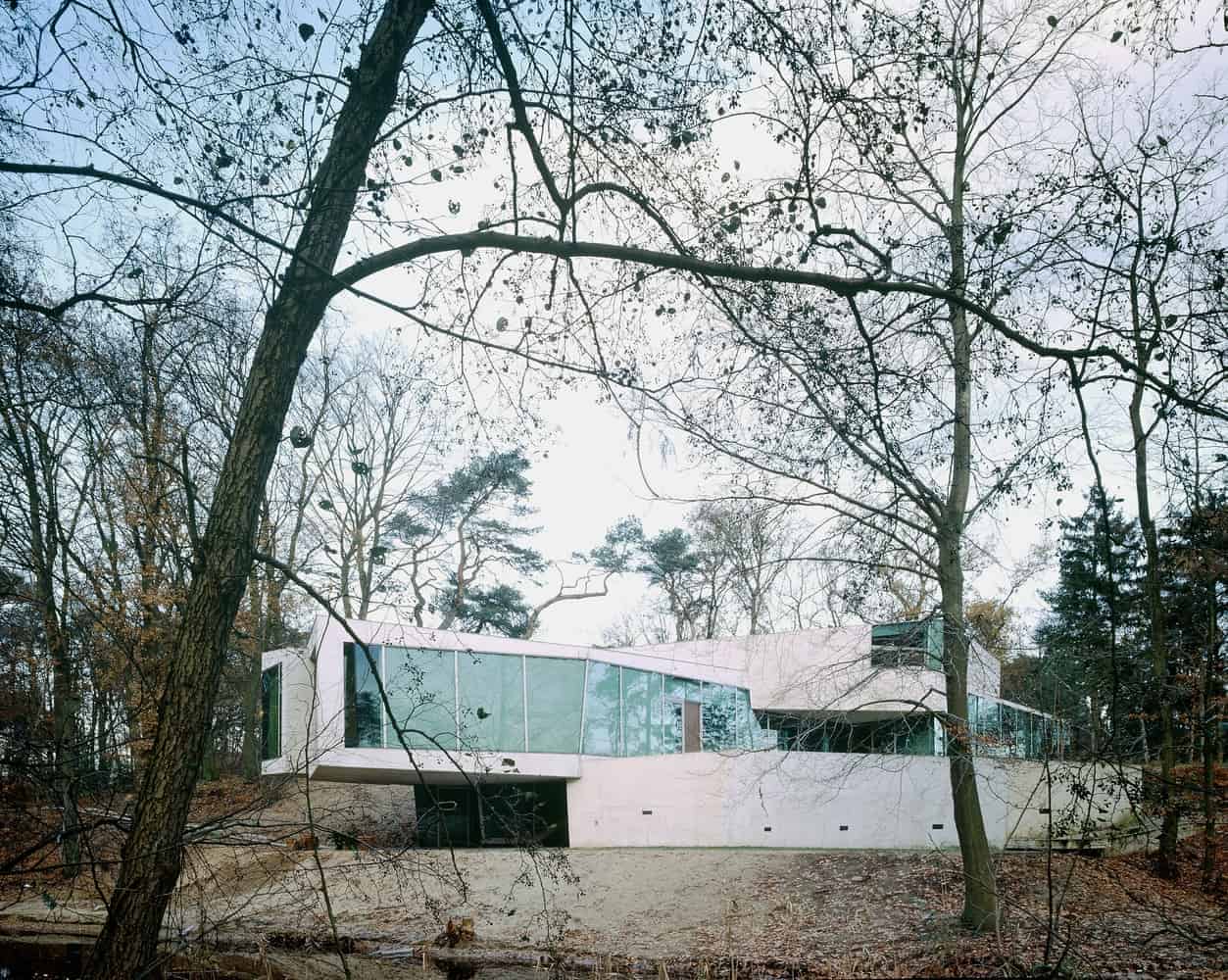
- Project: Möbius House
- Architect: UNStudio
- Location: Netherlands, Het Gooi
- Year: 1998
- Area: 520 m2
- Photography: Christian Richters, Eva Bloem
Möbius House by UNStudio
The Möbius House by UNStudio is one of the most celebrated works of late 20th-century architecture. Completed in 1998 in Het Gooi, The Netherlands, it is the creation of Ben van Berkel and Caroline Bos, who sought to explore new architectural languages through mathematics, technology, and parametric design.
Commissioned by a visionary couple from Amsterdam, the house was conceived as a home that would break free from convention and embody a new way of living. Inspired by the Möbius loop, a continuous surface with no boundaries, the project reimagined the spatial relationship of family life into a fluid 24-hour living cycle.
Concept and Inspiration
The Möbius strip became the organizing principle of the design. Its continuous, single-sided form provided a metaphor for unifying work, play, social life, and rest into a single flowing structure.
Instead of a sequence of compartmentalized rooms, the house follows two parallel circulation paths that twist and merge, creating interconnected living spaces without rigid separations. This continuous loop ensures that the functional program evolves seamlessly throughout the day.
A New Architectural Language
The clients’ lifestyle was central to the design approach. With two home studios alongside family spaces, the house had to merge professional and personal life. Instead of using walls and doors, spatial zones were defined by shifts in ceiling heights, natural light, and changes in spatial volume.
Higher ceilings mark areas of interaction and social energy, while lower ceilings create intimacy and focus. Abstract furniture pieces, embedded into the concrete structure, subtly indicate how spaces should be used—blurring the boundary between architecture and interior design.
Innovation Through Technology
One of the house’s most groundbreaking aspects was the use of 3D computer modeling. While early sketches were hand-drawn, by 1995 the design process became digital, coinciding with Ben van Berkel’s teaching at Columbia University’s paperless studio.
This technology allowed UNStudio to push the boundaries of complexity, experimenting with spatial ambiguity, fluidity, and parametric geometry in ways that had not been possible before. The Möbius House thus stands as one of the early icons of parametric design.
Materiality and Atmosphere
The house relies on a minimal material palette—primarily concrete and glass. Concrete provides weight, permanence, and sculptural presence, while glass opens the interiors to the surrounding forested landscape.
The south façade features an expansive curtain wall dramatically interrupted by a massive concrete element, orchestrating views and rhythms. Cantilevered slabs, long corridors, and transparent volumes reinforce the sensation of movement and continuity.
Integration with the Landscape
Located on a secluded wooded site, the house uses folding and unfolding planes to weave together interior and exterior spaces. At certain moments, the building’s external form morphs into interior furniture; at others, nature flows into the living areas through expansive glazing.
The Möbius loop concept ensures that the landscape is not separate but integrated, turning the architecture into an artificial topography where inside and outside merge.
Cultural Impact and Legacy
From its completion, the Möbius House received international acclaim. In 1999, it was featured in MoMA’s landmark exhibition “The Un-Private House” in New York. Beyond recognition, it became a manifesto project for UNStudio, symbolizing a turning point in Ben van Berkel’s career and positioning him as a pioneer of parametric design.
Though modest in size, the project redefined what a private house could be—an environment for living rather than a machine, where art, technology, and mathematics converge to produce a new architectural language.


