
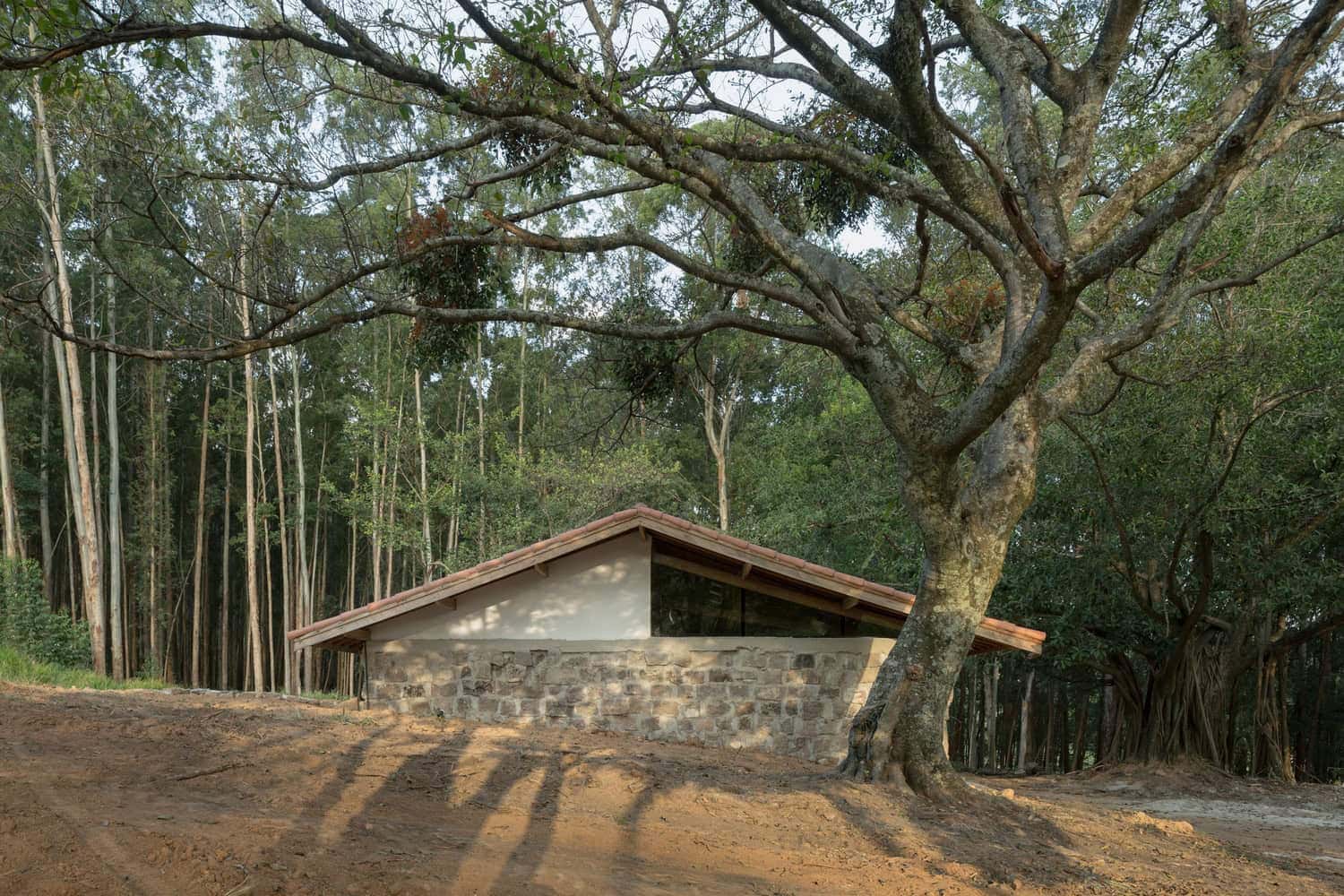
- Project: House in Ruins
- Architect: messina | rivas
- Location: Brazil, Itupeva
- Year: 2022
- Area: 211 m2
- Photography: Federico Cairoli
From Ruin to Resonance
On the edges of Itupeva, about 80 km from São Paulo, the House in Ruins by messina | rivas transforms a dilapidated 19-century farm structure into a deeply reflective residence. The project does not simply restore—it re-imagines the condition of ruin as an architectural opportunity: embracing existing stone walls, integrating nature, and introducing a new roof and timber structure that honours both fragility and permanence.
Concept & Site Story
The initial brief seems humble: inhabit a ruin. But the architects asked a provocative question: “What if the ruin is already inhabited by plants, air, and time?” The existing colonial stone walls become structural anchors; a majestic rubber tree with aerial roots becomes the core of the new design. A central void is created between the two autonomous residences—this courtyard mediates between past and present, between stone and timber, between nature and build.
In this way, the architecture does not overwrite history—it dialogues with it. The old walls delineate enclosure; the new timber roof lifts and invites sky. The courtyard becomes the hinge of living.
Spatial & Material Strategy
The 211 m² plan unfolds across two residences within the envelope of the ruin and the new addition. Notable strategies include:
-
Consolidation of existing walls: The stone walls were stabilized and a horizontal tie-beam rests atop them, converting the ruin into a usable base for a new timber roof.
-
Lightness over weight: The heavy stone mass is counter-balanced by a lightweight roof of locally sourced eucalyptus wood, offering visual and experiential contrast.
-
Layering of spaces: Opaque load-bearing walls sit underneath open roof planes with skylights and clerestories, framing shifting daylight and heightening spatial drama.
-
Courtyard as mediator: The central outdoor space becomes the living heart—bringing light, ventilation and connectivity between the two homes.
Materially, the stone, timber, and glass vocabulary is deliberately restrained. The texture of the old masonry is respected, the new timber is crafted with precision, and openings are strategically placed to preserve atmosphere rather than dominate it.
Nature, Time & Experience
In the House in Ruins, nature is not the backdrop—it is the collaborator. The rubber tree stands at the centre of the void; roots wind through floor-level elements, light filters through branches, and seasons become legible. Inside the residence, the interplay of shadow, stone texture and timber grain crafts a rich sensory experience. The roof does not fully enclose: openings allow sky, air and plant life in. The result is an architecture that breathes.
Walking through the home is a process of revelation: one moves from the heavy presence of stone walls, through layered spaces, into lighter wood-framed living zones, and out into the courtyard where time slows. The edifices feel rooted but also open. They engage history and the present simultaneously.
Significance in Contemporary Architecture
House in Ruins offers significant lessons:
-
It demonstrates how adaptive reuse can become poetic rather than purely functional.
-
It shows the power of contrasting materials (stone + timber) to express both continuity and change.
-
It uses the notion of ruin-as-foundation rather than ruin-as-problem, reframing heritage into design opportunity.
-
It integrates nature and structure seamlessly, allowing architecture to both resist and invite external forces (plants, roots, light).
For architects working in contexts where historic remains, vegetation and time-worn structures are present, this project provides a blueprint of care, poise and conceptual richness.
The House in Ruins by messina | rivas may appear modest in scale, but its ambition is generous. It celebrates ruin, time, material memory and nature—not as constraints, but as the core of architecture. It reminds us that to inhabit a ruin is not to forget history; it is to continue it with reverence, openness and craft.


