
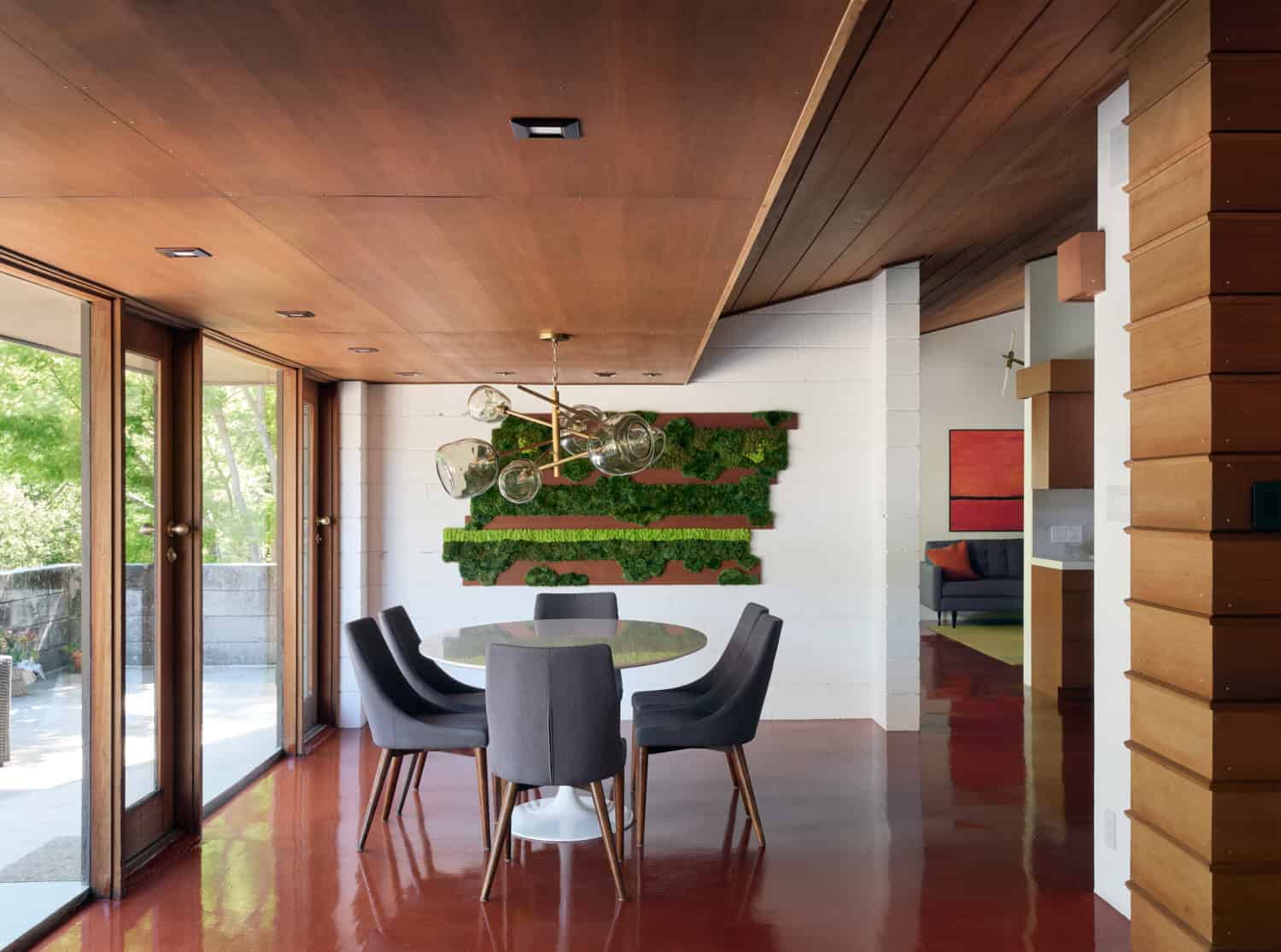
- Project: Olof Dahlstrand Mid-Century Remodel (The Magnificent Seven)
- Architect: Klopf Architecture
- Location: United States, Orinda, California
- Year: 2022
- Photography: Mariko Reed
A Rare Piece of Architectural Heritage
Nestled in the hills of Orinda, California, this 1951 residence is among the seven surviving homes designed by Olof Dahlstrand, a protégé of Frank Lloyd Wright. Known collectively as The Magnificent Seven, these homes embody the Wrightian principles of organic architecture: low-slung rooflines, natural materials, and an intimate dialogue with the sloping landscape.
Over the decades, successive homeowners have resisted the temptation to modernize at the expense of authenticity. Each steward has preserved Dahlstrand’s original vision, allowing the home to remain a living artifact of mid-century modernism.
When a family of five purchased the property, they were enthralled by its history yet mindful of the demands of 21st-century living. Their challenge was clear: respect the spirit of Dahlstrand’s design while adapting the house into a comfortable, sustainable family home.
A Remodel Rooted in Reverence
Klopf Architecture, supported by Larwood Construction and structural engineer Daniel Bastiao, approached the renovation with a shared ethos: any intervention must serve the integrity of the original architecture.
The mandate was not to overwrite history but to allow the home’s story to continue. This meant honoring material authenticity, preserving signature details, and seamlessly integrating new technologies and comforts.
One of the most decisive interventions involved the kitchen. Traditionally enclosed, Wright-inspired kitchens favored intimacy over openness. Klopf reconfigured the layout to invite natural light and improve connections with adjacent spaces, yet retained a sense of spatial separation. By replacing a visible ridge beam with a concealed steel solution, the team preserved the uninterrupted ceiling lines that define Dahlstrand’s aesthetic.
Light, Flow, and Detail
The remodel also reimagined circulation and light quality throughout the home. The powder room—once accessible only through the kitchen—was relocated, and its replacement carved from cabinetry space. A transom window extension and skylight transform what could have been a dark corner into a luminous retreat.
New solid-core mahogany-veneered doors echo the original material palette. Even subtleties such as doorknob placement—set precisely at 42 inches—reflect a commitment to proportion and authenticity.
The interiors’ redwood millwork and paneling, a hallmark of the home, were carefully restored. Where replacement was necessary, such as the soffit paneling, materials were sourced and detailed to be indistinguishable from the original. A blind door to the new powder room disappears into the board-and-batten wall, thanks to a custom in-swing mechanism devised by the architects and executed with surgical precision by the contractor.
Sustainability and Modern Comfort
While the site posed few technical challenges, the remodel embraced sustainability and energy efficiency. The roof insulation was upgraded, solar panels with battery storage were installed, and ductless mini-split cooling systems now regulate interior comfort.
Lighting merges history with innovation: new square LED fixtures recall the home’s original perimeter soffit lights, achieving continuity in both form and performance.
A planned expansion for a bedroom suite was postponed due to costs, but the design team maximized the existing footprint, resolving spatial constraints through ingenuity rather than square footage.
Collaboration as Craft
The remodel was as much a human story as an architectural one. The homeowners took active roles—one a detail-driven design enthusiast, the other focused on pragmatic durability—ensuring that each decision balanced aesthetics with functionality.
This collaborative approach, uniting client, architect, and contractor, produced a remodel that is neither nostalgic reproduction nor radical reinvention. Instead, it is an architectural conversation across decades—an extension of Dahlstrand’s vision into the present day.
A Legacy Preserved, a Future Secured
The remodeled residence now stands as a timeless modernist home—a space that honors Olof Dahlstrand’s architectural legacy while serving the evolving needs of a contemporary family. Grounded in nature, craftsmanship, and human-scale design, it ensures that this rare piece of California’s mid-century heritage will continue to inspire for generations to come.


