
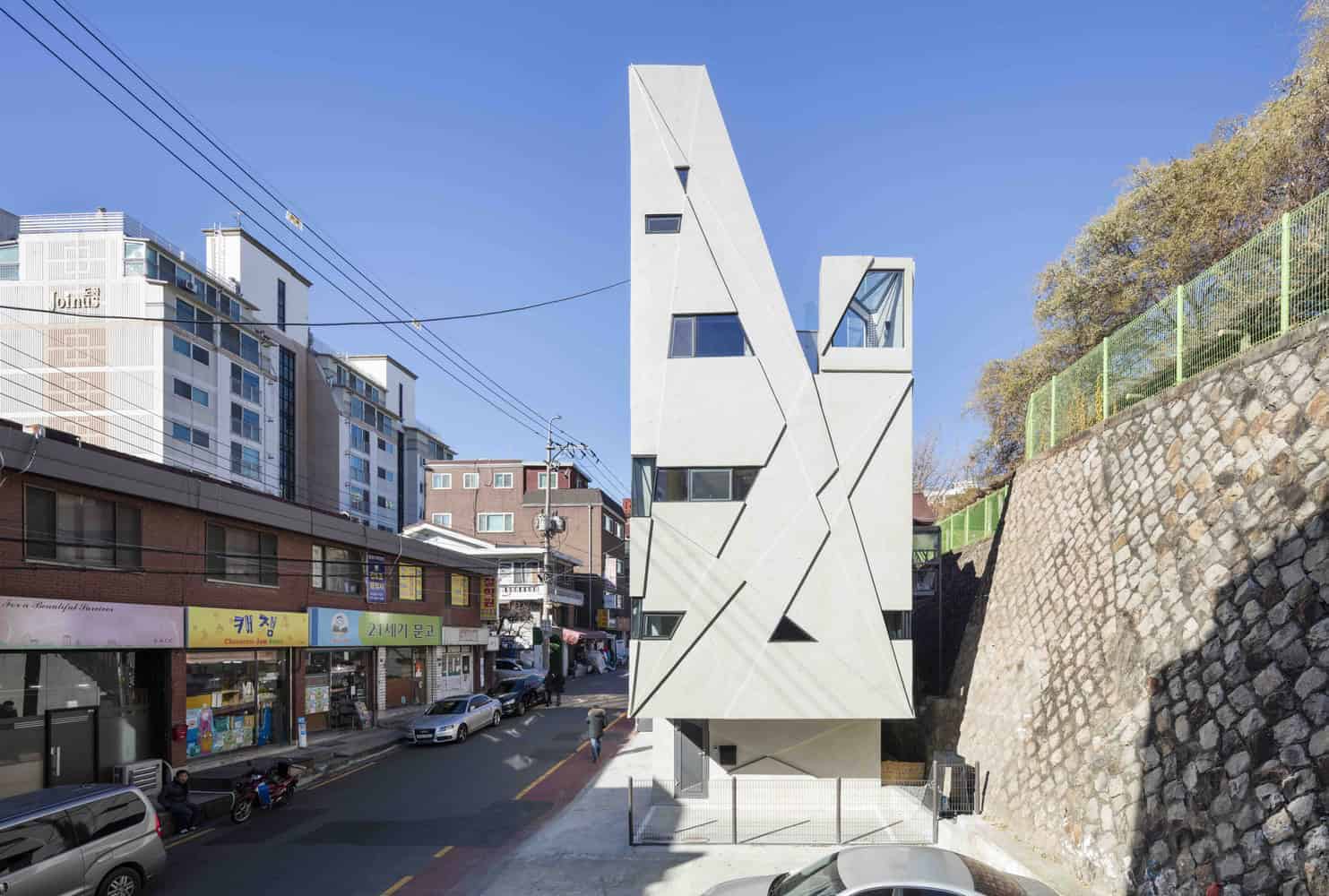
- Project: Dogok Maximum
- Architect: Moon Hoon
- Location: South Korea, Dogok-dong, Gangnam-gu, Seoul
- Year: 2017
- Area: 184 m2
- Photography: Namgoong Sun
A Narrow Lot, a Tall Statement
In the dense urban weave of Seoul’s Gangnam district, Dogok Maximum stands as a bold architectural response to extreme spatial constraints. Commissioned to house a photographer’s studio and a compact multi-generational dwelling, the project emerges from a notably narrow 68 m² plot — yet rises nearly 16 m, asserting presence through verticality and character.
Rather than yield to limitation, the design embraces it. A slim four-storey concrete body — topped with a modest penthouse level — stretches sky-ward, transforming a tight urban infill into a sculptural landmark. The result is a “maximum use” logic turned poetic: architecture as gasp rather than compromise.
Privacy, Light and the Language of Small Windows
One of the most distinctive characteristics of Dogok Maximum is its deliberately restrained fenestration. Rejecting large glazed façades commonly found in contemporary homes, Moon Hoon opted for numerous small, angular, randomly distributed windows across the concrete exterior.
This decision stems from the architect’s concern over privacy and light — especially for a residence in a packed urban context. The array of “shards of light” penetrates the interiors in spots, producing a dynamic interplay of brightness and shadow. The effect is both mysterious and protective: the house turns inward without turning away from the city.
Inside, the randomness of windows translates into an irregular rhythm of interior light, offering pockets of intimacy and occasional framed views. The design thus balances enclosure and openness, connection and privacy.
Mixed-Use Vertical Living: Studio, House, Reception
Dogok Maximum is not only a residence — it’s also a working home. The base levels accommodate a photography studio (for the client’s son) and a reception area at street level.
Above, three floors of living space are connected by a compact elevator — added to assist with mobility needs, acknowledging that part of the household may face physical constraints.
-
Basement & ground floor: studio + reception / utility spaces
-
Middle floors: living, dining, kitchen, flexible halls and possibly studio-residence hybrid zones
-
Top floor: private bedrooms and bathing facilities, arranged to maximize privacy and light while minimizing external exposure
This stacking of program — commercial / creative / residential — within a tiny footprint showcases how mixed-use design can be elegantly resolved even in cramped urban lots.
Architectural Character: Concrete, Angles & Spatial Tension
The material and form language of Dogok Maximum reflects Moon Hoon’s signature — raw concrete as primary expression, sharp geometric articulation, and a subtle tension between order and randomness.
Internally, walls carry irregular lines inspired by virtually projected “imaginary building lines,” translated into decorative marks, partition edges, and floor/ceiling geometry. This fragmentation introduces visual complexity within simple volumes — producing unexpected spatial dynamics, even in modest-sized rooms.
Despite its compact scale and narrow base, the house speaks of ambition and personality. It moves beyond the idea of “tiny urban home” — instead asserting a sculptural presence within Seoul’s dense residential tapestry.
Why Dogok Maximum Still Matters
-
Radical compactness redefined as richness — Instead of compromising, the project leverages constraints to produce a layered, multifaceted dwelling.
-
Intimacy through small openings — Privacy in dense cities can be a luxury; here, small angled windows craft a balance of light and enclosure, protecting inner life without isolation.
-
Mixed-use flexibility — Studio, reception, dwelling — all woven vertically. Demonstrates how multi-purpose urban houses can integrate work and living elegantly.
-
Architecture as identity and mystery — The building’s form and windows resist readability, inviting curiosity; it becomes a “sculpture-home,” rooted in context but expressive.
For architects, urban planners, and anyone intrigued by the challenge of “maximum building in minimum lot,” Dogok Maximum remains a compelling blueprint — not only for space-efficient design, but for creative resilience in constrained conditions.


