
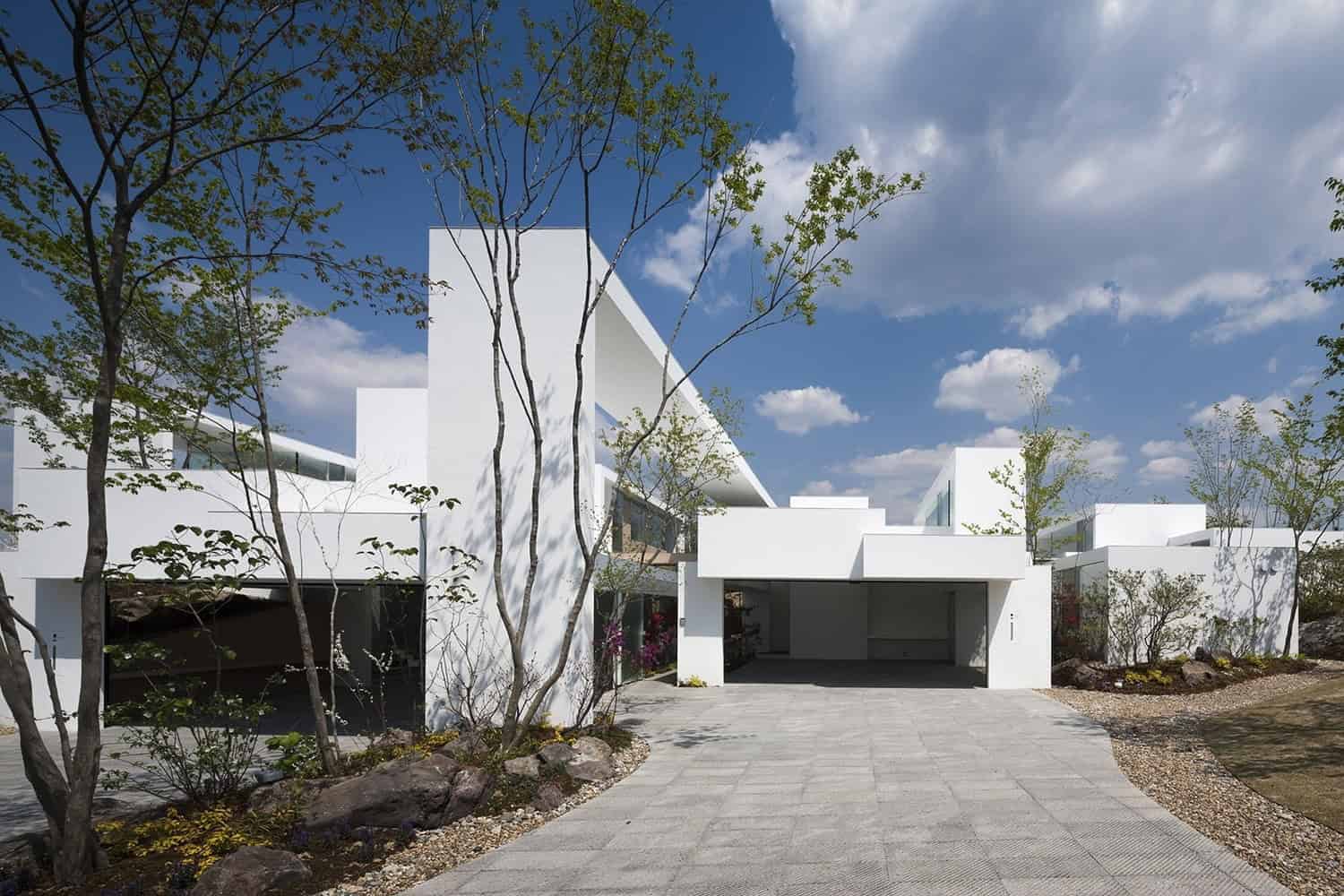
- Project: Cosmic
- Architect: UID Architects
- Location: Japan, Osaka
- Year: 2014
- Area: 611 m2
- Photography: Hiroshi Ueda
A Home that Blurs Boundaries — Cosmic’s Vision
Located on a gentle hillside near Osaka, Cosmic emerges as more than just a house — it is a poetic reinterpretation of dwelling, where architecture and nature interweave seamlessly. Designed by UID, this residence introduces a radical approach: instead of conventional compartmentalized interiors, Cosmic becomes a “living domain” that celebrates fluidity, transparency, and the subtle interplay between built form and landscape.
UID envisions Cosmic not as a static container but as a dynamic continuum — a home where boundaries dissolve, and interiors merge with the surrounding environment. Each corner of the house is crafted to evoke a sense of openness, calm and connection with nature.
Architecture as Connection: Indoor–Outdoor Integration
One of the most striking aspects of Cosmic is its transparent envelope. Expansive glass facades invite the outside world in — letting daylight flood interiors, offering panoramic views of the surrounding terrain, and redefining the relationship between inside and outside.
Rather than isolating the living spaces from their context, UID allows the architecture to become part of the landscape continuum: the hillside, the greenery, the shifting light throughout the day — all of these become integral to the living experience inside.
In this way, Cosmic resurrects a deeply Japanese sensibility: a sensitivity to seasons, light, and natural flow. The house doesn’t fight the environment — it harmonizes with it.
Layers, Screens & Spatial Continuity
Instead of rigid walls and separated rooms, Cosmic relies on screens, layers, and subtle spatial gradations. UID uses architectural screens — reminiscent of clouds drifting across a landscape — to filter light, provide shade, and shape spatial zones without strict physical barriers.
This layering results in shifting spatial experiences: areas bathed in light, pockets of shadow and calm, visual depth created by overlapping planes, and a gentle transition between public and private, interior and exterior. The spatial sequencing becomes an experience — a journey rather than a static layout.
A House That Breathes with Nature
Cosmic was conceived to react to its site’s topography and climate rather than to fight or ignore it. The layered screens not only regulate sunlight and shade, but also respond to wind, seasonal change, and natural rhythms.
As seasons pass, as light shifts, and as nature evolves around the house, the internal atmosphere of Cosmic transforms. It is architecture not fixed in time — but alive, adaptive, and deeply rooted in its surroundings.
Minimal Material, Maximum Atmosphere
Materiality in Cosmic leans toward minimalism: concrete, glass and structural subtlety. But the restraint is deliberate. Rather than decorate, UID crafts atmosphere — the house becomes a canvas for light, shadow, and nature’s presence.
Furniture and interior fixtures are rendered secondary — the real focus is on emptiness, on potential. Void becomes as important as volume; silence as meaningful as the structure itself.
Cosmic in the Context of UID’s Philosophy
To truly appreciate Cosmic, one must understand the ethos of UID. Founded in 2003 by Keisuke Maeda, UID emerged from a deep commitment to blending architecture with the environment — prioritizing experience over form, atmosphere over monumentality, and continuity over compartmentalization.
Cosmic epitomizes this vision: it is not a house in the traditional sense, but a habitable environment — one that evolves with time, climate, and natural context. As with other UID projects, the built form recedes into subtlety, while the user’s experience comes forward.
Why Cosmic Remains a Benchmark in Contemporary Residential Architecture
-
Fluid spatial logic — The house rejects rigid divisions, embracing continuity and layered spatial relationships.
-
Nature as co-designer — Light, seasons, vegetation and topography shape lived experience more than walls or décor.
-
Minimalism grounded in context — Sparse material palette and restrained detailing underscore atmosphere, not style.
-
Sustainable living concept — Rather than imposing on its environment, Cosmic aligns with it — encouraging a gentle footprint and synergy with landscape.
-
Timeless quality — Thanks to its subtle materiality and natural integration, Cosmic transcends trends.
For these reasons, Cosmic by UID remains a reference for architects and enthusiasts seeking a deeper, more poetic definition of home — one that respects nature, embraces simplicity, and elevates daily life into a gentle ritual.


