
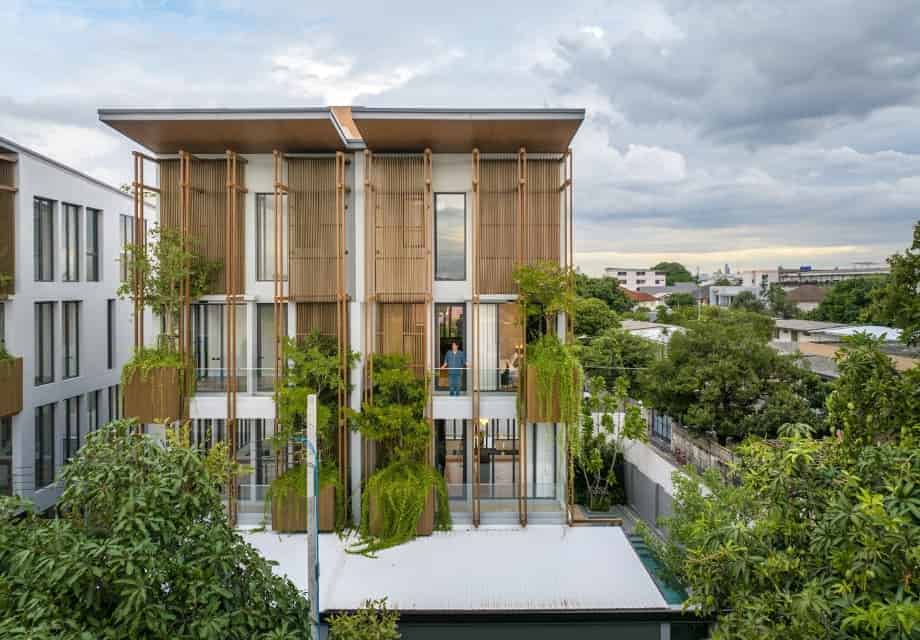
- Project: ALIVE Residence
- Architect: SaTa Na
- Location: Thailand, Bangkok
- Year: 2023
- Area: 237 m2
- Photography: Rungkit Charoenwat
A Tranquil Urban Refuge Rooted in Nature
ALIVE Residence by Sa Ta Na Architects redefines urban living in Bangkok by creating a peaceful retreat amid the city’s intensity. Designed for a family seeking balance between work, relaxation, and connection with nature, the home seamlessly blends privacy, adaptability, and biophilic design.
Enveloped in a distinctive three-story wooden façade, the residence captures the warmth of traditional Thai architecture while integrating modern environmental strategies. The result is a home that breathes — open to light, wind, and greenery, yet sheltered from the chaos of the city.
“The design began with the idea of turning away from the noise of the street to embrace inner peace and nature,” note the architects.
Design Concept: Turning Inward Toward Peace
The core concept of ALIVE Residence centers on creating an urban sanctuary by orienting the house away from the road. This gesture transforms the inward-facing layout into a haven of calm, where residents immediately feel detached from the outside world upon entering.
The three-story composition employs horizontal wooden slats and perforated panels—crafted from aluminum and artificial wood—to filter views, light, and noise. These rhythmic layers of timber reinterpret the texture of traditional Thai wooden houses, connecting modern life with cultural memory.
Behind this soft barrier, the architecture opens to a series of green pockets and terraces, inviting natural ventilation and a play of filtered sunlight throughout the interior.
Adaptive Living for Modern Lifestyles
In response to the evolving needs of contemporary urban families, the layout was conceived with flexibility and adaptability at its core. The architects anticipated the growing demand for multi-functional living spaces, particularly for work-from-home and home office setups.
Each floor is organized to allow reconfiguration over time — open-plan living areas can easily adapt to changing family dynamics, while private zones maintain intimacy and comfort. The spatial hierarchy moves from public to private as one ascends:
-
Ground floor: communal living and dining spaces connected to the garden.
-
Second floor: flexible rooms for working or guest accommodation.
-
Third floor: private bedrooms opening onto green balconies.
This thoughtful layering supports both solitude and connection, reflecting the realities of urban living in compact city plots.
Materiality & Façade: The Warm Shield
The façade design is central to the home’s character. The architects selected wood-toned aluminum and composite panels to form a breathable wooden skin—an environmentally resilient reinterpretation of vernacular materials.
This façade performs multiple roles:
-
Shades the interiors from Bangkok’s intense sun.
-
Screens the house from street noise and views.
-
Filters air and light for improved comfort.
-
Evokes the cultural lineage of Thai wooden architecture.
By day, the façade reads as a soft, tactile filter; by night, it glows warmly, embodying the project’s name — “ALIVE.”
The Pocket Garden: Nature as Filter
A defining feature of the design is the balcony garden, or pocket garden, where lush greenery blurs the boundary between architecture and nature. The balcony planters are carefully positioned to filter dust, light, and air, improving the microclimate while framing peaceful views.
These green interludes create micro-ecosystems that encourage biodiversity and provide residents with the emotional benefits of daily contact with nature. Even in a dense urban context, the architecture makes space for breathing, growing, and healing.
Sensory Experience & Emotional Architecture
ALIVE Residence is not only functional but deeply emotional. Its material warmth, filtered light, and natural textures evoke tranquility and nostalgia—a sense of returning home not just physically but spiritually.
Every design element contributes to a sequence of sensory transitions: from street noise to silence, from harsh light to dappled shadow, from the city’s heat to the coolness of wood and foliage. The architecture becomes an instrument for slowing down and reconnecting.
“It’s a home that marks the beginning of happiness,” the architects describe — “a starting point for an inspired urban life.”
A Living, Breathing Urban Home
ALIVE Residence stands as a model for human-centered urban design — compact yet open, private yet connected, contemporary yet rooted in tradition.
By integrating biophilic principles, sustainable materials, and adaptive planning, Sa Ta Na Architects have crafted a residence that truly feels alive — a dwelling that grows, evolves, and breathes with its inhabitants.


