
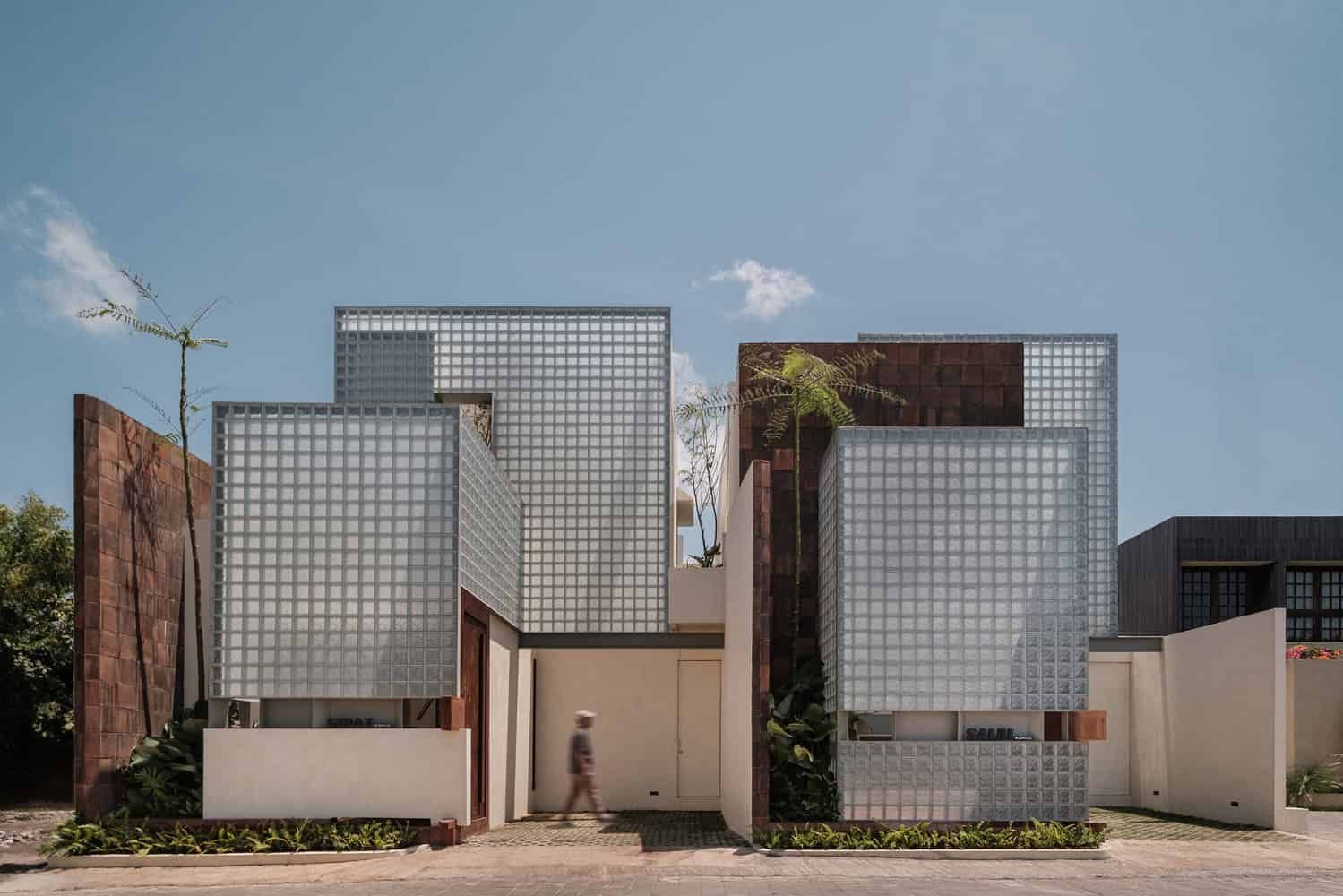
Villa Sipat & Sauh / Arkana Architects / Indonesia

  • Project: Villa Sipat & Sauh
  • Architect: Arkana Architects
  • Location: Indonesia, Bali
  • Year: 2025
  • Area: 250 m2
  • Photography: Thomas Irsyad

Crafting a Villa that Feels Like Home — Even in Hospitality

In the vibrant heart of Bali, Arkana Architects presents a project that challenges the conventional rental-villa paradigm. With Villa Sipat & Sauh, the brief was clear yet demanding: create a pool-villa designed for rent that nonetheless feels like a private home.

From this seed grew a two-level residence of around 250 m², rooted in compact urban conditions yet resonant with expansive domesticity. What emerges is not a flashy showpiece but a quietly refined retreat: textured, intimate, thoughtful.

Spatial Narrative & Material Intimacy

Arkana’s design pivots around key spatial ideas: light, texture, and interstitial space. The sequence begins at a modest foyer—an open-to-sky glass-block threshold where sunlight and occasional rain-fall engage directly with the visitor. This unconventional welcome immediately signals a departure from the typical rental-villa formality.

The living and dining spaces flow from the kitchen rather than the other way around, another subtle subversion of expectation. A translucent partition of timber and fluted glass softly delineates zones, allowing visual continuity and enabling light and air to pass through. The heart of the home is an interior courtyard housing the pool—serving simultaneously as mediator between public front zones and private upper-level sleeping areas.

Materially, the villa leans into texture and nuance rather than spectacle. Glass-block façades offer opacity with an inner glow, creating a façade that feels protective yet alive. The juxtaposition of solid and translucent, inside and outside, day and night, lends the design a subtle but persistent richness.

Designing for a Rental but Built for Living

Often, rental villas in Bali emphasise spectacle and scale; Villa Sipat & Sauh does something different. This is architecture conceived for everyday — albeit elevated — living. Arkana Architects injects domestic rhythms and tactility: the kitchen island where guests gather, the stair by the pool where movement becomes part of the experience, the filtered daylight that sketches patterns across wood and stone.

Moreover, within its modest site footprint, the design maximises spatial generosity through vertical layering and visual transparency. What might read as compact becomes expansive precisely because the architecture prioritises connection — to air, sky, water — over volume alone.

Significance & Architectural Impact

Villa Sipat & Sauh stands out for several reasons:

  • Re-imagined hospitality architecture: By prioritising “home” over “villa”, the project elevates guest experience into domestic belonging.

  • Refined use of modest scale: At approximately 250 m², the design shows how spatial richness need not derive from massive footprints.

  • Material and sensory sophistication: From glass-block façades to timber partitions, the detailing conveys a commitment to tactility and archetype, not just aesthetics.

  • Contextual resonance: Though contemporary, the villa is firmly grounded in Bali’s architectural culture of indoor-outdoor living, natural light, and comfort in climate.

Summary

Villa Sipat & Sauh by Arkana Architects is a masterclass in how architecture for rent can feel deeply personal. It sees the challenge of limited area not as constraint but as opportunity: to craft spatial nuance, reinforce material integrity, and allow living-architecture to emerge in subtler gestures. In a world of tourism-driven volume, this project reminds us of the enduring power of calm, considered design.

Front elevation of Villa Sipat & Sauh by Arkana Architects in Bali, Indonesia with glass block facades
Photography © Thomas Irsyad
Oblique daytime street view of Villa Sipat & Sauh by Arkana Architects in Bali, Indonesia
Photography © Thomas Irsyad
Front elevation of Villa Sipat & Sauh by Arkana Architects in Bali, Indonesia illuminated at dusk
Photography © Thomas Irsyad
Oblique dusk street view of Villa Sipat & Sauh by Arkana Architects in Bali, Indonesia
Photography © Thomas Irsyad
Right-side entry volume of Villa Sipat & Sauh by Arkana Architects in Bali, Indonesia at dusk
Photography © Thomas Irsyad
Left-side entry volume of Villa Sipat & Sauh by Arkana Architects in Bali, Indonesia at dusk
Photography © Thomas Irsyad
Rear elevation of Villa Sipat & Sauh by Arkana Architects in Bali, Indonesia with large glass block wall at dusk
Photography © Thomas Irsyad
Upper courtyard corridor at Villa Sipat & Sauh by Arkana Architects in Bali, Indonesia with skylight and tree view
Photography © Thomas Irsyad
Upper corridor overlooking bedroom and courtyard at Villa Sipat & Sauh by Arkana Architects in Bali, Indonesia
Photography © Thomas Irsyad
Living room with floating concrete stair at Villa Sipat & Sauh by Arkana Architects in Bali, Indonesia
Photography © Thomas Irsyad
Living room stair with vertical wood columns and courtyard at Villa Sipat & Sauh by Arkana Architects in Bali, Indonesia
Photography © Thomas Irsyad
Living room stair and poolside lounge at Villa Sipat & Sauh by Arkana Architects in Bali, Indonesia
Photography © Thomas Irsyad
Warm dining room and kitchen interior at Villa Sipat & Sauh by Arkana Architects in Bali, Indonesia with marble backsplash and wood shelving
Photography © Thomas Irsyad
Dining and living space connected to kitchen by sliding partition at Villa Sipat & Sauh in Bali, Indonesia
Photography © Thomas Irsyad
Marble kitchen island with warm wood cabinetry at Villa Sipat & Sauh in Bali, Indonesia
Photography © Thomas Irsyad
Kitchen island at Villa Sipat & Sauh with natural light filtering through glass block walls in Bali, Indonesia
Photography © Thomas Irsyad
View from kitchen island toward living room at Villa Sipat & Sauh in Bali, Indonesia
Photography © Thomas Irsyad
Freestanding bathtub with natural plants and stone flooring at Villa Sipat & Sauh in Bali, Indonesia
Photography © Thomas Irsyad
Bedroom and wooden vanity with warm lighting at Villa Sipat & Sauh in Bali, Indonesia
Photography © Thomas Irsyad
Architectural first floor plan of Villa Sipat & Sauh by Arkana Architects in Bali
1st Floor Plan – Villa Sipat & Sauh
Ground floor plan of Villa Sipat & Sauh in Bali designed by Arkana Architects
Ground Floor Plan – Villa Sipat & Sauh
Master plan architectural drawing for Villa Sipat & Sauh in Bali
Master Plan – Villa Sipat & Sauh
Rooftop floor plan showing terrace and upper layout of Villa Sipat & Sauh
Rooftop Floor Plan – Villa Sipat & Sauh
Architectural site elevation drawing of Villa Sipat & Sauh by Arkana Architects
Site Elevation A – Villa Sipat & Sauh
Second elevation drawing showing facade and architectural massing of Villa Sipat & Sauh
Site Elevation B – Villa Sipat & Sauh
Detailed architectural site elevation of Villa Sipat & Sauh designed by Arkana Architects
Site Elevation C – Villa Sipat & Sauh
Architectural section A showing vertical relationships and interior layout of Villa Sipat & Sauh
Site Section A – Villa Sipat & Sauh
Modern architectural cross-section drawing of a contemporary residential building featuring multiple floors, green interior spaces, and structural details emphasizing innovative architecture and design.
Site Section B – Villa Sipat & Sauh
Modern residential architectural floor plan with sleek lines, open spaces, and minimalist design, showcasing contemporary house architecture, interior design, and efficient layout.
Site Section C – Villa Sipat & Sauh

Posted by Arkana Architects

Arkana Architects is a design studio headquartered in Bali, Indonesia, specialising in architecture, interiors and master planning across luxury villas, resorts and bespoke residences. The practice combines modern tropical architecture with Balinese-influenced landscapes, using local materials and thoughtful contextual response to deliver spaces that feel both refined and relaxed. With a collaborative approach and global client base, Arkana Architects leads each project from concept through to construction, ensuring design integrity, environmental sensitivity and a genuine connection to place.