
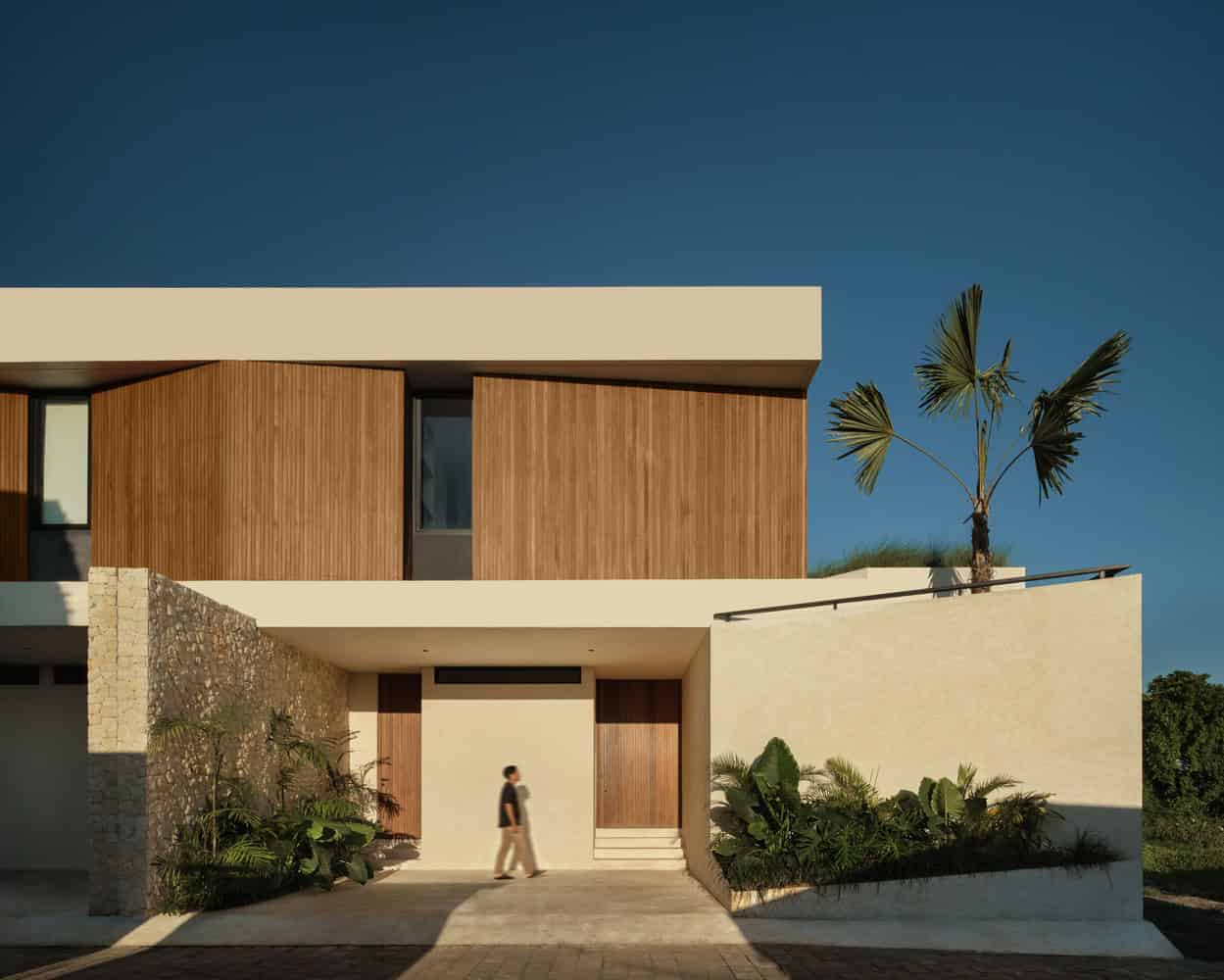
- Project: Tapa Villa
- Architect: Studio Tanama
- Location: Indonesia, Bali
- Year: 2025
- Area: 260 m2
- Photography: Thomas Irsyad
Tropical house as slow sanctuary
Tapa Villa is conceived as a retreat where time slows: a low, earthy, modern-tropical house resting in the middle of rice fields and river sounds, not a villa chasing Instagram drama. Studio Tanama takes three ideas and weaves them together:
-
Modern Tropical (for climate and openness)
-
Balinese groundedness (whitewashed, textural, courtyard-like edges)
-
Tulum / wabi-sabi softness (raw, weathered, lived-in).
The result is a home that feels both global and deeply local — Bali at heart, but ready for design travelers.
Site & orientation
The villa sits in Beraban, Tabanan — away from the touristy parts, where rice terraces, humidity and cross-breezes define how you build. So the house is porous on purpose: big openings toward the view, protected edges where sun and rain are harsher, and in-between terraces that let you live half inside, half outside. The elongated plan lets breezes run through, while deep overhangs and timber-slat shading stop glare and overheating.
Plan: indoor–outdoor stitched together
At 260 m², the villa isn’t oversized — it’s tuned. Public spaces (living, dining, kitchen) are on the front, fully opening to the pool and landscape. Bedrooms pull back slightly for privacy, often with their own garden slice. Circulation is not a corridor but a sequence of shaded walks, edges, and framed views — very resort-like, but scaled to a house.
Material language
Studio Tanama keeps the palette short and tactile: lime/plaster walls, timber, rattan, stone, microcement, handmade tiles. Surfaces are allowed to age — wabi-sabi — so the villa will look better in five years than on opening day. Furniture follows the same idea: chunky, low, textural, linen and wood instead of gloss and metal.
Climate-responsive, not gadget-driven
Instead of hiding behind AC, the villa uses:
-
cross-ventilation via aligned openings,
-
deep eaves for shade and rain,
-
light roofs and breathable façades,
-
landscape as a microclimate buffer (ponds, planting, perimeter green).
So comfort comes from architecture + landscape, not just machines.


