
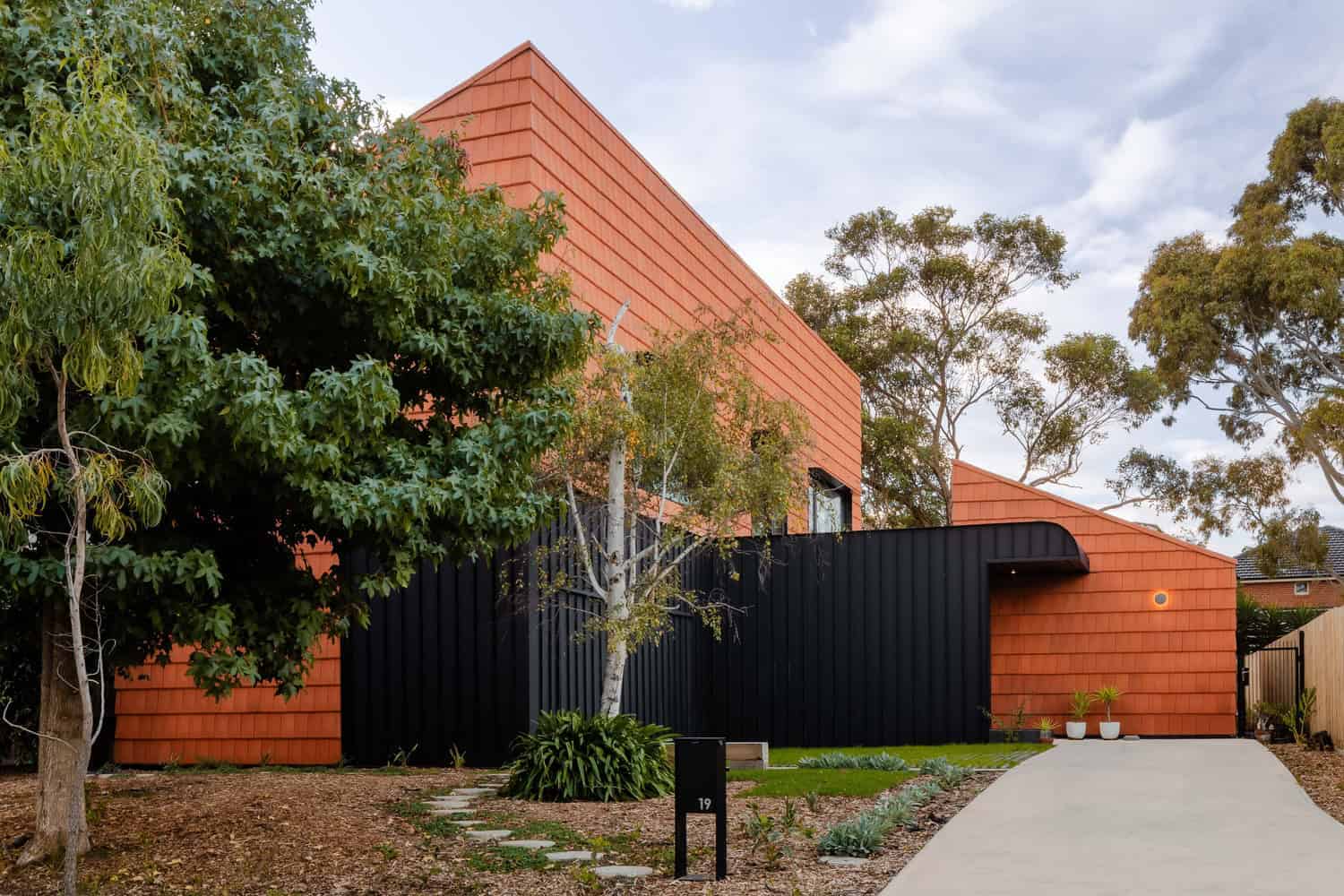
- Project: Mahogany House
- Architect: R ARCHITECTURE
- Location: Australia, Mount Waverley, Victoria
- Year: 2023
- Area: 380 m2
- Photography: Chris Murray
A House Rooted in Nature and Family
In a quiet suburban pocket of Mount Waverley, R ARCHITECTURE designed Mahogany House as a refined model for multigenerational living — a residence that orbits around a single, mature mahogany tree that has occupied the site for decades. The house does not dominate its context; it listens to it. Around the tree, architecture, light, and landscape fold together to form a sanctuary that feels both local and timeless.
The home was conceived for the architects’ own family, serving as a testing ground for how performance, adaptability, and emotion can coexist within the suburban typology.
Concept and Design Approach
The project began with a question: How can a family home remain relevant across generations?
The answer lay in a two-pavilion strategy — dividing the house into a main family wing and a self-contained secondary suite for aging parents. Between them lies a north-facing courtyard and pool, anchored by the mahogany tree that inspired the project’s name.
This open heart brings natural light deep into the interior, defines circulation, and organizes the house around a living landscape. The architectural expression is simple and grounded: pitched rooflines, human-scaled openings, and a language of crafted surfaces that soften the modern geometry.
Street Presence and Spatial Sequence
From the street, Mahogany House reads as a low, sculptural composition that blends into the neighborhood. Its broken roofline recalls familiar suburban silhouettes — gabled and domestic — while its detailing and materials signal quiet sophistication.
Entry is intentionally understated. A compressed vestibule opens into an expansive lounge where the first glimpse of the courtyard and mahogany tree establishes orientation. Every major space frames this central green room, ensuring that the experience of nature is constant and immersive.
Living with Light and Air
The architecture prioritizes comfort, daylight, and cross-ventilation. Clerestory glazing, deep overhangs, and sliding doors create a fluid exchange between interior and exterior. The courtyard becomes a microclimatic device — cooling the home in summer, inviting low winter sun, and maintaining visual calm throughout the year.
This sense of flow continues through the kitchen and dining areas, where open sightlines allow family members to remain connected across spaces. The secondary living pod, designed for privacy and independence, mirrors this openness at a smaller scale, with its own lounge, kitchenette, and direct access to the garden.
Material Palette: Earth, Clay, and Timber
Materiality anchors the home to its setting. Terracotta shingles wrap both roof and façade, lending warmth, texture, and a strong tactile identity. The material’s subtle variation responds beautifully to the Australian sun, shifting from ochre to deep red throughout the day.
Inside, Australian hardwoods, plywood joinery, and terrazzo floors provide tonal continuity. Every element feels crafted rather than assembled — from custom green cabinetry to fine joinery detailing around windows and stairs. The color story celebrates natural imperfection: earthy, honest, and resilient.
Performance and Sustainability
Mahogany House quietly integrates Passivhaus principles to achieve comfort without reliance on technology. The structure uses Structural Insulated Panels (SIPs) for airtightness, insulation, and construction efficiency. Cross-ventilation, thermal mass, and strategic shading minimize energy demand.
Rainwater harvesting, low-VOC materials, and locally sourced finishes further reduce the home’s footprint. The project exemplifies “performance through simplicity” — proof that elegance and efficiency can share the same space.
Multigenerational Adaptability
Designed for three generations, the layout supports changing family dynamics. The grandparents’ wing offers autonomy yet remains within arm’s reach of the main home. Sliding partitions and adaptable spaces allow reconfiguration as needs evolve — from guest suite to home office, or eventually, caregiver quarters.
This flexibility transforms the house from a fixed product into a living system — one that can evolve gracefully over decades.
The Atmosphere of Everyday
Despite its technical discipline, Mahogany House is above all a place of emotion: the play of filtered light on terracotta, the scent of warm timber, the sound of children by the pool. It’s a home built to engage the senses, to encourage slowness, and to celebrate togetherness.
The architects describe it as “a house you can touch” — not pristine, but alive.
A Contemporary Australian Archetype
Mahogany House redefines what suburban family architecture can be in Australia: contextual, climate-sensitive, handcrafted, and generationally aware. It neither mimics heritage nor fetishizes modernity — it simply belongs.
With its red clay skin, breathable interior, and a mahogany tree at its center, the house stands as both a shelter and a conversation with nature — an architecture of empathy, performance, and enduring warmth.


