
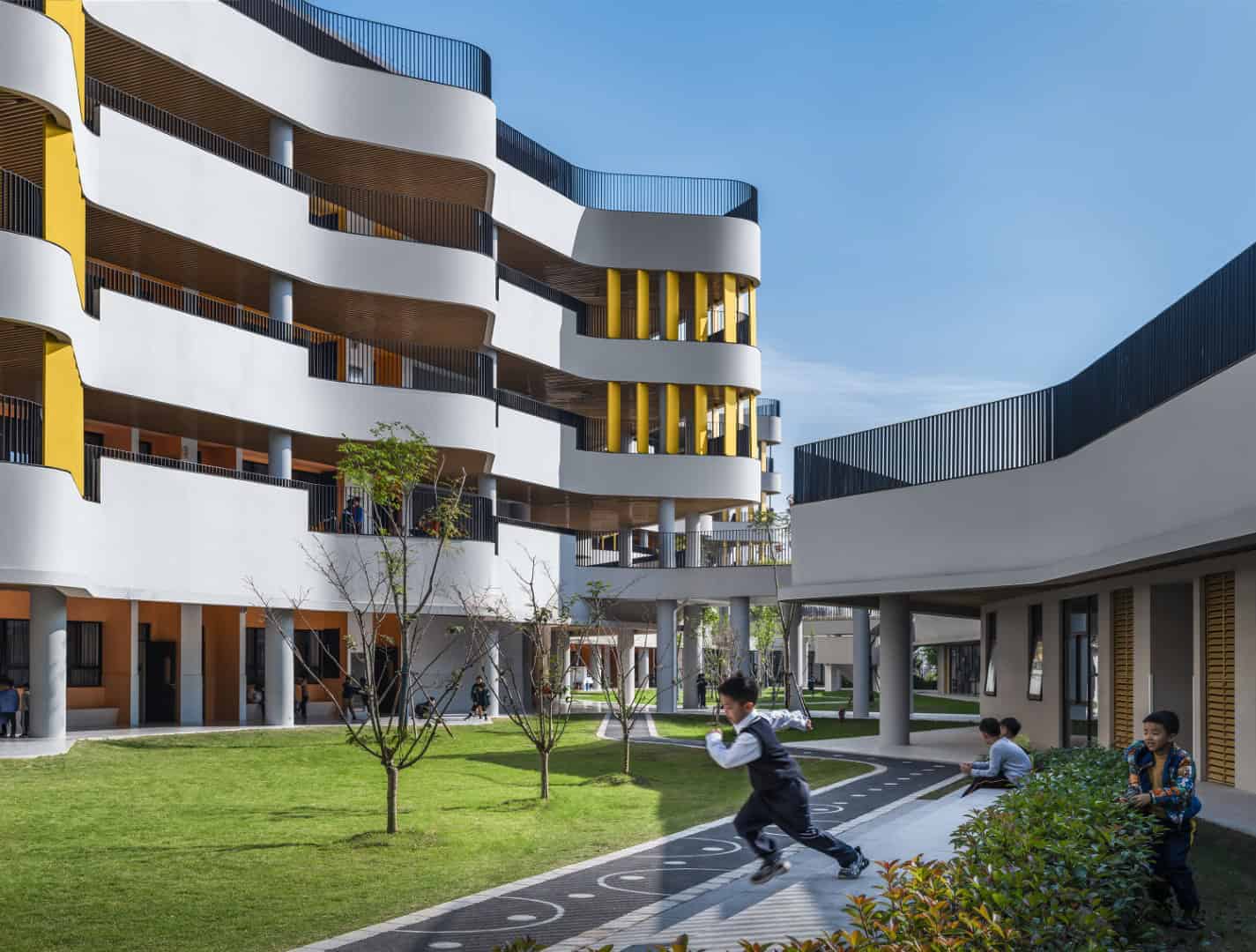
- Project: Chonggu Experimental School
- Architect: BAU Brearley Architects + Urbanists
- Location: China, Shanghai
- Year: 2023
- Area: 21430 m2
- Photography: INNSimages
Redefining the Architecture of Learning in Shanghai
Public schools across Shanghai are often marked by rigid layouts and institutional uniformity — buildings that resemble factories as much as they do places of education. In contrast, Chonggu Experimental School by BAU Brearley Architects + Urbanists (BAU) reimagines the role of the school as a space for exploration, creativity, and emotional engagement.
The project represents a paradigm shift not only in its formal expression but in its pedagogical potential — providing an architectural framework that supports both traditional learning and progressive, student-driven education models.
A Design Language Shaped for Joy and Curiosity
Drawing inspiration from the canal-side site and the poetic drawings of late architect Zhang Zai Yuan, the architecture of Chonggu Experimental School is conceived as a dreamlike landscape.
BAU distorts the familiar typology of the linear school slab to create a more fluid, dynamic form. The façades bend, twist, and ripple toward the central courtyards. Balconies curve like frozen waves, parabolic bay windows burst outward, and façades vibrate with light and movement — an architecture of daydreams and discovery.
The result is a school that feels alive — a place where children are encouraged to wonder, explore, and play, where the environment itself becomes an active participant in learning.
From Discipline to Discovery
The design directly responds to China’s traditional pedagogy, which emphasizes discipline and memorization. While these systems have produced generations of highly educated students, they often lack spatial environments that promote collaboration, creativity, or self-driven exploration.
BAU’s design anticipates a future transformation in education, providing flexible frameworks that can adapt to evolving teaching philosophies.
-
Operable partitions allow classrooms to merge for team teaching.
-
Corridors enclosed in glass become internal streets for exhibitions and social interaction.
-
Corner “knuckle rooms” serve as open study zones for small group work.
-
Wide meandering hallways within extracurricular buildings form a network of learning nooks and informal gathering pods.
These interconnected environments support emerging learning models such as peer-to-peer collaboration, STEAM education, and digital-based project learning.
A School Connected to Nature and Community
Located beside one of Qingpu’s historic canals, the campus is designed as a sequence of terraced learning landscapes. Specialized facilities — including the gymnasium, library, auditorium, and art and music schools — are placed along the water’s edge, with generous verandas and windows framing views of the canal.
In the future, removing the existing public fence could further integrate the school’s gardens with the surrounding public realm, reinforcing a sense of community openness and connection to the local environment.
The classroom buildings overlook the green roofs of these specialized facilities, creating a layered vertical ecosystem of learning, recreation, and biodiversity.
Sports, Play, and Informal Gathering
Sports and social activity play a central role in student well-being. BAU positioned the canteen and sports hall adjacent to the main playing fields, linking them with grandstand seating that connects the rooftop terrace to the sports grounds.
This cascading space serves both as spectator seating and a social amphitheater, encouraging students to gather, relax, and observe daily life — a spatial metaphor for education beyond the classroom.
Prefabrication and Sustainable Innovation
Although fluid in form, the school’s construction is founded on a standardized structural grid, allowing for over 40% prefabrication.
This approach minimized waste, reduced construction time, and improved finish quality, demonstrating how expressive architecture and cost-effective modularity can coexist.
To combat Qingpu’s humid, subtropical climate, the design employs passive solar control through deep eaves, vertical fins, and extensive vegetation. Green roofs and permeable surfaces contribute to sponge city objectives, biodiversity enhancement, and the reduction of urban heat.
A Framework for the Future of Learning
Chonggu Experimental School is more than a building — it’s an educational ecosystem that supports change.
While it accommodates traditional teaching today, it’s designed to embrace future pedagogies that value collaboration, curiosity, and creative thinking.
In doing so, BAU Brearley Architects + Urbanists offers Shanghai a bold prototype for student-centered education, proving that architecture can both shape and inspire the way we learn.


