
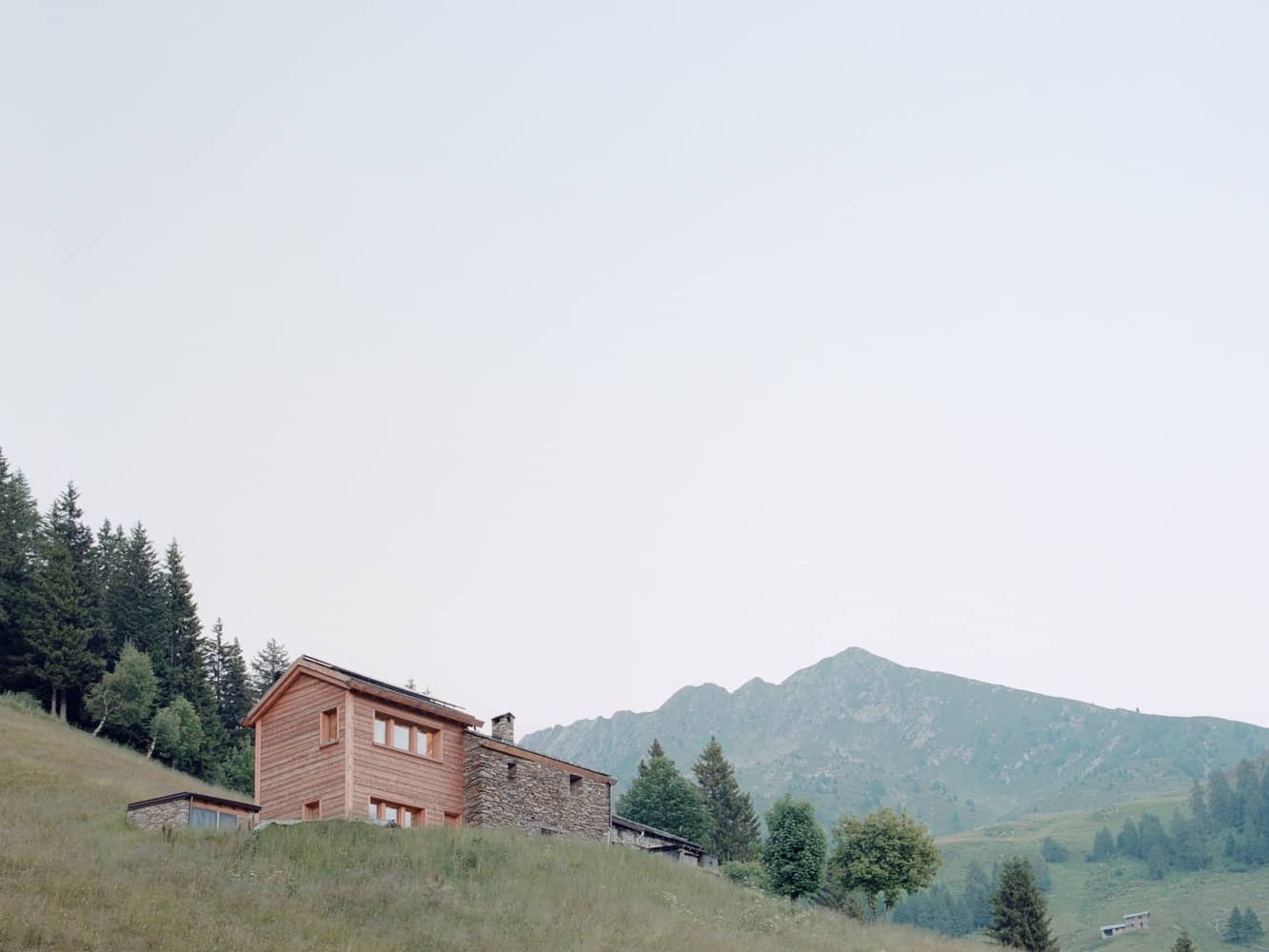
- Project: Baitridana Hut
- Architect: Rinaldo Del Nero
- Location: Italy, Albaredo per San Marco
- Year: 2022
- Photography: Marcello Mariana
A Dialogue Between Past and Present in the Italian Alps
Perched 1,900 meters above sea level in the Orobic Alps of Valtellina, Baitridana Hut by Rinaldo Del Nero is a poetic restoration project that redefines the relationship between heritage and modernity. While the structure was never officially listed as a historical site, its vernacular Alpine character—crafted from stone and time—embodies the rural legacy and architectural wisdom of generations past.
The architect’s vision was not to alter, but to revive: to safeguard the cultural soul of the building while reinterpreting its spatial and material narrative for contemporary use.
Concept & Design Philosophy
The restoration was guided by a simple but profound intent — to preserve authenticity while ensuring resilience. Rather than reconstructing the ruin, Del Nero sought to stabilize and reinforce it from within, inserting a new insulated wooden core that nestles inside the original stone shell.
“The project respects the past by allowing it to remain visible and tangible,” notes the architect. “The goal was not mimicry, but dialogue.”
This duality—old stone embracing new wood—forms the architectural essence of the project. The juxtaposition of permanence and renewal reveals a layered identity, where every surface tells a story of endurance and adaptation.
Composition & Spatial Experience
The restored hut is composed of two interconnected volumes:
-
The original stone structure, conserved and stabilized, housing the main living spaces.
-
A new contemporary extension, attached through a deliberate opening on the northwest façade.
This architectural “conversation” is both functional and symbolic. The extension provides additional living area and modern comfort, while visually contrasting with the ancient masonry through its larch-wood cladding and minimalist geometry.
The relationship between the two is intentionally explicit — past and present are never disguised. Instead, the extension’s sharp lines and warm tones highlight the rugged texture of the stone, celebrating both difference and harmony.
Del Nero describes this union metaphorically:
“It is like a young man supporting an old man — the new gives strength to the old, while the old gives meaning to the new.”
Materiality & Transformation Over Time
Material distinction is the project’s defining language.
-
The historic façade remains in local stone, rough and irregular, preserving its tactile authenticity.
-
The new volume, clad in untreated larch wood, stands in quiet contrast — bright and fresh at first, but destined to weather naturally into a silvery gray, merging gradually with the alpine landscape.
Inside, the wooden structure acts as a thermal envelope, ensuring energy efficiency and year-round usability. The contrast between cold stone and warm timber enhances the experiential quality of the space: raw yet refined, primitive yet contemporary.
Sustainability & Heritage Preservation
Though modest in scale, Baitridana Hut exemplifies sustainable adaptive reuse. Instead of consuming new land or resources, the project gives new life to an existing structure through reversible interventions and low-impact materials.
-
Reinforced envelope: improves thermal insulation and structural longevity.
-
Minimal intrusion: original foundations and façades retained.
-
Local materials: stone and timber sourced from the surrounding region.
-
Long-term sustainability: untreated wood requires no synthetic coatings and ages gracefully with time.
The restoration thus becomes a lesson in temporal sustainability—not merely environmental, but cultural.
A Timeless Alpine Revival
Baitridana Hut is more than a renovation; it is an act of cultural continuity. It reaffirms that architectural progress need not erase the past, but can instead build upon it—literally and symbolically.
By preserving the hut’s rugged identity and pairing it with a refined contemporary gesture, Rinaldo Del Nero crafts a structure that stands as a quiet manifesto: that memory, when cared for, can evolve without losing its soul.


