
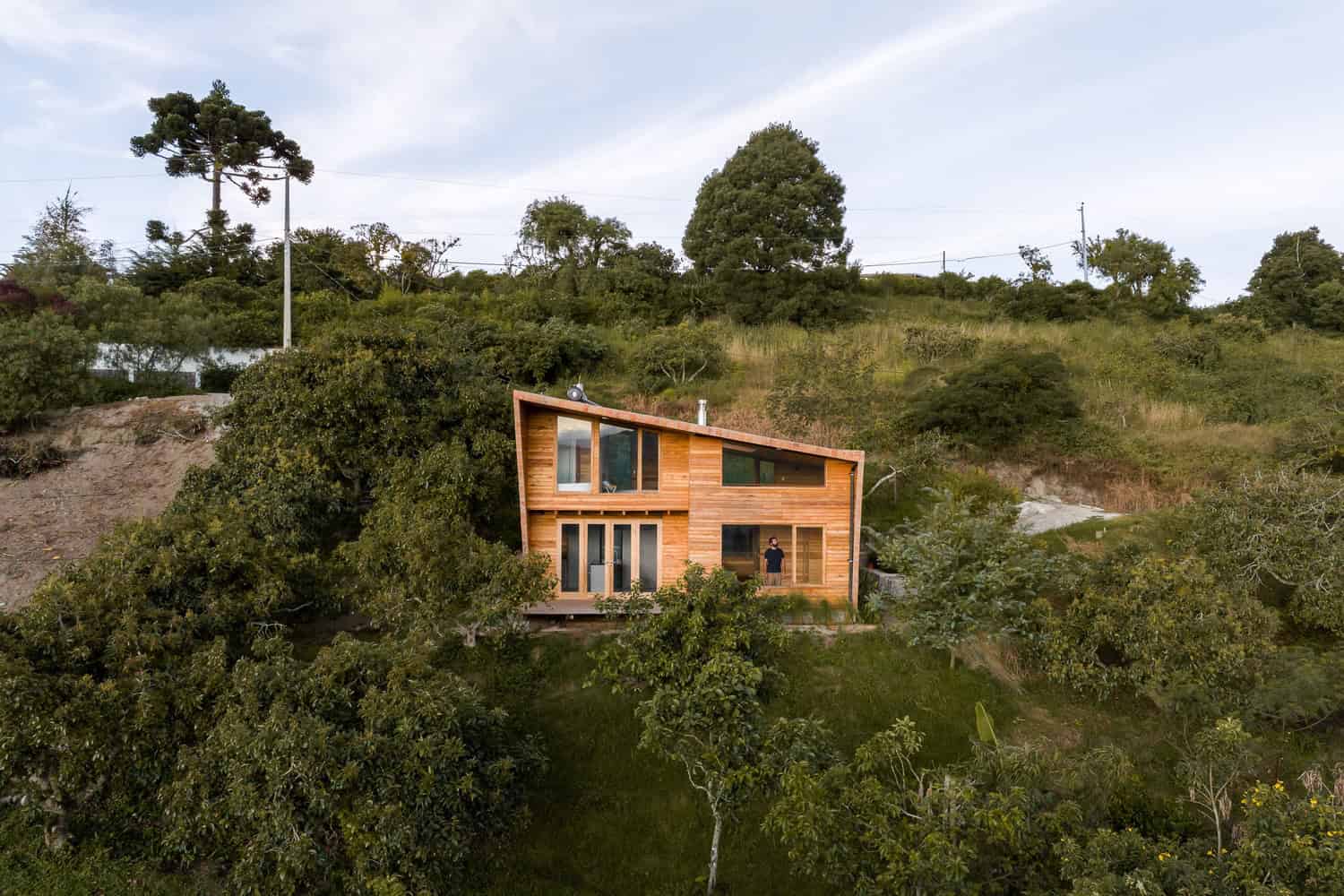
- Project: Perucho House
- Architect: El Sindicato Arquitectura
- Location: Ecuador, Perucho, Quito
- Year: 2023
- Area: 72 m2
- Photography: Francesco Russo, Andrés Villota
A Rural Haven Rooted in Simplicity
Tucked into the green mountains of Perucho, a rural parish on the outskirts of Quito, Perucho House is a celebration of modest living and contextual architecture. Designed by El Sindicato Arquitectura in collaboration with Pedro Calle, the 72 m² dwelling embodies the idea of retreat through simplicity, material honesty, and spatial precision.
It is a small house with a big presence — not because of its size, but because of the clarity with which it responds to its landscape and purpose.
The Spirit of Place
The site is defined by rolling hills, scattered trees, and panoramic views toward the Andes. The design begins with an understanding of this rural setting — quiet, slow, and deeply connected to the land. The architects envisioned a compact home that would provide refuge from urban life, framing the surrounding landscape while maintaining privacy from nearby properties.
Facing the public road, the house presents a discreet, almost closed façade. Yet toward the west, it opens dramatically with large windows and an outdoor deck, capturing the afternoon light and mountain views. The result is a home that balances enclosure and exposure — calm from the outside, open and expansive from within.
A Continuous Skin of Brick and Tile
The most striking feature of Perucho House is its continuous terracotta skin — a mantle of fired tile that wraps around walls and roof as a single surface. This unbroken envelope performs multiple roles: it acts as structure, protection, and identity.
From a distance, the house reads as a sculpted volume in warm earth tones, harmonizing with the surrounding soil and vegetation. The texture of the brick tiles catches the changing light, making the building appear alive throughout the day.
This idea of a uniform skin reinforces the notion of refuge. Just as traditional rural houses in Ecuador used clay, adobe, and tile to protect from sun and rain, the Perucho House reinterprets this logic with contemporary precision.
Compact Form, Expansive Feeling
Inside, the architecture unfolds in a straightforward yet thoughtful layout across two levels.
-
The ground floor houses the main social spaces — living area, kitchen, dining space, and a small bathroom — all connected to a covered terrace that extends living outdoors.
-
The upper floor holds private areas: a bedroom, workspace, and guest zone. Despite the compact footprint, the visual openness and strategic placement of openings give each room a generous sense of space.
Circulation is simple and direct. Vertical movement is emphasized through the visual continuity between floors, while large west-facing windows maintain a constant dialogue with the landscape.
Prefabrication and Material Logic
To build efficiently in a remote location, the structure was prefabricated using a solid wood frame system. This reduced construction time, minimized waste, and allowed precise detailing. The wood structure contrasts beautifully with the fired-tile exterior, creating a tactile balance between warmth and permanence.
The material palette is intentionally restrained: natural wood, clay tile, and neutral plaster define the space. Inside, the tone is serene and warm, allowing the focus to remain on the quality of light and the surrounding scenery.
Light, Shadow, and Privacy
The design carefully orchestrates light. On the western side, full-height glazing captures sunsets and frames the horizon, while the brick skin filters brightness on the more exposed elevations. Throughout the day, the interior evolves with the changing intensity of natural light — a dynamic that strengthens the emotional connection between the house and its environment.
At night, the house glows softly through its apertures, revealing its layered textures and warm wooden interiors. From the outside, it appears as a lantern in the rural landscape — subtle, grounded, and inviting.
Living with the Land
The landscape design is deliberately minimal. Stones from the site are reused for pathways and garden borders. Native vegetation grows freely around the house, merging the built form with its surroundings. The architects avoided artificial landscaping, allowing the local ecology to define the setting.
The passive design approach extends to climate performance. The thick tile-and-wood envelope ensures thermal stability, keeping interiors cool during the day and insulated at night. Cross-ventilation through operable windows eliminates the need for mechanical cooling.
Modesty as a Design Principle
Perucho House embodies a philosophy of restraint. Rather than trying to impress, it seeks to belong. Its modest size is an expression of sustainability, not limitation. Every detail — from the rhythmic brick pattern to the precise roof slope — reflects the architects’ commitment to clarity and proportion.
In an age where excess often defines modern architecture, this project reminds us that refinement comes from reduction. The result is a home that feels timeless — rural yet modern, compact yet generous, humble yet undeniably architectural.
Architecture as Shelter, Not Statement
What makes Perucho House remarkable is its quiet confidence. It does not compete with its environment; it becomes part of it. The architects have translated the spirit of Ecuador’s rural vernacular into a refined architectural language — one that values craft, landscape, and human scale.
This is not a house designed for spectacle; it is designed for living. It represents a vision of architecture as shelter, where materials age gracefully and the passage of time adds beauty rather than decay.
Perucho House is a poetic example of small-scale architecture achieving emotional depth through honesty and context. The collaboration between El Sindicato Arquitectura and Pedro Calle results in a residence that is tactile, balanced, and deeply rooted in its place.
It is a project that demonstrates how thoughtful design can transform minimal resources into maximum experience — a home that breathes with its surroundings, offering tranquility in both spirit and form.


