
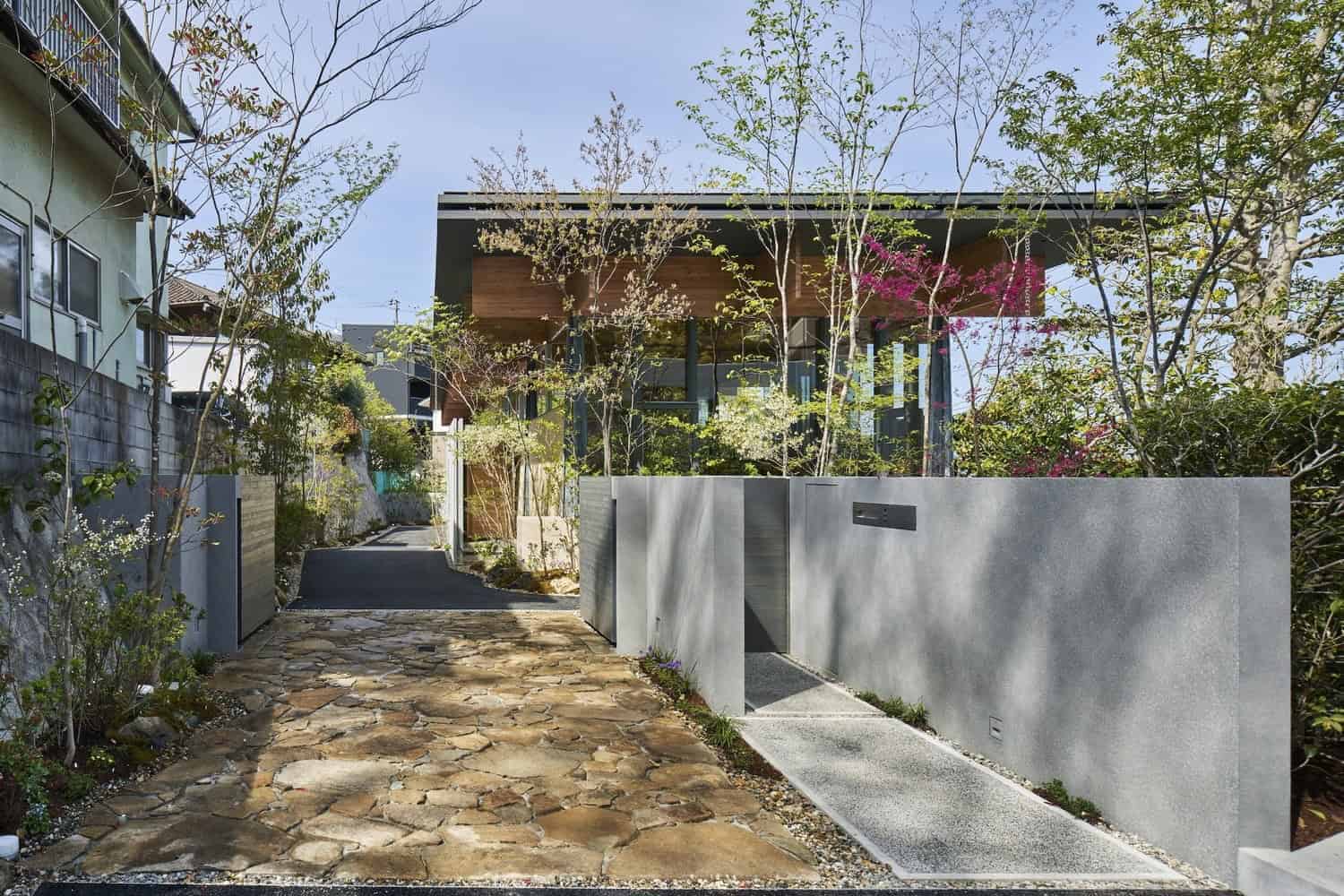
- Project: KNIT House
- Architect: UID Architects
- Location: Japan, Nagano
- Year: 2021
- Area: 233 m2
- Photography: Koji Fujii / TOREAL
Perched on a sloping site in Nagano, KNIT House by UID Architects is a residence that embraces the complexities of its environment. Designed for a plot that stretches from the mountainside to the base, the house responds to both its natural surroundings and the urban intrusions of nearby condominiums. The result is a home that feels simultaneously protective and expansive, weaving together structure, landscape, and light.
Responding to Site Challenges
The site’s southern edge faces a cluster of incongruous high-rise condominiums, obstructing natural light and privacy. In contrast, the eastern side overlooks a river, city, and distant mountains. This duality guided the design approach: shelter from the south and openness to the east. By using sectional planning and microtopography as key tools, UID Architects conceived a three-dimensional composition that grounds the building in its terrain.
A Roof That Weaves Structure and Space
At the heart of the design is an expansive laminated timber roof woven in a 2,700 mm grid pattern. Measuring 1,000 mm by 64 mm, these beams form a flat yet rigid canopy supported by six cross-shaped steel pillars. This roof structure becomes both protective and connective, uniting the house beneath a singular, dominant plane.
The roof’s strength allows for a series of interior floor levels arranged at varying heights, producing a range of spatial experiences. Spaces shift from extroverted, light-filled areas that open to views of the river and mountains, to more introverted zones oriented inward for privacy.
Layered Spatial Experiences
Rather than a single flat level, the house unfolds across multiple platforms that follow the site’s slope. These subtle shifts in elevation enrich circulation and daily experience, encouraging occupants to engage with both the building and its natural setting. The changing levels create visual depth and frame specific perspectives of the surrounding landscape.
Integration with Nature
UID Architects’ goal was to restore the relationship between people, architecture, and environment. By carefully decoding the site’s topography, the design integrates greenery, views, and daylight into the home. Large windows open toward the east, capturing mountain vistas, while the roof and structural elements shield the house from intrusive southern views.
A Contemporary Japanese House in Harmony
KNIT House exemplifies a contemporary Japanese approach to architecture: rooted in material honesty, sensitive to environment, and rich in spatial complexity. Its interplay of timber, steel, and landscape creates a dwelling that is both grounded and uplifting. For its inhabitants, it is more than a home—it is a crafted framework for living with nature.


