
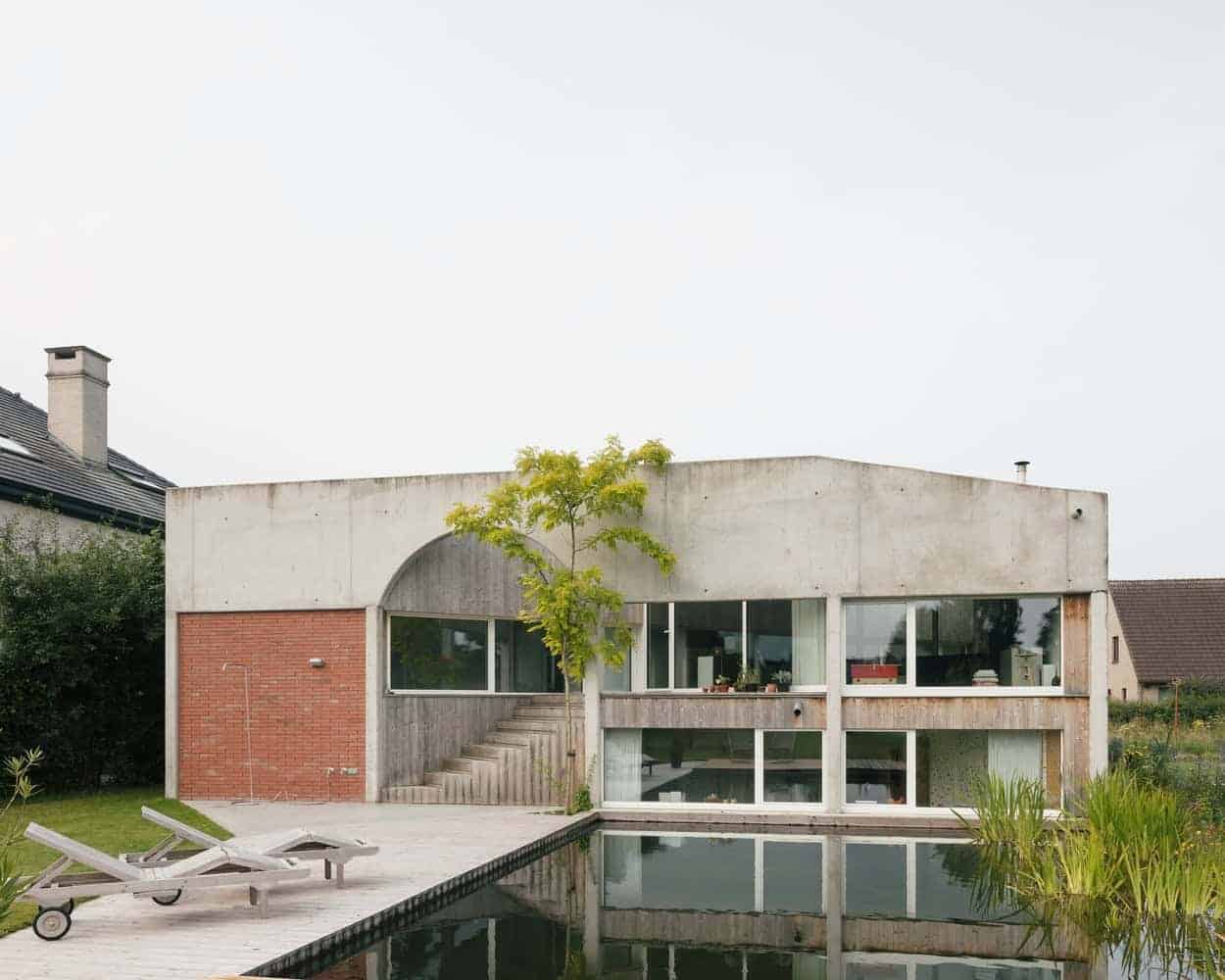
- Project: House hkZ
- Architect: BLAF Architecten
- Location: Belgium, Zoersel
- Year: 2020
- Area: 200 m2
- Photography: Stijn Bollaert
Redefining the Single-Family Home
In Zoersel, Belgium, BLAF Architecten designed House hkZ as both a residence and an exploration of pressing issues in spatial planning, sustainability, affordability, and housing. Completed in 2020, the 2,152-square-foot home stands out through its innovative concrete grid framework, which defines a strong architectural boundary while maintaining openness and transparency to the surrounding green context.
The Concrete Grid Structure
The home’s footprint includes the heated residential volume as well as private outdoor spaces, all contained within a rhythmic grid of concrete piers and a ring beam. This structure outlines a clear figure in the landscape without resorting to fences or parcel divisions. Enclosed and open zones alternate seamlessly, producing a flexible boundary that preserves the natural relief of the site.
Within this grid, facades shift between masonry, timber, and glass, creating a balance between solidity and transparency. Angled glazed walls open the home to multiple perspectives, while wooden cladding on the south-facing side reduces overheating, optimizing both comfort and energy performance.
Orientation and Energy Logic
Spaces are carefully planned according to orientation and environmental logic.
-
Ground floor: living areas, parents’ bedroom, kitchen, and essential facilities, enabling lifelong occupation.
-
Semi-underground level: children’s bedrooms, oriented to garden views, benefiting from stable temperatures and reducing energy demand.
This strategic arrangement maximizes daylight, ventilation, and thermal efficiency, showcasing BLAF’s commitment to sustainable performance beyond energy metrics.
Indoor-Outdoor Interplay
A hallmark of House hkZ is the integration of “outside rooms” that fold from the structural grid into the residence. These sheltered spaces blur the boundary between interior and exterior, providing transitional areas that extend living zones into the garden.
Minimal paved surfaces—restricted to a permeable access path and car lanes—preserve the natural character of the plot. The design ensures that the home remains embedded in its green surroundings, avoiding unnecessary disruption to the landscape.
Sustainability as a Design Philosophy
House hkZ reflects BLAF Architecten’s vision of architecture as a response to increasingly complex housing challenges. By experimenting with the genetic model of the single-family home, the project balances circularity, affordability, and ecological responsibility. The result is a house that is both innovative and deeply contextual, designed not as an isolated object but as a dialogue with its site and society.


