
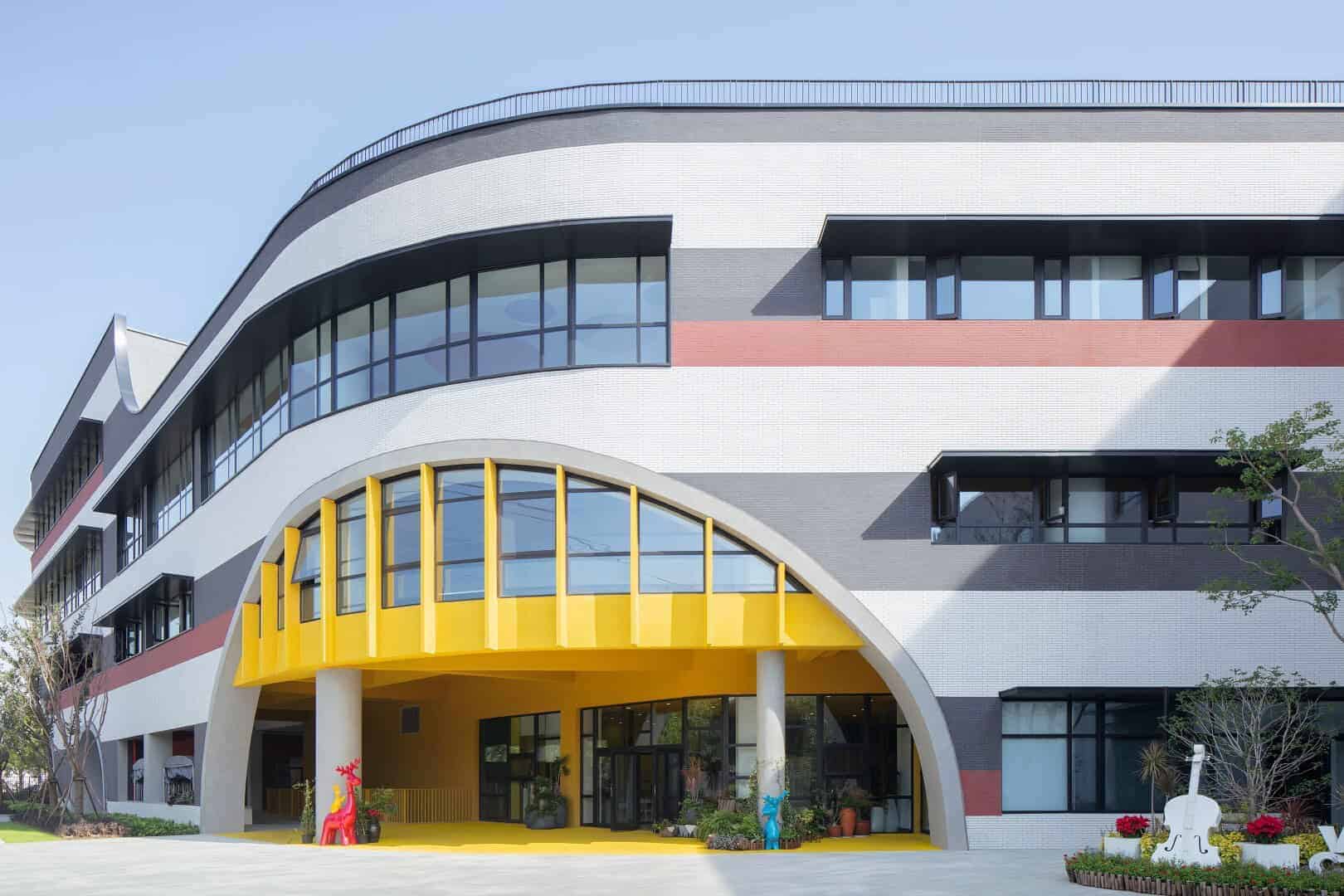
Tianyou Experimental Primary School | BAU – Brearley Architects & Urbanists | Suzhou, China

  • Project: Tianyou Experimental Primary School
  • Architect: BAU Brearley Architects + Urbanists
  • Location: China, Suzhou New District, Suzhou, Jiangsu
  • Year: 2021
  • Area: 67760 m2
  • Photography: Courtesy of BAU – Brearley Architects & Urbanists

A New Model for Learning Environments in Suzhou

In the rapidly urbanizing fringe of Suzhou’s New District, BAU – Brearley Architects & Urbanists was commissioned through an invited competition to design a combined 24-class kindergarten and 48-class primary school. The result is Tianyou Experimental Primary School — a forward-thinking educational complex that challenges traditional school design by transforming both classrooms and circulation spaces into interactive learning landscapes.

This project redefines how architecture can foster curiosity, creativity, and collaboration in modern education.

Blurring the Line Between Formal and Informal Learning

BAU’s design begins with a fundamental question: What if every corner of a school could become a space for learning?
The architecture dissolves the rigid boundary between formal classrooms and informal “in-between” zones, creating an environment where learning happens everywhere — in corridors, courtyards, and even under staircases.

Wide, meandering internal corridors act as “learning beams”, replacing traditional hallways with generous, flexible spaces for group activities, exhibitions, and impromptu discussions. These informal areas flow seamlessly into classrooms, inviting students to engage in collaborative and self-directed learning.

A Compact Site Reimagined

Unlike BAU’s earlier campus projects that placed discrete buildings in open landscapes, this smaller, denser site demanded a reversal of figure and ground.
Here, open spaces are carved out of a solid architectural podium, resulting in a composition that resembles a series of gardens, courtyards, and terraces framed by a continuous built edge.

The design extracts key outdoor programs — sports grounds, playgrounds, and green rings — from the podium mass, leaving behind a continuous “beam” of interconnected learning spaces. This concept turns the compact site into a dynamic topography of movement, light, and discovery.

The Classroom as a Flexible Framework

Six sun-oriented “regular beams” house the formal teaching zones. Within each pair of classrooms, BAU introduces a glass-walled breakout room for small-group collaboration — a space that bridges independence and supervision.

This dual system — structured classrooms within a fluid, interactive framework — encourages both concentration and creativity. Teachers can guide teams without isolating them from the collective learning environment.

The contrast between the meandering informal beam and the linear classroom beams is both spatial and material, visually articulating the balance between play and structure that defines the school’s educational philosophy.

Learning from the Chinese Garden

Working with Chinese classical-garden scholar Craig Easton, BAU infused the project with a subtle layer of local cultural geometry and symbolism.
Through techniques of framing, layering, scaling, and wrapping, the design references Suzhou’s historic gardens — reinterpreting their poetic spatial qualities within a contemporary educational context.

The result is a campus that feels both deeply rooted in place and forward-looking, merging the sensory richness of traditional Chinese landscapes with the fluidity of modern pedagogy.

The Kindergarten: Five Gardens of Discovery

The kindergarten portion of the complex celebrates the true meaning of “children’s garden.”
BAU designed five themed gardens, each stimulating different aspects of development:

  • 🌿 Imagination Garden: A space for dreaming, performing, and storytelling.

  • 🧗 Muscle Garden: For climbing, swinging, sliding, and jumping — encouraging physical expression.

  • 🌾 Nature Garden: A sensory landscape for digging, planting, and exploring.

  • 🛠️ Work Garden: A practical environment for sweeping, shoveling, and organizing.

  • 🌸 Garden of the Senses: An immersive garden of fragrance, sound, texture, and taste.

Together, these landscapes form a pedagogical ecosystem — nurturing emotional, physical, and intellectual growth.

Past, Present, and Future

Tianyou Experimental Primary School demonstrates how ancient spatial models and progressive educational theories can coexist in harmony.
By combining cultural abstraction with contemporary flexibility, BAU has created a prototype for future schools — one that transforms the built environment into a continuous, evolving classroom.

This is not just a building for learning; it’s a living framework for imagination, play, and lifelong curiosity.

Colorful modern building with curved architectural design, large glass windows, and vibrant yellow accents, exemplifying innovative architecture and contemporary design elements.
Photography © Courtesy of BAU – Brearley Architects & Urbanists
Tianyou Experimental Primary School | BAU – Brearley Architects & Urbanists | Suzhou, China
Photography © Courtesy of BAU – Brearley Architects & Urbanists
Tianyou Experimental Primary School | BAU – Brearley Architects & Urbanists | Suzhou, China
Photography © Courtesy of BAU – Brearley Architects & Urbanists
Tianyou Experimental Primary School | BAU – Brearley Architects & Urbanists | Suzhou, China
Photography © Courtesy of BAU – Brearley Architects & Urbanists
Tianyou Experimental Primary School | BAU – Brearley Architects & Urbanists | Suzhou, China
Photography © Courtesy of BAU – Brearley Architects & Urbanists
Tianyou Experimental Primary School | BAU – Brearley Architects & Urbanists | Suzhou, China
Photography © Courtesy of BAU – Brearley Architects & Urbanists
Tianyou Experimental Primary School | BAU – Brearley Architects & Urbanists | Suzhou, China
Photography © Courtesy of BAU – Brearley Architects & Urbanists
Tianyou Experimental Primary School | BAU – Brearley Architects & Urbanists | Suzhou, China
Photography © Courtesy of BAU – Brearley Architects & Urbanists
Tianyou Experimental Primary School | BAU – Brearley Architects & Urbanists | Suzhou, China
Photography © Courtesy of BAU – Brearley Architects & Urbanists
Tianyou Experimental Primary School | BAU – Brearley Architects & Urbanists | Suzhou, China
Photography © Courtesy of BAU – Brearley Architects & Urbanists
Tianyou Experimental Primary School | BAU – Brearley Architects & Urbanists | Suzhou, China
Photography © Courtesy of BAU – Brearley Architects & Urbanists
Tianyou Experimental Primary School | BAU – Brearley Architects & Urbanists | Suzhou, China
Photography © Courtesy of BAU – Brearley Architects & Urbanists
Tianyou Experimental Primary School | BAU – Brearley Architects & Urbanists | Suzhou, China
Photography © Courtesy of BAU – Brearley Architects & Urbanists
Tianyou Experimental Primary School | BAU – Brearley Architects & Urbanists | Suzhou, China
Photography © Courtesy of BAU – Brearley Architects & Urbanists
Tianyou Experimental Primary School | BAU – Brearley Architects & Urbanists | Suzhou, China
Photography © Courtesy of BAU – Brearley Architects & Urbanists
Tianyou Experimental Primary School | BAU – Brearley Architects & Urbanists | Suzhou, China
Photography © Courtesy of BAU – Brearley Architects & Urbanists
Tianyou Experimental Primary School | BAU – Brearley Architects & Urbanists | Suzhou, China
Photography © Courtesy of BAU – Brearley Architects & Urbanists
Tianyou Experimental Primary School | BAU – Brearley Architects & Urbanists | Suzhou, China
Photography © Courtesy of BAU – Brearley Architects & Urbanists
Tianyou Experimental Primary School | BAU – Brearley Architects & Urbanists | Suzhou, China
Photography © Courtesy of BAU – Brearley Architects & Urbanists
Tianyou Experimental Primary School | BAU – Brearley Architects & Urbanists | Suzhou, China
Photography © Courtesy of BAU – Brearley Architects & Urbanists
Tianyou Experimental Primary School | BAU – Brearley Architects & Urbanists | Suzhou, China
Photography © Courtesy of BAU – Brearley Architects & Urbanists
Tianyou Experimental Primary School | BAU – Brearley Architects & Urbanists | Suzhou, China
Photography © Courtesy of BAU – Brearley Architects & Urbanists
Tianyou Experimental Primary School | BAU – Brearley Architects & Urbanists | Suzhou, China
Photography © Courtesy of BAU – Brearley Architects & Urbanists

Drawings

Tianyou Experimental Primary School | BAU – Brearley Architects & Urbanists | Suzhou, China

Posted by BAU Brearley Architects + Urbanists

BAU (Brearley Architects + Urbanists) is a multidisciplinary studio headquartered in Melbourne with an additional office in Shanghai. Established in 1992, the practice combines architecture, urban design, planning, and landscape architecture under a unified, research-informed approach. BAU draws on both Eastern and Western philosophies to develop creative, context-sensitive solutions that are environmentally, socially, and economically sustainable. The firm’s work spans public, cultural, commercial, and residential projects, often engaging with complex urban issues to produce designs that engage users, enrich place, and elicit unexpected synergies. Through thorough site analysis, iterative research, and integrative design strategies, BAU aims to deliver built environments that resonate across scales and communities.