
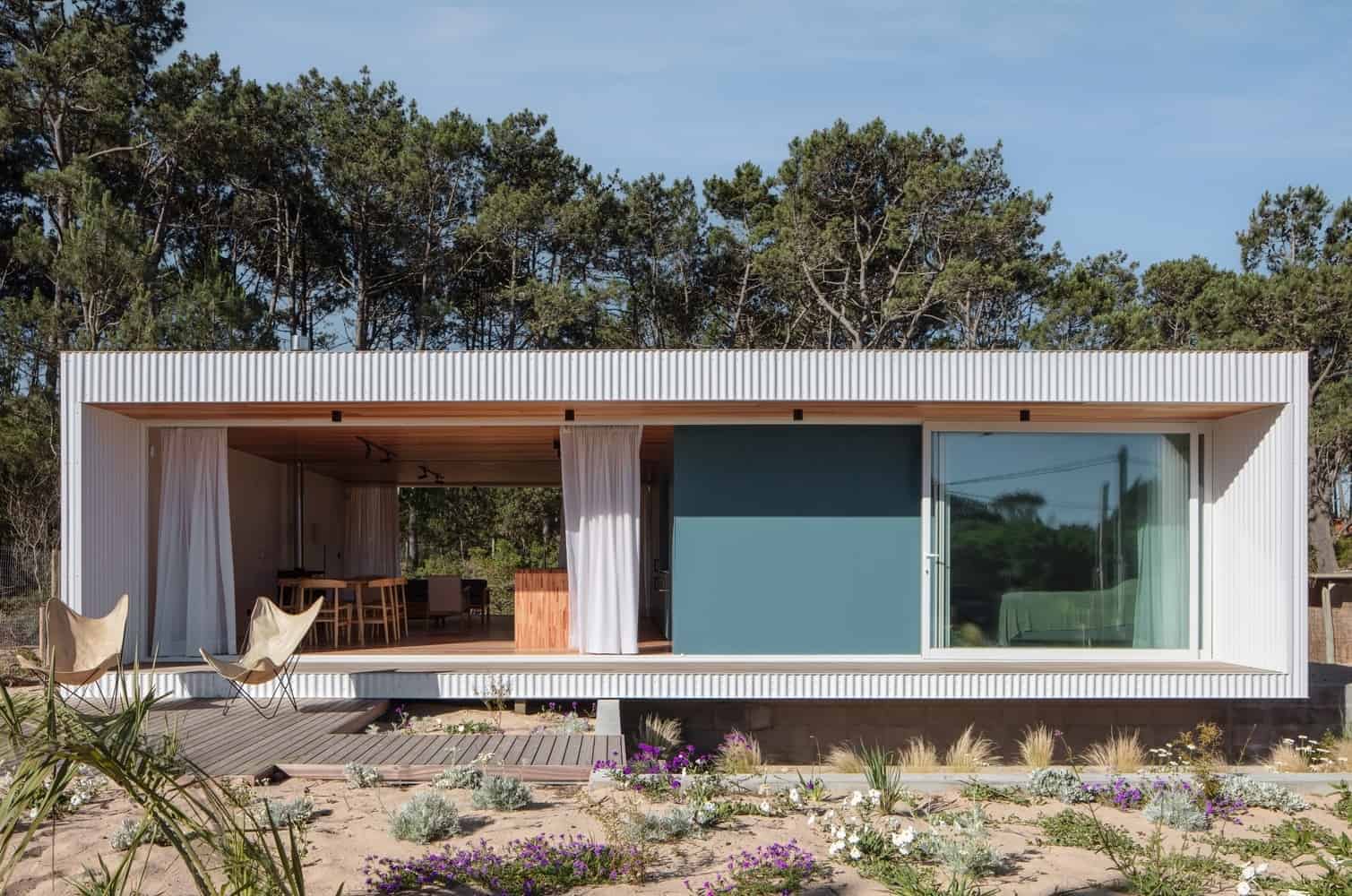
- Project: Trica House
- Architect: iHouse
- Location: Uruguay, Chihuahua
- Year: 2023
- Area: 114 m2
- Photography: Aldo Lanzi
A Modular Coastal Retreat Built Entirely Through Video Calls
When a Uruguayan client living in Australia decided to build a vacation home in his homeland, distance became both the challenge and inspiration. Designed and constructed entirely through virtual collaboration, Trica House by iHouse estudio embodies the future of architecture — where technology, sustainability, and design precision unite across continents.
Set in Chihuahua, a rapidly evolving coastal town in the Maldonado Department, the residence is both a modern prefabricated dwelling and a sensitive response to nature. Without disturbing the native topography or vegetation, the home was conceived to merge minimal intervention with maximum efficiency, ensuring it would be completed — move-in ready — upon the owner’s arrival from across the world.
Concept & Remote Collaboration
The brief was clear: design and build a vacation retreat that feels deeply connected to the outdoors, employs environmentally conscious construction, and respects the rugged coastal landscape. The twist — it all had to be done remotely.
Every phase — from design conceptualization to final detailing — was conducted via video conferencing, making Trica House an example of digital-era architectural collaboration.
To address the challenges of executing a project 120 kilometers away from the construction site, the architects turned to factory-built modular construction, a method that ensures precision, consistency, and speed while minimizing waste and environmental impact.
Design & Spatial Organization
The house consists of two symmetrical prefabricated modules, joined along their longest sides to form a rectangular prism. This simple yet refined composition defines both the structural logic and the aesthetic identity of the residence.
Inside, the plan is organized along dual symmetry axes, creating a balance between order and openness:
-
The central block separates social areas (living, dining, kitchen) from private zones (bedrooms and bathrooms).
-
The short and lateral façades remain mostly solid, ensuring privacy and protection from prevailing winds.
-
The long façades are glazed, opening fully toward the landscape and extending the interior into nature.
The result is a compact but spacious home that feels light, transparent, and deeply integrated with its environment.
Modular Construction & Efficiency
Trica House was built using prefabricated steel-frame modules manufactured under controlled factory conditions. This off-site construction process guaranteed:
-
Consistent quality control, unaffected by weather or on-site variability.
-
Rapid assembly, with on-site installation completed in less than one week.
-
Reduced material waste and lower carbon footprint compared to conventional building.
The prefabrication approach also allowed the design to minimize ground disturbance, preserving the site’s natural contours and flora. Every component — from cladding to joinery — was engineered to ensure precision fit and structural longevity.
Materiality & Atmosphere
The architectural expression of Trica House blends simplicity, clarity, and texture.
-
The exterior combines metallic panels and neutral tones, echoing the coastal hues of sand and rock.
-
Inside, natural woods and clean surfaces create a sense of warmth and tranquility, in contrast to the robust exterior shell.
-
Large sliding glass panels blur the line between indoor and outdoor life, inviting the sea breeze and natural light to animate the interiors.
The overall experience is one of calm modernity — a space where design and landscape coexist without competition.
Sustainability & Environmental Response
From its earliest conception, Trica House was envisioned as an eco-efficient coastal dwelling.
-
Its modular fabrication minimized waste and transportation emissions.
-
The home’s compact footprint preserves much of the site’s vegetation and natural permeability.
-
Passive design strategies — including cross-ventilation, solar orientation, and insulated paneling — ensure comfort with minimal energy use.
This conscious design approach positions the residence as a model for environmentally responsible prefabricated housing in Uruguay’s growing coastal regions.
Trica House by iHouse estudio demonstrates how architecture, technology, and environmental respect can converge to create meaningful living spaces, even across continents.
What began as a digital experiment became a built testament to efficiency, sustainability, and connection to place — a home that arrived ready, yet feels timeless in its setting.
It stands as proof that the future of architecture lies not only in innovation, but in human-centered adaptability, where design responds seamlessly to both global challenges and personal dreams.


