
Passive House by Mareines Arquitetura: A Self-Sustaining Retreat in Brazil’s Backlands

  • Project: Passive House
  • Architect: Mareines Arquitetura
  • Location: Brazil, Interior São Paulo
  • Year: 2024
  • Area: 1350 m2
  • Photography: Leonardo Finotti

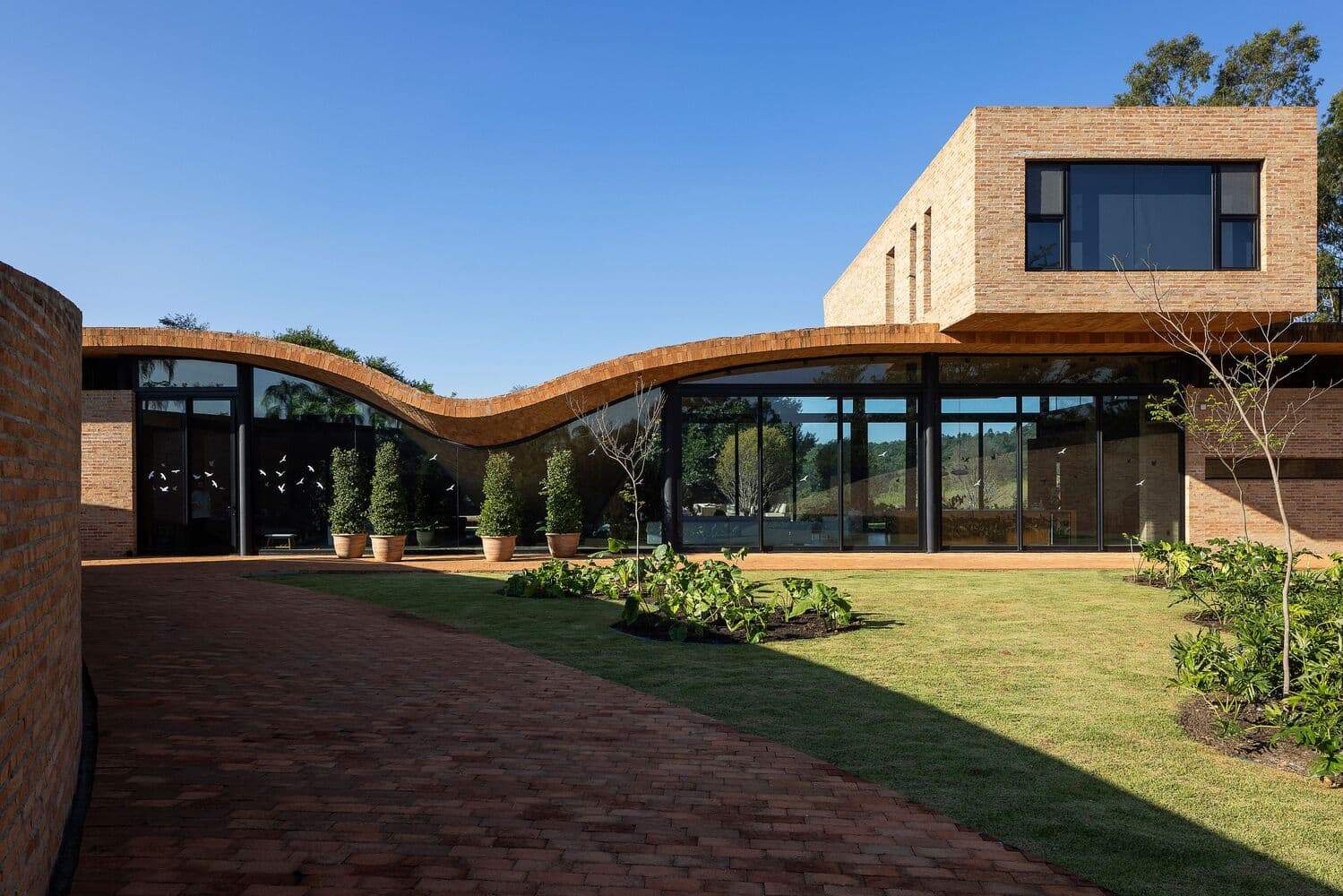
Built during the pandemic, Passive House by Mareines Arquitetura is an ambitious expression of autonomous, nature-rooted living. Located in a reforested plot in the interior of São Paulo, the residence combines high-performance energy standards with lush landscaping and architectural calm. The result is a house that disappears into its forest setting while operating close to net zero in energy use.

This is not just a sustainable home—it’s a manifesto for a slower, more deliberate life.

Context & Vision: Reforesting the Land, Reclaiming Simplicity

Mareines Arquitetura and Vistara Landscape Architecture collaborated to reforest the original site, planting native species to reestablish ecological richness. The design is not about making a dramatic sculptural gesture, but about integrating quietly with the landscape—so much so that from a distance the home is almost camouflaged by trees.

The idea emerged during lockdowns, as the architects and clients sought a retreat away from urban pressures. The brief was simple: live lightly, live well. Passive House is the architectural realization of that ideal.

Passive House Principles in a Brazilian Climate

While the Passive House standard originated in cold climates, Mareines adapts it for Brazil’s interior conditions with a climate-responsive approach:

  • Compact massing and orientation to reduce unwanted solar heat gain, while capturing cooling breezes.

  • Superinsulation and thermal breaks to maintain thermal stability.

  • High-performance glazing and envelope sealing to minimize thermal losses and maximize airtightness.

  • Balanced mechanical ventilation with heat recovery to ensure fresh air without energy penalty.

  • Landscape shading and reforestation to buffer microclimate extremes and soften solar exposure.

In short: every element of the home is integrated into its energy strategy.

Spatial Organization & Zoning

Passive House is arranged across three principal volumes, with interior layout responding to microclimates and programmatic needs:

  • Private wing: bedrooms and quieter rooms placed away from solar exposure.

  • Social core: living, dining, and kitchen arranged to open toward gardens and terraces, with controlled exposure and overhangs.

  • Service & support: garages, utilities, and storage are tucked into the building mass, buffered from view yet functionally accessible.

Each zone is insulated from the others, allowing independent control and optimization, so the house can adapt to varying occupancy or seasonal use.

Materiality, Expression & Warmth

Mareines uses a restrained palette: exposed concrete, brick, wood, and generous glazing. These aren’t decorative afterthoughts—they are part of the sustainable logic:

  • Concrete and brick provide thermal mass, storing coolness or warmth and moderating internal swings.

  • Wood accents soften the aesthetic, linking interiors to the forest outside.

  • Glass surfaces are optimized with deep shading, low-emissivity coatings, and precision framing to control light and climate.

Inside, beams and structural elements are exposed rather than hidden—celebrated rather than disguised. The home reads as honest, not ornamental.

Indoor-Outdoor Continuity

One of the most compelling aspects is how interior and exterior interlock:

  • Terraces, courtyards, and green edges wrap the house, creating transitional zones rather than hard walls.

  • Large sliding doors open the social core to gardens, merging inside and outside during temperate seasons.

  • Strategic landscaping ensures that views are framed and solar access is balanced—trees help shade in summer and allow light in winter.

This blurred boundary supports both comfort and connection to nature.

Comfort, Performance & Autonomy

Passive House is designed to require minimal mechanical input:

  • Even in extreme conditions, heating or cooling demand should be modest.

  • Ventilation systems recover heat and preserve indoor air quality.

  • The landscape and building envelope act as a buffer against external extremes.

  • The home can be managed in low-energy modes during periods of absence.

In short: the house is a machine for comfortable living, but one that breathes, pulses, and rests like an organism.

Why This Project Elevates the Standard

  • It demonstrates how Passive House can be adapted to tropical or subtropical climates, not just cold ones.

  • It is not flashy—but that is its strength. The architecture is durable, serene, and consistent in both form and performance.

  • It’s a holistic work: reforestation, structure, landscape, energy strategy, and interior life are unified.

  • It gives a modern answer to the tension between nature and home, showing you don’t have to dominate the land—you can live lightly.

Passive House by Mareines Arquitetura swimming pool roof view São Paulo Brazil
Photography © Leonardo Finotti
Passive House by Mareines Arquitetura curved roof pool São Paulo Brazil
Photography © Leonardo Finotti
Passive House by Mareines Arquitetura aerial top view São Paulo Brazil
Photography © Leonardo Finotti
Passive House by Mareines Arquitetura aerial overview São Paulo Brazil
Photography © Leonardo Finotti
Passive House by Mareines Arquitetura front facade São Paulo Brazil
Photography © Leonardo Finotti
Passive House by Mareines Arquitetura pool courtyard São Paulo Brazil
Photography © Leonardo Finotti
Passive House by Mareines Arquitetura garden view São Paulo Brazil
Photography © Leonardo Finotti
Passive House by Mareines Arquitetura curved wall São Paulo Brazil
Photography © Leonardo Finotti
Passive House by Mareines Arquitetura terrace view São Paulo Brazil
Photography © Leonardo Finotti
Passive House by Mareines Arquitetura garden seating São Paulo Brazil
Photography © Leonardo Finotti
Contemporary modern house with unique curved brick architecture and an outdoor pool, surrounded by potted plants and lush greenery, showcasing innovative design and stylish outdoor living spaces.
Photography © Leonardo Finotti
Passive House pool and cantilevered brick volume in São Paulo, Brazil
Photography © Leonardo Finotti
Passive House garden view with cantilevered upper volume, São Paulo, Brazil
Photography © Leonardo Finotti
Passive House courtyard elevation with wave roof and glazing, São Paulo, Brazil
Photography © Leonardo Finotti
Passive House brick walkway and courtyard garden, São Paulo, Brazil
Photography © Leonardo Finotti
Passive House wave-shaped brick roof over courtyard, São Paulo, Brazil
Photography © Leonardo Finotti
Passive House living room with panoramic glazing to garden, São Paulo, Brazil
Photography © Leonardo Finotti
Passive House interior beneath sculptural brick vault, São Paulo, Brazil
Photography © Leonardo Finotti
Passive House front with cantilevered upper volume, São Paulo, Brazil
Photography © Leonardo Finotti
Passive House interior stair with perforated metal screen, São Paulo, Brazil
Photography © Leonardo Finotti

Passive House by Mareines Arquitetura: A Self-Sustaining Retreat in Brazil’s Backlands Passive House by Mareines Arquitetura: A Self-Sustaining Retreat in Brazil’s Backlands Passive House by Mareines Arquitetura: A Self-Sustaining Retreat in Brazil’s Backlands Passive House by Mareines Arquitetura: A Self-Sustaining Retreat in Brazil’s Backlands Passive House by Mareines Arquitetura: A Self-Sustaining Retreat in Brazil’s Backlands

Passive House by Mareines Arquitetura: A Self-Sustaining Retreat in Brazil’s Backlands Passive House by Mareines Arquitetura: A Self-Sustaining Retreat in Brazil’s Backlands Passive House by Mareines Arquitetura: A Self-Sustaining Retreat in Brazil’s Backlands Passive House by Mareines Arquitetura: A Self-Sustaining Retreat in Brazil’s Backlands Passive House by Mareines Arquitetura: A Self-Sustaining Retreat in Brazil’s Backlands
Passive House by Mareines Arquitetura: A Self-Sustaining Retreat in Brazil’s Backlands Passive House by Mareines Arquitetura: A Self-Sustaining Retreat in Brazil’s Backlands Passive House by Mareines Arquitetura: A Self-Sustaining Retreat in Brazil’s Backlands Contemporary modern house with unique curved brick architecture and an outdoor pool, surrounded by potted plants and lush greenery, showcasing innovative design and stylish outdoor living spaces. Passive House by Mareines Arquitetura: A Self-Sustaining Retreat in Brazil’s Backlands
Contemporary house architectural elevation with curved roof and extensive glass windows, surrounded by greenery, detailed in modern architectural style. Passive House by Mareines Arquitetura: A Self-Sustaining Retreat in Brazil’s Backlands Passive House by Mareines Arquitetura: A Self-Sustaining Retreat in Brazil’s Backlands Passive House by Mareines Arquitetura: A Self-Sustaining Retreat in Brazil’s Backlands

Posted by Mareines Arquitetura

Mareines Arquitetura is a Brazilian architecture and urbanism studio based in Rio de Janeiro. The firm embraces organic design, technological sensitivity, and eco-efficient strategies to forge harmonious relationships between nature, people, and built form. Rejecting formulaic solutions, each project is approached as a unique challenge, with emphasis on sustainability, context, and poetic expression. Leadership includes founding architect Ivo Mareines and partner Matthieu Van Beneden, steering the practice toward both local and international impact.