
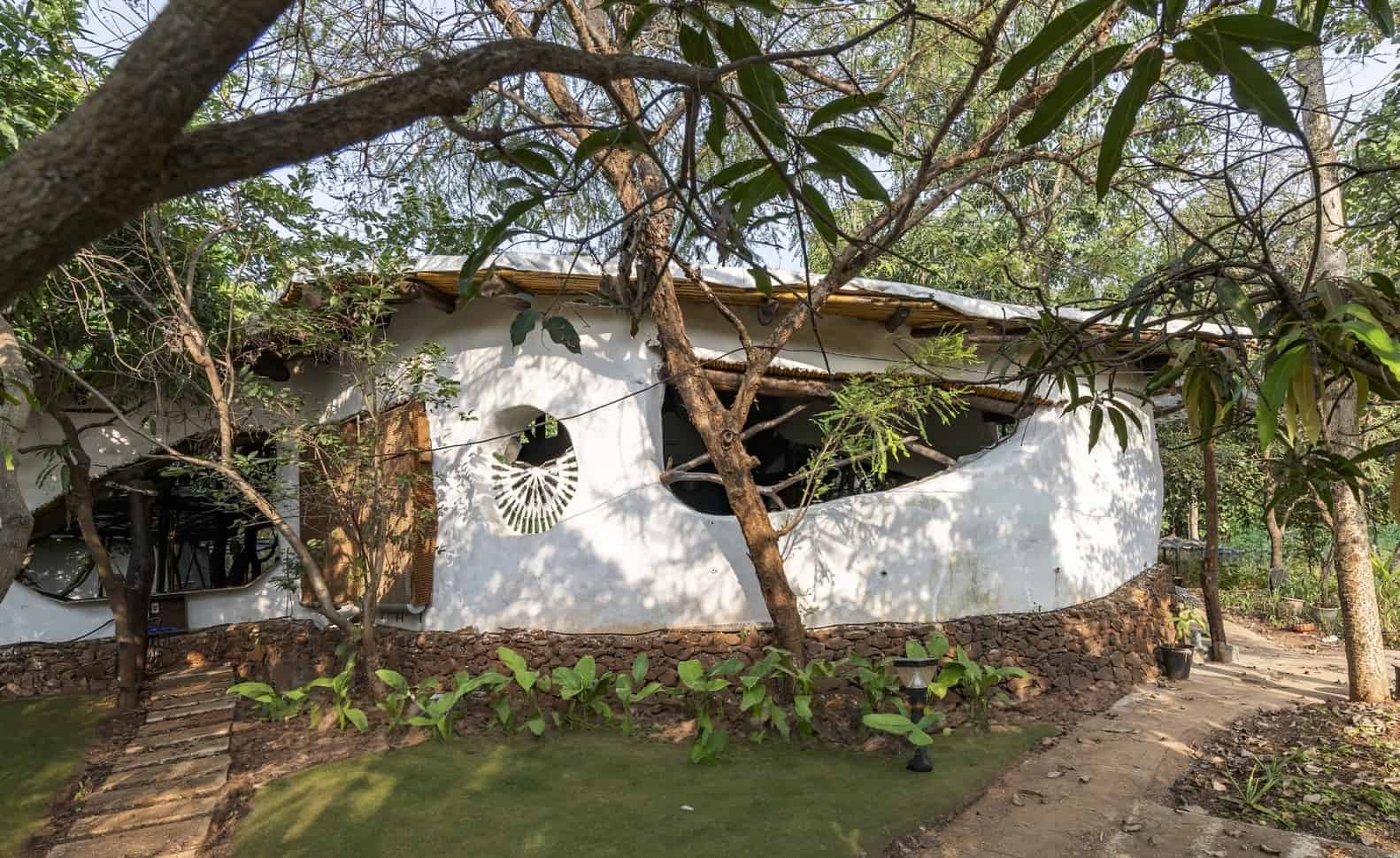
- Project: Maativan Farmhouse
- Architect: Blurring Boundaries
- Location: India, Mumbai
- Year: 2023
- Area: 557 m2
- Photography: Inclined Studio
Maativan Farmhouse by Blurring Boundaries emerges as a living poem where architecture, material, and nature converge. On the edge of the Tansa Reserved Forest near Mumbai, this 557 m² retreat is conceived as a biophilic haven built from earth, among trees—honoring the forest rather than dominating it.

This is not an object placed in the forest but a forest in architecture. Curved walls, courtyards, natural light, and layered textures produce an immersive, atmospheric experience of dwelling within nature.
Concept & Spatial Flow
The design is led by organic form, material memory, and ecological dialogue. Spaces undulate with sinuous masonry, pathways wind gently, and existing trees anchor the plan. Rather than forcing geometry, the house sways with nature, weaving public and private areas through a constellation of courts and sheltered edges.

Arrival unfolds through an open court, dappled in diffused light. From here, the living, dining, kitchen, and guest rooms spiral outward. Four bedrooms are distributed for privacy yet maintain constant reference to the forest. Washrooms open to pocket courts, dissolving the boundary between inside and out.


Material Palette & Expression
Maativan is embodied in earth, stone, wood, bamboo, and recycled artifacts, assembled with traditional techniques that preserve craft and reduce embodied energy.
- Cob/mud walls and lime plaster set the primary fabric.
- Random-rubble basalt establishes foundations and accents.
- Bamboo and timber articulate roofs, lintels, and joinery.
- Recycled bottles, wheels, and glass animate select surfaces with light-play.
- Kota stone and pigmented IPS flooring mark circulation and rooms.

With site-sourced materials and craft processes such as cob and wattle & daub, the house is anchored to place—quietly expressive, textural, and resilient.


Light, Ventilation & Climatic Strategy
The climatic strategy is holistic. Thick mud walls provide thermal mass, damping temperature swings. Roofs angle north to soften solar load; south-facing walls are thickened and shaded. Courts and narrow apertures encourage cross-ventilation, while layered overhangs temper sun and monsoon rain.

Passages and courts are aligned to catch seasonal breezes; trees shade façades; groundcover cools the soil; the massing steps with terrain. Comfort is sustained passively—with architecture acting as climate moderator.


Sensory Atmosphere & Human Experience
To walk through Maativan is to discover. Stone, clay, bamboo, timber—surfaces are palpably tactile. Shadows move across curved walls. Light pigments through glass bottle mosaics. Wind in the leaves accompanies quiet contemplation.

The building recedes; the forest leads. Interiors feel humble and alive. Every threshold is framed yet open; every courtyard becomes a breathing pause in the sequence of rooms.


Rooms, Rituals & Everyday Life
Living, dining, and kitchen spaces hold the social core; guest rooms extend hospitality; four bedrooms orient to the forest for privacy and calm. Bath courts open skyward, making bathing a sensorial encounter with light, air, and foliage.


Crafted details—niches, thresholds, bottle lights—register hands at work and seasons in motion. The house becomes a slow archive of climate and craft.


A Reverent Statement in Ecological Architecture
With Maativan Farmhouse, Blurring Boundaries affirms that architecture can be gentle, contextual, and alive. In a time of technocratic excess, Maativan speaks of slowness, material wisdom, and ecological patience—a house not built on the forest so much as grown from it.
