
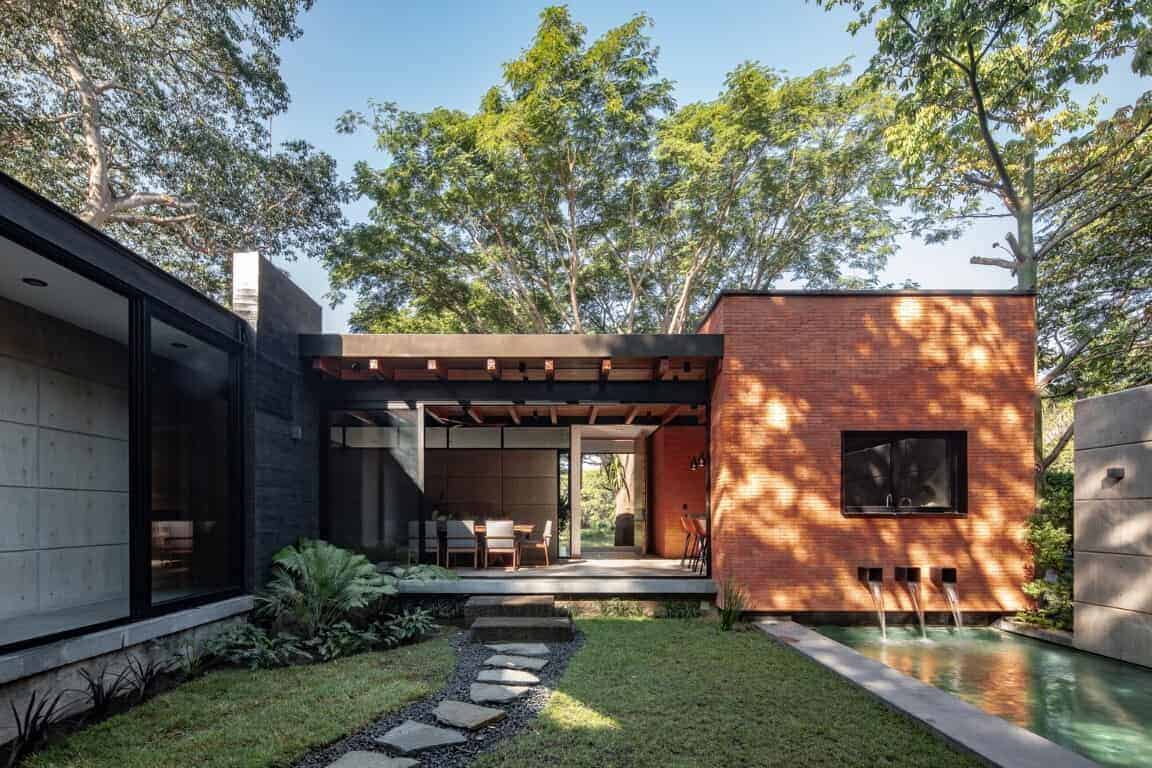
- Project: Keita House
- Architect: Di Frenna Arquitectos
- Location: Mexico, Colima
- Year: 2020
- Area: 283 m2
- Photography: Onnis Luque
A Contemporary Interpretation of the Mexican Patio House
In the warm, tropical city of Colima, Keita House by Di Frenna Arquitectos reimagines the essence of the traditional Mexican courtyard home through a modern architectural lens. Modest in scale yet rich in spatial experience, the single-story residence embraces light, air, vegetation, and water as central design elements, erasing boundaries between nature and architecture.
“The central patio became the circulation and main view of the residence — its true heart,” explain the architects. “From any point in the house, one feels its presence.”
Concept: Modern Typology, Timeless Spirit
The architectural concept stems from reinterpreting Mexico’s vernacular dwelling — a house organized around an open courtyard, where indoor and outdoor spaces coexist seamlessly. Di Frenna Arquitectos sought to honor this typology while adapting it to contemporary living.
The design promotes constant openness to natural light and ventilation, responding to Colima’s warm, humid climate. The result is a home that lives with the environment, not apart from it — a sanctuary that breathes with the rhythm of the landscape.
Spatial Organization: A House That Flows Around a Courtyard
The project’s single-story configuration ensures intimacy and accessibility. All spaces — both private and social — open toward the central courtyard, which becomes the visual and emotional anchor of the home.
-
Social core: At the entrance, a spacious living, dining, and kitchen area welcomes guests with double-height ceilings supported by exposed wooden beams, creating a sense of warmth and shelter.
-
Transparency and openness: Floor-to-ceiling glass walls blur the transition between interior and garden, framing views of a preserved tree supported by a delicate steel structure that provides shade to the terrace.
-
Private wing: The bedrooms are arranged along a secondary axis, ensuring privacy while maintaining visual connection with the courtyard’s greenery.
This U-shaped layout enables natural cross-ventilation and an organic connection to the garden and swimming pool — key to achieving thermal comfort in Colima’s tropical climate.
Materials & Structure: Earthy Warmth and Modern Precision
Materiality plays a defining role in Keita House’s identity, uniting craft and structure in a palette both raw and refined.
-
Red brick, crafted by local artisans, forms tactile volumes that resonate with the warmth of the landscape.
-
Pigmented black concrete walls serve as grounding elements, protecting and framing the lighter materials.
-
Steel columns and beams create rhythm and proportion, visually recalling the verticality of fissures or water channels.
-
Wood enriches ceilings, furnishings, and thresholds, balancing the cooler tones of steel and concrete.
These elements together produce a delicate tension between permanence and lightness, as if the architecture itself were shaped by the tropical air and filtered sunlight.
“Mixing steel with concrete was not only a technical choice but also an aesthetic one,” the architects note. “The structure became part of the visual language.”
Light, Water & Atmosphere
Water and light are the two most expressive components of the project. Subtle reflecting pools trace the geometry of the walls, catching sunlight and animating the surfaces throughout the day.
Openings and vertical slits in the brick walls allow shafts of light to penetrate deeply, creating rhythmic patterns of brightness and shade that shift with time. These luminous sequences enhance the natural tactility of the materials, transforming simple moments — a shadow on the floor, a reflection on the wall — into sensory experiences.
A Tropical Haven of Balance
Keita House embodies Di Frenna Arquitectos’ mastery of spatial harmony and material honesty. Rooted in Mexican tradition yet profoundly modern, the residence celebrates connection over confinement, nature over artifice, and warmth over minimalism.
Its architecture invites the elements inside — wind, light, and water — to compose a tranquil, living environment that speaks quietly of place, craft, and culture.


