
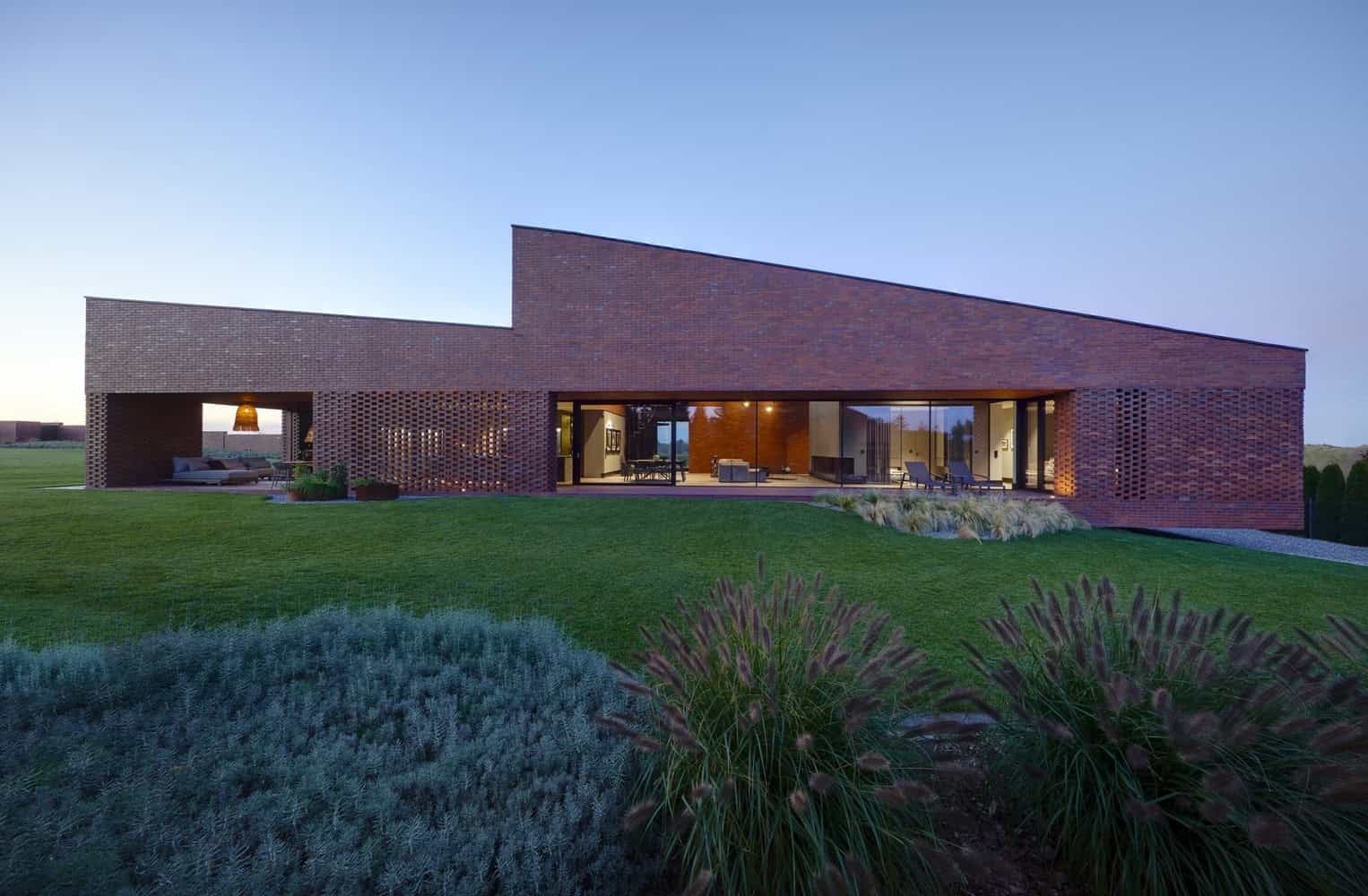
- Project: Industrial House
- Architect: archistudio studniarek + pilinkiewicz
- Location: Poland, Mikołów
- Year: 2022
- Area: 285 m2
- Photography: Adam Miozga
Reinventing the Silesian Heritage: An Industrial Residence

Set within the rolling suburban landscape of Mikołów in Silesia, Poland, the Industrial House by archistudio studniarek + pilinkiewicz transforms regional industrial memory into a contemporary residential experience. More than a private home, this project stands as a sculptural homage to Silesia’s industrial legacy—expressed through brick, form, and spatial ingenuity.
Rather than adopting generic rural forms, Industrial House reframes local identity by referencing the vernacular factory halls and industrial buildings that define the region’s historic character. The result is architecture that is both contextually resonant and unapologetically contemporary—a residence where heritage is not mimicked but reinterpreted.

Industrial Form and Material Presence
The building’s elongated, one-story body is clad entirely in red clinker brick, immediately evoking the architecture of historic Silesian industrial sites. The architects deliberately reference this industrial aesthetic, aligning the house’s form with the double shed roof typology commonly found in factory buildings throughout the region.

This single horizontal block stretches along the narrow east–west oriented plot in line with neighboring development, but its sculptural presence and brick articulation elevate it far beyond typical suburban housing. The clinker façade—enhanced both as structure and pattern—creates a nuanced dialogue of light and shadow while projecting an enduring material authenticity.

Spatial Organization: Everyday Life Anchored in Volume
Inside, the residence is organized into two principal volumes: a dominant living area with high ceilings and an open spatial flow, and a secondary zone housing utilitarian functions including the garage and ancillary rooms. The generous living space integrates a dining area and mezzanine that overlook the main room, accentuating the building’s longitudinal qualities.

Large glazed openings frame views and infuse the interior with daylight, yet careful modulation ensures privacy and visual comfort. In contrast, the north and east façades present more restrained, almost monolithic faces—reinforcing a sense of enclosure that becomes a backdrop for interior life.

Brick as Architecture and Ornament
Brick in Industrial House goes beyond mere cladding: it becomes structural, ornamental, and atmospheric. The use of perforated brickwork screening creates layers of texture that break down the mass of the façade while softening light and defining transitional zones. These articulated patterns allow diffused sunlight to penetrate living spaces, enriching the interior ambiance and connecting inhabitants to the passage of light throughout the day.

Contrasts between solid brick walls and large glazed openings generate spatial tension: where the façade recedes, it reveals moments of transparency that visually expand interior spaces toward the surrounding environment. A deep covered terrace on the southwest side extends living spaces outward, blurring boundaries between inside and outside.

Contextual Narrative and Architectural Identity
Industrial House’s architectural strategy underscores a larger narrative about Silesian identity. Rather than replicating rural barn typologies common in residential design, archistudio studniarek + pilinkiewicz anchored their concept in the region’s industrial memory—embracing brick and structural form as cultural materials. By doing so, the house affirms its place in both past and present architectural discourse.

The choice of materials—red clinker brick, black framed windows, and engineered detailing—enhances both the interior and exterior character. Inside, spaces are anchored by expressive brick surfaces, while minimalist finishes and controlled daylight foster a serene yet dynamic living environment.

A Refined Industrial Residence for Contemporary Living
Industrial House demonstrates how residential architecture can thoughtfully interpret industrial heritage without resorting to superficial stylistic tropes. It embodies a sophisticated material sensibility and spatial clarity that honors both tradition and innovation. Through its disciplined form and tectonic presence, it offers a compelling model for how contemporary homes can engage deeply with local history and identity.


