
- Project: House on the Hill
- Architect: HW Studio
- Location: Mexico, Morelia
- Year: 2021
- Area: 250 m2
- Photography: César Béjar Studio, Juan Pablo Guerra, Dane Alonso
Concept & Context
Nestled into a wooded ravine in Morelia, HW Studio’s House on the Hill exudes quiet introspection and a deep respect for the natural landscape. The architects describe the project as a response to “how can one feel protected?”—evoking the image of a child drawing a sheet over themselves to seek comfort and safety.
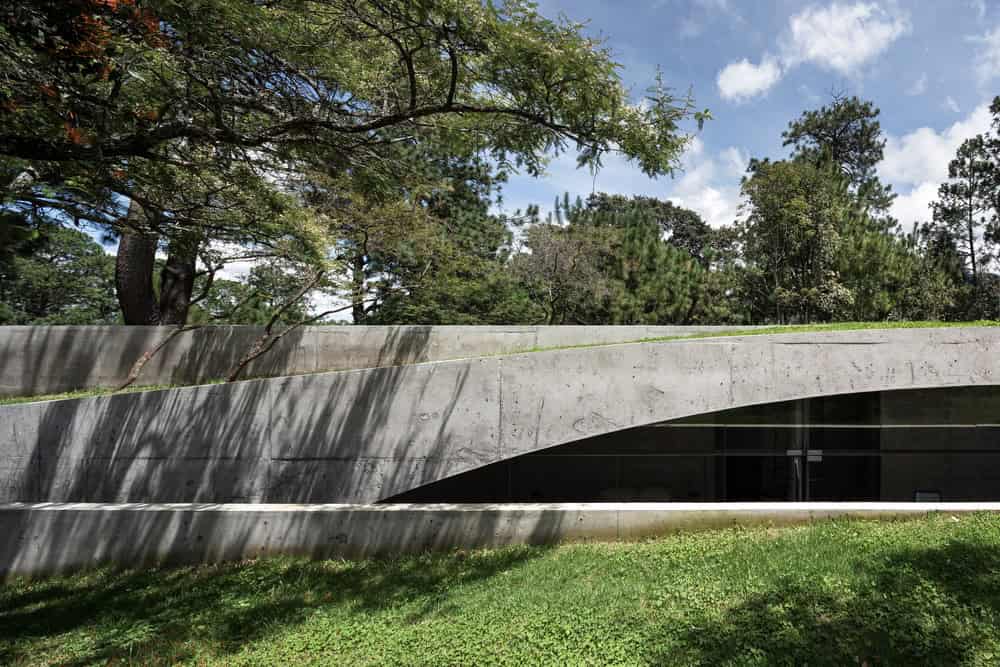
In this metaphor, the architecture becomes the “sheet”: a protective, sheltering form rather than an ostentatious monument. The house is conceived less as a building and more as a subtle intervention in the landscape—a gentle hill rising among the trees, a cave among oaks, a new terrain that invites contemplation.
Architecture & Spatial Organization
Approach and arrival are integral to the experience. Two tall concrete walls emerge from the forest floor: one carrying the weight of the new “hill,” the other guiding the visitor toward a pre-existing tree of significance. The path is intentionally narrow—“wide enough to walk comfortably alone, yet narrow enough to discourage accompaniment”—creating a moment of introspective arrival.
After descending solid stone steps and passing through a heavy steel door, one enters a vaulted concrete space under the “sheet” of architecture—a cavernous living volume whose concrete vault is described as a rock melting into the forest.
The plan divides public and private:
-
Public areas on the left open fully toward the wooded ravine with full-height glazing and strong connections to nature.
-
Private areas on the right open more modestly toward a courtyard and sky-view, creating a more introspective interior experience.
Materiality & Atmosphere
The material palette is intentionally minimal and elemental: concrete, wood, steel, and stone. These are used not only for aesthetic coherence but to allow time and nature to participate in the building’s evolution.
-
Concrete: Chosen for its capacity to age, weather and merge into the forest terrain; envisioned as “new rock melting while inevitably interacting with the forest”.
-
Wood: The flooring smells of pine and wood, providing warmth and aroma in contrast to the cool concrete surfaces.
-
Steel: With time and rainfall, it acquires a bark-like appearance; adds durability and humility to the structure.
-
Stone: Often used in the external context, anchoring the building to the land and lending a primitive sensibility.
The effect is one of a building that gradually fades into its environment rather than dominating it—stillness, silence, and atmosphere become the dominant qualities.
Landscape & Sensory Experience
The house is not only set in nature but intentionally uses it. The facade is low and embedded; the building forms a continuation of the ground rather than a disruption. As one nears the structure, the built environment dissolves into the forest—shadows, tree trunks, and stone become part of the house’s experience.
Light and enclosure are carefully handled: daylight filters through the canopy, large glazed panels allow views out while keeping the interior cool and intimate. The “cave-like” main living volume is described as cold, dark, yet strangely cozy.
The path to the house becomes a ritual: arriving through the forest, beside a great tree so important that the architecture curves around it, descending into the form—a pilgrimage of sorts.
Sustainability & Experience
While the data does not explicitly highlight high-tech sustainability systems, the project’s low-impact approach and deep integration with its environment suggest an ecological sensitivity. Materials are allowed to age, the building is embedded rather than perched, and the experience encourages reflection and connection—qualities often overlooked in “sustainable architecture” discussions.
Moreover, the decision to keep references minimal—appliances hidden, lighting discreet, the palette restrained—signals a design that values longevity, timelessness, and sensory richness over trend.
Why It Matters
In a time when “signature architecture” often means dramatic forms or flashy materials, House on the Hill stands out for its opposite: restraint, silence, and integration. The architecture asks: What is a home when one already lives among trees? It suggests that shelter isn’t always about “standing out” but sometimes about “fitting in,” about creating safety with atmosphere rather than with dominance.
For an architecture-journalist audience, this house offers a case study in how minimal form, deep context-sensitivity and material honesty can create a rich life experience. It offers lessons in how to translate poetic notions—childhood metaphors, forest rituals—into built form without becoming overly literal.


