
- Project: Forest Edge House
- Architect: Marc Thorpe Design
- Location: United States, Roscoe, New York
- Year: 2025
- Area: 140 m2
- Photography: Clay Banks
A Quiet Intervention at Forest’s Edge
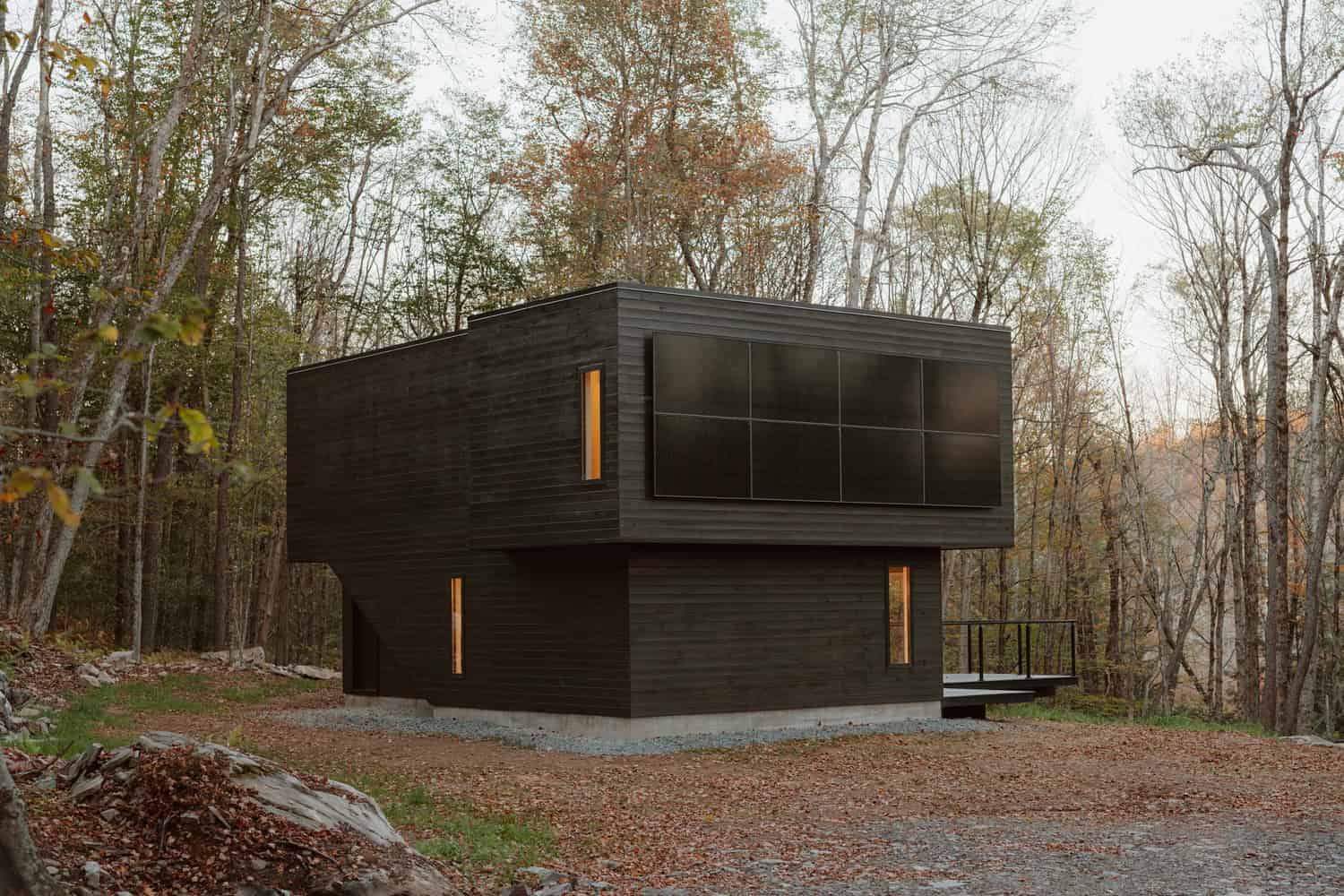
Tucked into the wooded slopes of the western Catskills, the Forest Edge House emerges as a quiet act of environmental and aesthetic clarity. Designed by Marc Thorpe Design and completed in 2025, this compact two-story residence occupies 1,500 ft² and rests on a three-acre forest parcel outside Roscoe, New York. The house is a modest yet deliberate intervention — a retreat that embraces autonomy, sustainability, and a deep resonance with its site.


Harmonizing Form, Setting, and Sustainability
The architectural language of Forest Edge House is at once simple and thoughtful. Its rectangular form is clad in FSC-certified natural pine, a material that allows the building to weather and age gracefully with the forest. The home’s design draws from the rural agrarian vernacular of the Catskills — a nod to vernacular roots rather than a bold imposition of urban modernism.

But the true power of the project lies in its integrated approach to sustainability. Forest Edge House is the fifth solar-powered residence by Edifice Upstate. It’s powered by 24 monocrystalline solar panels connected to a 15 kW inverter and a lithium-ion battery bank — generating roughly 38 kWh per day, enough to sustain the entire home off-grid.

Inside, radiant floor heating and an open plan combining living, kitchen, and dining areas ensure that the limited 1,500 ft² feels purposeful and efficient. The home has three bedrooms and two full baths, making it a realistic choice not just for a weekend retreat — but potentially for permanent residence.


A Cantilevered Connection to Nature
One of the most striking architectural gestures is the 25-foot (roughly 7.6 meter) cantilevered steel deck that projects out into the forest canopy. This elevated platform effectively extends the living space into the trees, offering a place for quiet mornings, forest light, and ambient rustle of leaves — blending indoors and outdoors in a harmonious continuum.


By lifting the house slightly above the ground and embracing a minimal footprint, the design protects existing trees and root systems while maximizing views and privacy. The pine cladding — over time — will weather and blend, softening the visual presence and allowing the house to settle gently among the trees.


Philosophy: Autonomy, Responsibility, Respect
At the heart of Forest Edge House lies a philosophical stance: architecture as autonomy — a thoughtful resistance to overconsumption, unnecessary systems, and energy dependence. As described by Marc Thorpe, the house is “an opportunity to take back our autonomy.”


This autonomy isn’t austere or punitive. Instead, it emerges from a position of responsibility and respect — for the land, the environment, and ourselves. The project demonstrates that modern comforts and ecological mindfulness are not mutually exclusive. Through its full off-grid capability, modest scale, and material choice, Forest Edge stands as a model for sustainable, deeply contextual architecture.


Why Forest Edge Matters Now
In a moment when climate change, energy access, and ecological impact are shaping the future of housing, Forest Edge House points to a possible path forward. It rejects the idea that bigger always means better, or that modern living demands disconnection from nature. Instead, it suggests a lifestyle where design is modest, systems are efficient, and the footprint — physical and environmental — is minimal.

As part of the growing portfolio of Edifice Upstate, this project also signals a rising interest in responsible off-grid living. It’s a house designed not to shout, but to listen: to seasons, to woods, to quiet sunlight filtering through pine needles. In that quiet, there is power.


