
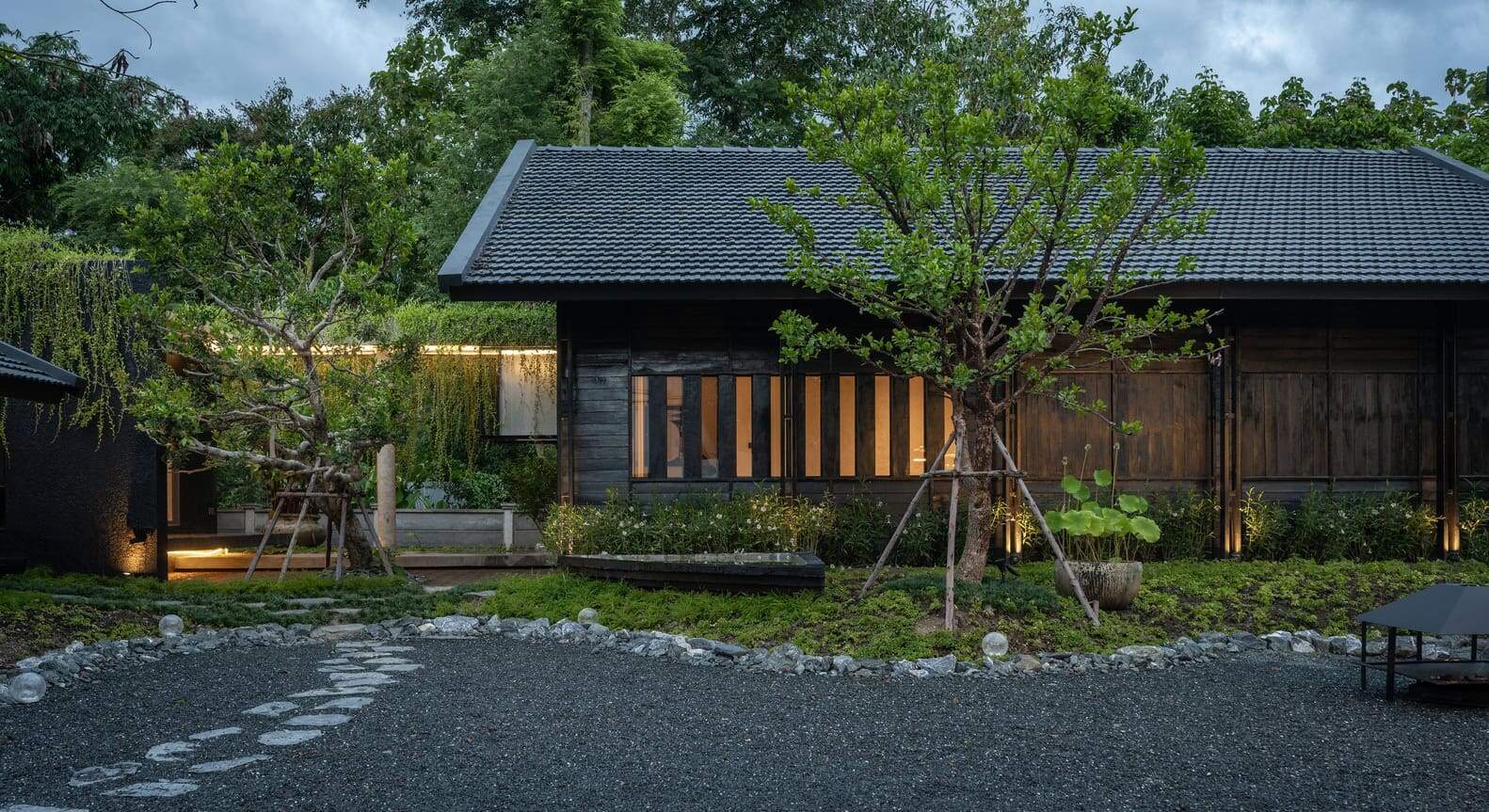
- Project: Baan Dam
- Architect: Housescape Design Lab
- Location: Thailand, Chiang Mai
- Year: 2023
- Area: 250 m2
- Photography: Rungkit Charoenwat
A House of Shadow and Light in Northern Thailand
Nestled in Chiang Mai, Baan Dam by Housescape Design Lab presents a compelling vision of contemporary tropical living—anchored in local craft, material exploration and spatial nuance. With approximately 250 m² of built area, the residence reinterprets traditional Thai spatial logic through a monochromatic lens: the name itself means “Black House”, signifying the dark tone of its exterior and the layered meaning behind the design.
The home engages with time and materiality rather than fleeting décor or spectacle. It invites inhabitants to dwell consciously—among shadow, timber, courtyards and craft.
Concept – Material Experimentation & Spatial Discipline
The starting point of the design is both poetic and pragmatic: the client desired a home rooted in the essence of Chiang Mai—its craft traditions, its climate, its culture—while enabling contemporary living. The studio responded with an architectural motto: “Endless processing”—a reference to how everyday materials can perform new roles when introduced through experiment and thoughtful assembly.
The home is structured around multiple courtyards of varying scale and function:
-
A large landscape yard sits at the heart of a U-shaped planning, offering open-air activity, connection to nature and a spatial anchor for the home.
-
The housescape yard acts as the entry zone, linking semi-public spaces and featuring baked-clay flooring referencing local vernacular.
-
A narrower corridor yard leads to the bedroom zone, offering privacy and transitional space between public and private realms.
Meanwhile, the entirely black roof and façade act not just as visual signature, but as a material challenge: the studio worked with local artisans to paint nearly twenty thousand cement tiles black, enabling the home to absorb and transform light, emphasizing texture rather than surface brightness.
Spatial Flow & Experience
Entering the house, one passes through the baked-clay entry yard into a sequence of open and semi-open spaces. The U-configuration wraps the landscape yard, so living, dining and gathering areas all face green and sky. Large sliding doors dissolve boundary between inside and outside. The arrangement encourages fluid movement, visual connections and a sense of calm immersion.
Private zones—bedrooms and intimate lounges—are placed where they receive filtered light and natural ventilation, often facing the smaller yards or courtyards. The material palette inside remains restrained: warm timber, crisp concrete, soft natural finishes. These choices help create interiors of stillness, where material and light matter more than ornament.
Materials & Climate Response
In a tropical, humid region with monsoon rains, shading, ventilation and resilience are central. Baan Dam responds on several levels:
-
The dark-toned roof and façade absorb heat but also create deep overhangs that offer shade and moderate daylight.
-
Courtyards introduce cross-ventilation, daylight access and a connection to greenery, reducing reliance on heavy mechanical systems.
-
The use of local materials and craft—rather than high-imported finishes—reduces environmental footprint and supports local production.
-
The layout and orientation respond to sun and rainfall: open yards and protected indoor volumes create comfortable living zones year-round.
Materially and conceptually, the home acknowledges ageing, process and weathering—embracing the patina of use rather than fighting it.
Significance in Contemporary Residential Architecture
Baan Dam stands as a benchmark for how modern tropical homes can be both elegant and rooted. Its significance lies in:
-
Material integrity: Rather than superficial decoration, the architecture emerges from craft, texture and honest material use.
-
Spatial layering: The home’s sequence of yards, volumes and transitions creates depth in what might be a modest footprint.
-
Context & climate intelligence: The design recognises Chiang Mai’s climate and local culture—not as constraints, but as sources of richness.
-
Monochrome reinterpretation: The bold use of ‘black’ transforms the house into a statement of discipline, calm and conceptual strength.
For architects, clients and enthusiasts interested in tropical residential design, Baan Dam offers a blueprint of restraint, meaning and environmental empathy.
With Baan Dam, Housescape Design Lab delivers a home that is at once timeless and of its time; calm yet layered; modern yet tactile. It is architecture that asks less — less show, less spectacle — and gives more: space, materiality, contemplation, connection.
In Chiang Mai’s lush setting, Baan Dam doesn’t mimic the jungle—it dialogues with it. It reminds us that a house is not just where we live, but how we slow down, feel material, sense light and inhabit time.


