
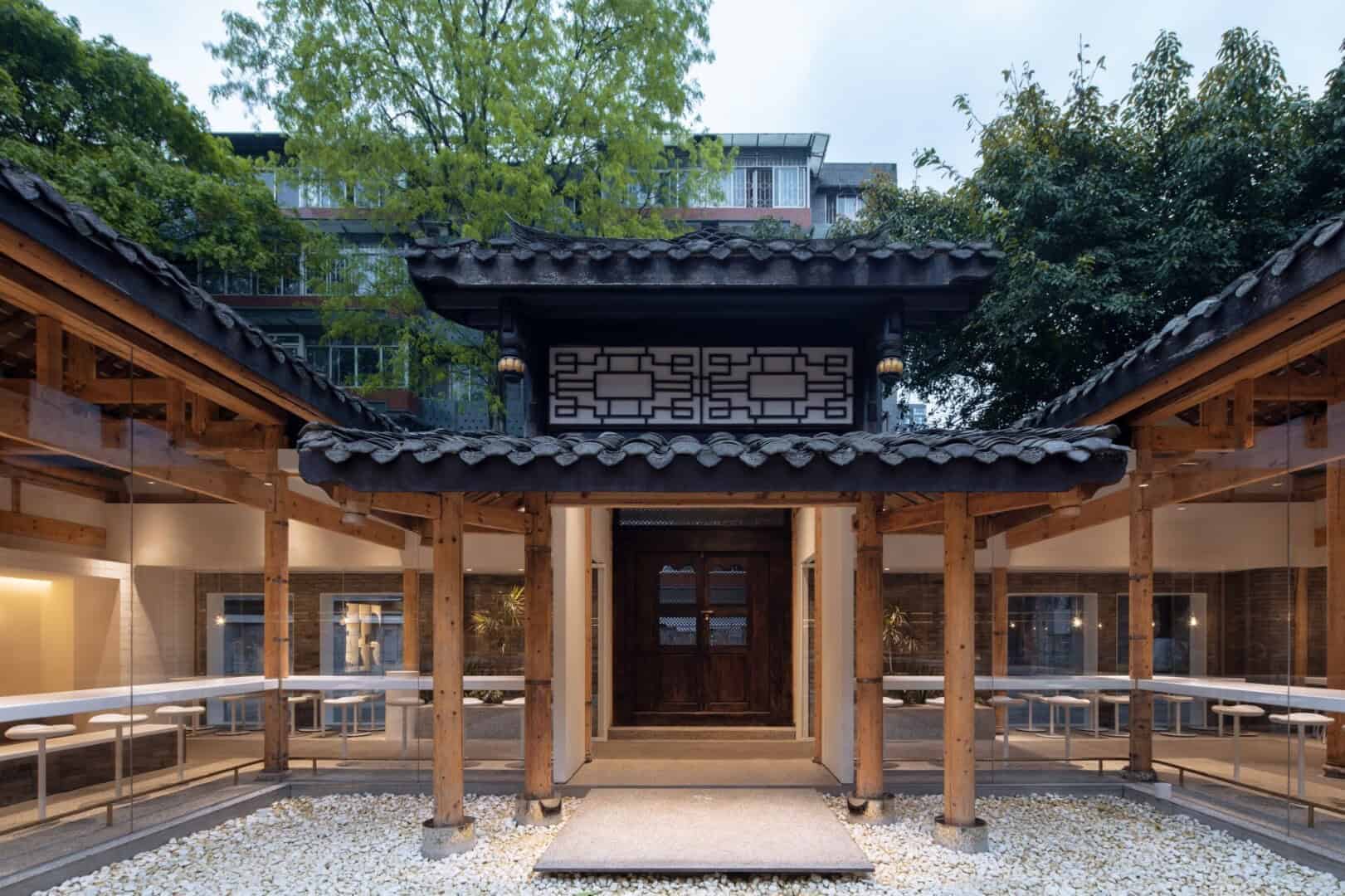
- Project: Arabica, Wide & Narrow Alley
- Architect: B.L.U.E. Architecture Studio
- Location: China, Chengdu
- Year: 2020
- Area: 320 m2
- Photography: Zhi Xia
Restoring a Historic Courtyard
Kuanzhai Alley in Chengdu, first established during the Qing Dynasty’s Kangxi period, remains one of the city’s most vibrant cultural landmarks. Defined by its trio of streets—Wide Alley, Narrow Alley, and Well Alley—the district preserves the authentic pace of Chengdu life. Amidst its crisscrossing alleys, the project site stood as a traditional Western-Sichuan courtyard house, its grey brick walls and black-tiled roofs echoing the memory of old Chengdu.
Chosen as the site for % Arabica Chengdu, the building faced Jing Alley, a relatively tranquil stretch in contrast to the bustle of Wide and Narrow Alleys. Here, B.L.U.E. Architecture Studio undertook the challenge of transforming the structure into a modern café while honoring its cultural roots.
A Design Inspired by Spirit of Place
The design philosophy mirrors both Chengdu’s leisurely lifestyle and Arabica’s ethos of “seeing the world through coffee.” For B.L.U.E., the café was envisioned not simply as a retail space, but as a public forum—a place where people could gather, slow down, and share in the cultural rhythm of the alley.
The guiding idea was to integrate the relaxed Chengdu spirit into the café while expressing the brand’s minimalism. Thus, the project became a dialogue between heritage and modernity, a re-creation of neighborhood life within the walls of a restored courtyard.
The Courtyard as Centerpiece
The design team began by removing a glass roof that a previous owner had added, restoring the original courtyard typology. The central courtyard was transformed into a serene white pool, a reflective surface that instantly sets a tranquil atmosphere for visitors entering from the bustling street.
Encircled by floor-to-ceiling glass, the courtyard blurs the boundary between interior and exterior. Natural light floods into the space, while transparency fosters fluidity and openness. Seating around the pool creates both intimacy and distance—guests gather in close proximity while separated by the water, evoking a social yet reflective environment.
A Street Within a Café
Encircling the water courtyard, the architects designed a looping indoor street with alternating wide and narrow passages, echoing the very character of Kuanzhai Alley.
-
Materials: The floor and seating are crafted from reclaimed grey bricks, ubiquitous in Chengdu’s alleys, grounding the design in local tradition.
-
Semi-open retreat: At the corridor’s end, a small room surfaced with handcrafted bricks offers privacy. Its irregular texture and artisanal quality reflect the historic tactility of the district.
-
Street-like counter: Opposite the pool, a sleek white bar counter under a light eave recalls a roadside stall—enhancing the sense of urban publicness.
The result is a café where human activity defines the architecture. People stroll, linger, and converse, transforming the café into a dynamic extension of Chengdu’s streetscape.
Balancing Tradition and Modern Minimalism
Original timber columns were stripped of black paint, revealing their authentic grain. Reinforcements were subtly integrated with steel, ensuring structural integrity while preserving historic character.
The design juxtaposes timeless textures—wood, handmade bricks, natural stone—with Arabica’s clean modern lines. This contrast embodies both Chengdu’s cultural memory and the café brand’s minimalism, creating a setting that is at once rooted and global.
A Dialogue With the City
For B.L.U.E. Architecture Studio, the project was more than a renovation—it was a conversation with Chengdu’s history and lifestyle. The café embodies the publicness of urban space and the playfulness of daily life.
By layering memory, culture, and modern use, % Arabica Kuanzhai Alley reimagines a historic courtyard as a gathering place for locals and visitors alike. It is a project where architecture, culture, and community intersect, reinforcing Chengdu’s identity as a city of tradition and leisure.


Drawings


