
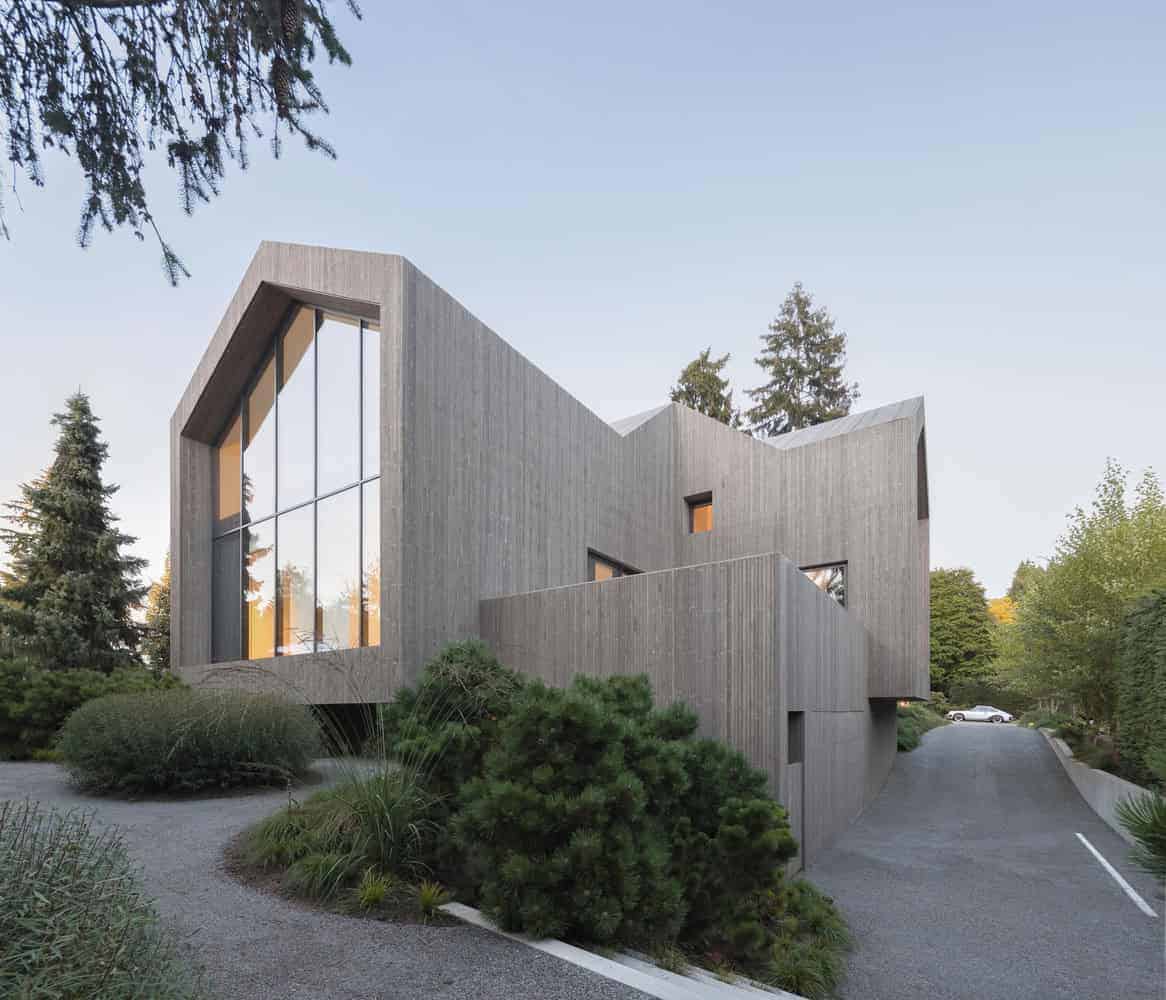
Re‑folded House / McLeod Bovell Modern Houses / Canada

  • Project: Re‑folded House
  • Architect: Mcleod Bovell Modern Houses
  • Location: Canada, Vancouver
  • Year: 2024
  • Area: 470 m2
  • Photography: Ema Peter

Re-folded House / McLeod Bovell Modern Houses / Canada

Emerging in Vancouver’s dynamic architectural context, Re-folded House by McLeod Bovell Modern Houses is a bold reinterpretation of residential form, material and program. At 470 m², this project pivots on a pivotal moment: the client’s decision to take over construction mid-process, redefining the home’s concept from the inside out. Rather than following a typical floor-by-floor layout, the architects embraced folding geometry, layered landscapes and a refined material palette to create a house that responds to place, climate and family life in equal measure.

Architectural Vision & Site Strategy

The design begins with a textured reading of the site: a floodplain shaped by the meandering delta of the Fraser River, with its periods of inundation and sediment deposition. McLeod Bovell treated the ground not as a blank slate but as a layered landscape — sediment, vegetation, constructed elements — and translated those layers into the architecture. The house itself becomes a fold: of roof, wall, floor plate and programmatic sequence.

Interior and exterior planes are clarified through the same geometries. Walls, ceilings and hovering floor plates are lifted off conventional connections, establishing flexible thresholds, angled volumes and cinematic flows of light and space. The result: rooms that unfold, not just function.

Materiality & Construction Approach

One of the most significant moves is the pervasive use of Accoya pine wood, chosen for its durability in water-contact situations and its capacity to age gracefully to soft grey tones that tie back to the surrounding hemlock trees and floodplain conditions. The choice acknowledges site constraints (flood risk) by removing vulnerable finishes (drywall, batt insulation) at the lowest level and housing mechanical systems in waterproof bunkers. A material logic deeply responsive to context.

Externally the house appears monolithic, clad in timber with minimal disruption. Internally, the surfaces are spare yet sculptural: concrete floors, expansive glazing, built-in joinery, furniture minimal and deliberately open to interpretation — each piece supportive of multiple modes of living rather than prescribed function.

Spatial Experience & Living Logic

Re-folded House rejects traditional circulation: no long linear hallways, no closed-off rooms by default. Instead, angled walls, floating floor plates and irregular thresholds define movement. Light enters from unexpected axes; views are framed by folded corners; the domestic programme is read in layers and sequences rather than zones.

The landscape becomes part of the living experience. The driveway and stairs reference sediment, the vegetation carpet rises from wetland into gardens, and elevated boardwalks hover above it all — the built and natural merge. Inside the home, the layers continue: public spaces flow into semi-private, volumes stack subtly, and the house invites inhabitants to move, pause, look and inhabit rather than simply pass through.

Why this Project Matters

  • Programmatic reinvention mid-process: The client’s switch in leadership challenged the design team to revisit assumptions of residential typology.

  • Folded geometry as narrative tool: Walls, ceilings and floors don’t just contain space—they articulate movement, change and experience.

  • Material & climate responsiveness: The use of Accoya timber and waterproof detailing shows an architecture that takes its site seriously, structurally and symbolically.

  • Landscape as layered partner: The house does not fight the ground—it rereads it, folds it, inhabits it.

  • Spatial richness in moderate scale: At 470 m², the project achieves great depth of experience without excess.

Re-folded House stands not just as a striking visual object, but as a reflection on how homes in sensitive environments can be both rigorous and poetic, functional and expressive.

Re-folded House by McLeod Bovell Modern Houses, wood volume in landscape, Vancouver
Photography © Ema Peter
Re-folded House by McLeod Bovell Modern Houses, gable window entry elevation, Vancouver
Photography © Ema Peter
Re-folded House by McLeod Bovell Modern Houses, twin gables driveway approach, Vancouver
Photography © Ema Peter
Re-folded House by McLeod Bovell Modern Houses, minimal corridor with bench by window, Vancouver
Photography © Ema Peter
Re-folded House by McLeod Bovell Modern Houses, living room panorama seat, Vancouver
Photography © Ema Peter
Re-folded House by McLeod Bovell Modern Houses, façade detail with wood cladding, Vancouver
Photography © Ema Peter
Re-folded House by McLeod Bovell Modern Houses, double-height glazing toward courtyard, Vancouver
Photography © Ema Peter
Re-folded House by McLeod Bovell Modern Houses, cantilevered gable window, Vancouver
Photography © Ema Peter
Re-folded House by McLeod Bovell Modern Houses, overall exterior at dusk, Vancouver
Photography © Ema Peter
Re-folded House by McLeod Bovell Modern Houses, corner volume above meadow path, Vancouver
Photography © Ema Peter
Re-folded House by McLeod Bovell Modern Houses, façade and meadow path detail, Vancouver
Photography © Ema Peter
Re-folded House by McLeod Bovell Modern Houses, front gable full-height glazing at dusk, Vancouver
Photography © Ema Peter
Re-folded House by McLeod Bovell Modern Houses, courtyard with sliders to living room, Vancouver
Photography © Ema Peter
Re-folded House by McLeod Bovell Modern Houses, concrete corridor leading to patio, Vancouver
Photography © Ema Peter
Re-folded House by McLeod Bovell Modern Houses, stair core with wood cladding, Vancouver
Photography © Ema Peter
Re-folded House by McLeod Bovell Modern Houses, kitchenette niche behind sliding door, Vancouver
Photography © Ema Peter
Re-folded House by McLeod Bovell Modern Houses, skylight oculus with wood ceiling folds, Vancouver
Photography © Ema Peter
Re-folded House by McLeod Bovell Modern Houses, lounge nook with Eames chair by window, Vancouver
Photography © Ema Peter
Re-folded House by McLeod Bovell Modern Houses, interior timber canopy hall, Vancouver
Photography © Ema Peter
Re-folded House by McLeod Bovell Modern Houses, timber roof lantern above hallway, Vancouver
Photography © Ema Peter
Re-folded House by McLeod Bovell Modern Houses, minimal shelves corner, Vancouver
Photography © Ema Peter
Re-folded House by McLeod Bovell Modern Houses, timber faceted ceiling detail, Vancouver
Photography © Ema Peter
Re-folded House by McLeod Bovell Modern Houses, white angled corridor, Vancouver
Photography © Ema Peter
Re-folded House by McLeod Bovell Modern Houses, Japanese soaking tub, Vancouver
Photography © Ema Peter
Re-folded House by McLeod Bovell Modern Houses, minimal vanity under sloped ceiling, Vancouver
Photography © Ema Peter
Re-folded House by McLeod Bovell Modern Houses, concrete stair lightwell, Vancouver
Photography © Ema Peter
Re-folded House by McLeod Bovell Modern Houses, stair entrance framed with wood cladding, Vancouver
Photography © Ema Peter
Re-folded House by McLeod Bovell Modern Houses, gable window portrait exterior, Vancouver
Photography © Ema Peter
Re-folded House by McLeod Bovell Modern Houses, side gable exterior at evening, Vancouver
Photography © Ema Peter
Re-folded House by McLeod Bovell Modern Houses, forest view elevation, Vancouver
Photography © Ema Peter
Re-folded House basement plan, McLeod Bovell Modern Houses, Vancouver
Drawings © McLeod Bovell Modern Houses
Re-folded House main floor plan with suite, kitchen, dining, living, Vancouver
Drawings © McLeod Bovell Modern Houses
Re-folded House second floor plan with pod suite, studio, lounge, Vancouver
Drawings © McLeod Bovell Modern Houses
Modern architectural house floor plan with multiple levels and spaces including living areas, garage, and staircases, showcasing innovative home design and contemporary architecture art.
Drawings © McLeod Bovell Modern Houses
Modern architectural house blueprint with detailed room layout, including living spaces, wine cellar, garage, and bedrooms, showcasing innovative home design and floor plan architecture.
Drawings © McLeod Bovell Modern Houses

Posted by Mcleod Bovell Modern Houses

McLeod Bovell Modern Houses is a Vancouver-based architecture partnership founded in 2008, dedicated to designing custom residential environments that respond to complex sites and lived experience. The studio seeks out steep, irregular and view-rich landscapes and transforms them into homes where light, structure and narrative converge. By engaging closely with clients to uncover both spoken and unspoken needs, McLeod Bovell frames each project as a layered sequence of spatial experiences rather than a standard formula. Their portfolio features cedar-clad volumes, dramatic cantilevers, intimate courtyards and integrated landscapes, all connected through a deep commitment to material integrity, craftsmanship and context.