
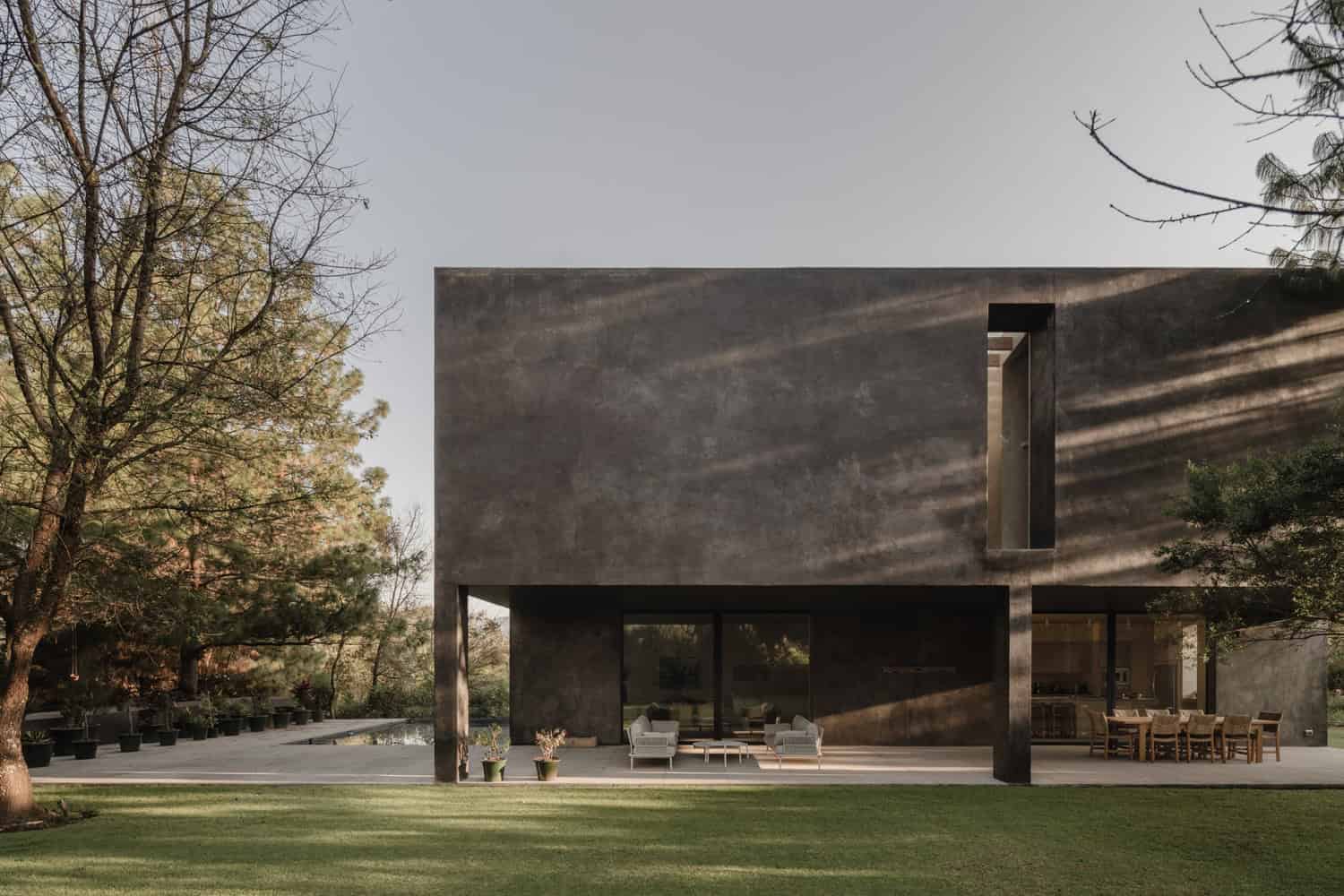
- Project: Ocote House
- Architect: PPAA
- Location: Mexico, Valle de Bravo
- Year: 2024
- Area: 342 m2
- Photography: v
A Dialogue Between Architecture and Nature
In the forested hills of Valle de Bravo, Ocote House by PPAA stands as a modern reflection on balance — between solitude and connection, structure and landscape, weight and transparency. Designed for two families who wished to share a single retreat, the 342-square-meter residence transforms the concept of coexistence into architectural poetry.
This is not a statement of dominance over nature — it’s an act of harmony. The house settles into the terrain rather than erasing it. Water, light, and material are orchestrated to heighten awareness of the site’s rhythm: wind through trees, the mirrored reflection of clouds, the sound of stillness.
Design Concept – Living Together, Apart
PPAA approached Ocote House with one clear intention: to design a home that allows multiple lives to intertwine without losing individuality.
A central axis organizes the plan, dividing the volume symmetrically while maintaining visual continuity through open corridors and expansive glazing. On the lower floor, social life unfolds — the living room, kitchen, and dining areas open fluidly to a semi-covered terrace that stretches toward a tranquil reflecting pool.
This architectural mirror becomes both threshold and mediator: it blurs the distinction between inside and outside, amplifies the surrounding forest, and cools the microclimate naturally.
On the upper level, private wings branch out like extensions of the forest canopy. Each family enjoys an autonomous set of bedrooms and terraces, yet the sense of togetherness remains intact through subtle sightlines and shared spatial language.
Materials and Atmosphere – Crafted Minimalism
The material palette of Ocote House is intentionally restrained. Exposed concrete and natural wood dominate, punctuated by dark metal frames and transparent glass. The neutrality of the materials amplifies the beauty of light and shadow; it lets the landscape provide the color.
Concrete offers permanence and thermal stability; timber adds intimacy and warmth. Large openings dissolve boundaries, allowing the forest to enter — every reflection on the water surface becomes part of the architecture’s texture.
The result is a calm, sensory atmosphere — tactile yet weightless, minimalist yet deeply emotional.
Connection with the Landscape
What distinguishes Ocote House from the wave of contemporary minimalist homes is its empathy for the site.
PPAA refused to flatten the terrain. Instead, the architecture adapts to the slope, creating natural terraces that preserve existing trees. The design celebrates topography as a narrative tool — each step, wall, and window frame responds to a view, a light angle, a breeze.
This sensitivity transforms the home into an extension of its surroundings rather than an imposition upon them. It’s architecture that listens.
Sustainable Comfort, Not Technology
While many projects chase sustainability through devices and data, Ocote House achieves it through intelligence of form.
The orientation maximizes passive ventilation; deep roof overhangs prevent solar gain; the reflective pool lowers temperature around the façade. These are traditional yet timeless responses — sustainability embedded in geometry, not gadgets.
Such passive design strategy ensures comfort throughout the year, reaffirming PPAA’s belief that modern architecture must begin with environmental empathy.
The Architectural Language of PPAA
PPAA (Pablo Pérez Palacios Arquitectos Asociados) has built a global reputation for its quiet, idea-driven architecture. Their projects are not formal exercises but spatial meditations on time, memory, and presence.
In Ocote House, that philosophy finds a mature expression. Every volume feels deliberate; every void holds meaning. It’s an architecture that privileges emotion over spectacle — where serenity, balance, and human experience take precedence over visual noise.
A Modern Mexican Retreat Rooted in Context
Ocote House encapsulates what defines the new era of Mexican architecture: raw material honesty, contextual intelligence, and emotional precision. Valle de Bravo — long known as an escape for artists and thinkers — provides the perfect stage for PPAA’s architectural restraint.
The house doesn’t attempt to be photogenic; it becomes photogenic by being true. It’s the rare kind of project that looks better in real life than in pictures, precisely because it was designed to be felt, not simply seen.
Conclusion
Ocote House by PPAA is a masterclass in architectural restraint — a home that defines luxury not through excess, but through silence. Every space honors its surroundings; every reflection becomes part of a living landscape.
In an age when architecture often screams for attention, Ocote House whispers — and the world listens.


