
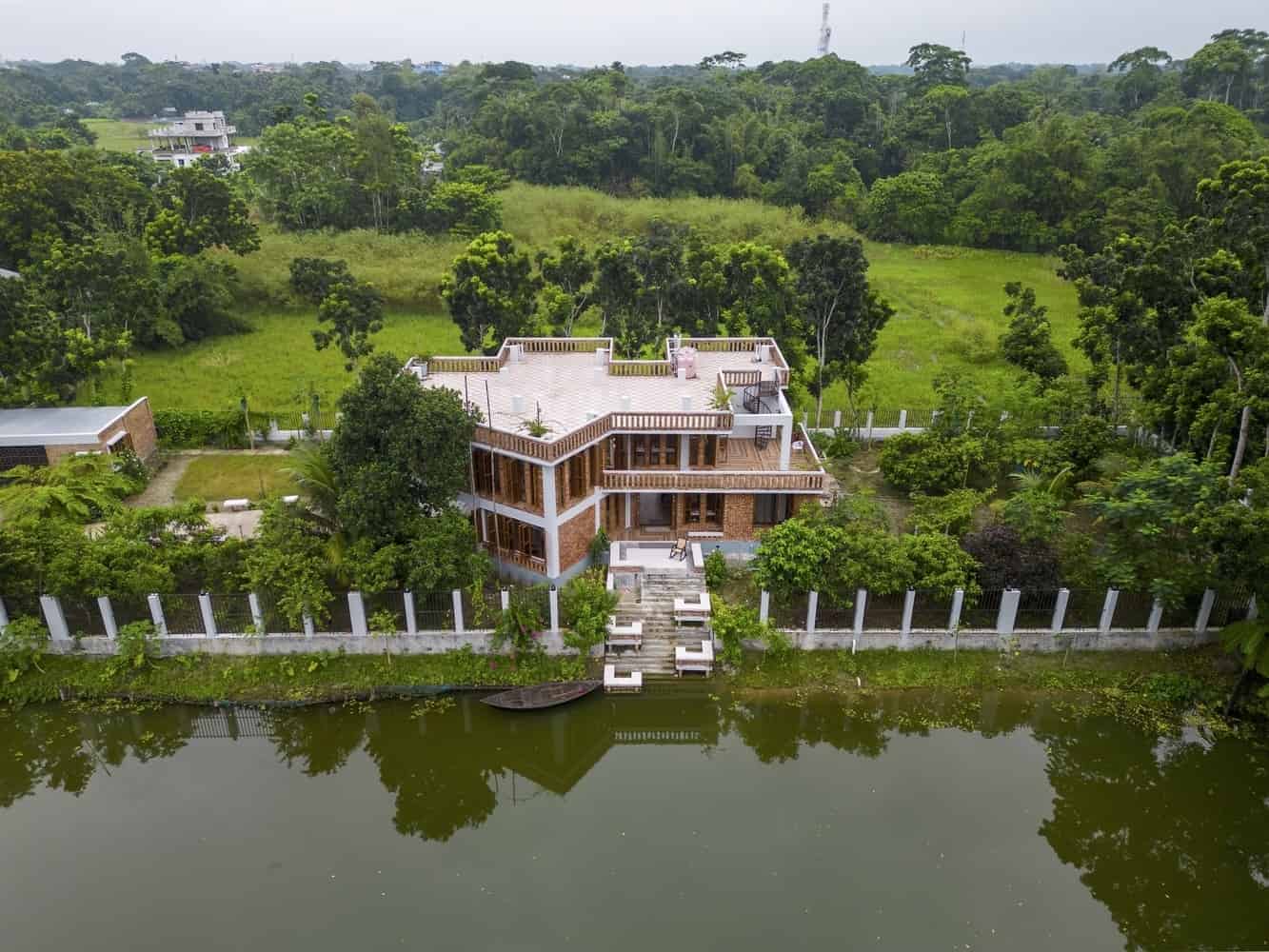
- Project: Hawladar House
- Architect: Maruf Raihan.Works
- Location: Bangladesh, Shibchar
- Year: 2023
- Area: 418 m2
- Photography: Maruf Raihan
Located in the lush rural heart of Shibchar, Bangladesh, Hawladar House by Maruf Raihan.Works reinterprets the archetype of the contemporary Bengali homestead. Designed to host extended family gatherings, prayer, and moments of quiet retreat, the residence stands beside a large pond, weaving together memory, culture, and climate-responsive design.

The home is conceived as the central gathering point for a large, close-knit family—a space that honors ancestral rhythms while responding to modern life. Balancing privacy and openness, it bridges the emotional and functional needs of multiple generations under one roof.
A Modern Homestead Bridging Tradition & Family Life
Upon approach, the structure greets visitors with a sequence of shaded layers. The house opens into a semi-open veranda—the Kacharighar—a communal zone that doubles as a prayer hall. This orientation toward the qiblah integrates faith naturally within domestic life, while open edges link daily routines to the surrounding landscape.

Spatial Layout & Family Geometry
The plan reflects the essence of family geometry—fluid connections between public and private zones. From the veranda, one enters the public living room and dining area overlooking the pond, while the private wing upstairs hosts three bedrooms and a multi-use family chamber for celebrations, study, and rest.

The pond anchors the architecture, creating a visual and climatic dialogue. A stepped ghat at the water’s edge invites informal gatherings and reflection, reinforcing the connection between built and natural domains.

Light, Privacy & Ventilation Strategy
Given the density of rural settlements, privacy and climate control were critical. The design uses parallel vertical strip walls instead of large windows—creating narrow openings that bring in light and air while maintaining seclusion. These 10″ × 10″ slits animate the façades with rhythmic light play throughout the day.

Semi-private verandas off each bedroom extend the living area outward, equipped with built-in seating for contemplation. Circulation paths are designed to draw the cool pond breeze through the interiors, enhancing passive ventilation and comfort across seasons.

Materiality & Cultural Resonance
The project’s material language is authentically local, combining regional availability with craftsmanship. Construction draws from a palette of:
- Gas-burnt bricks sourced regionally, forming textured walls
- Salvaged timber from trees within the property
- Cement and metal components from nearby workshops
- Minimal surface finishes to preserve tactile and visual honesty
The garden becomes an extension of the architecture, with native vegetation, fruit trees, and vegetable plots enveloping the structure. This landscape continuity reinforces the vernacular spirit of coexistence between living, cultivation, and water.


A Living Legacy in Rural Bangladesh
Hawladar House / Maruf Raihan.Works / Bangladesh stands as a living legacy—a home that merges tradition, family, and sustainability. It exemplifies how modern architecture can honor cultural heritage while embracing climatic intelligence and material honesty. Beyond its walls, it fosters a daily rhythm of connection between people, landscape, and faith—a poetic dialogue between past and present.


