
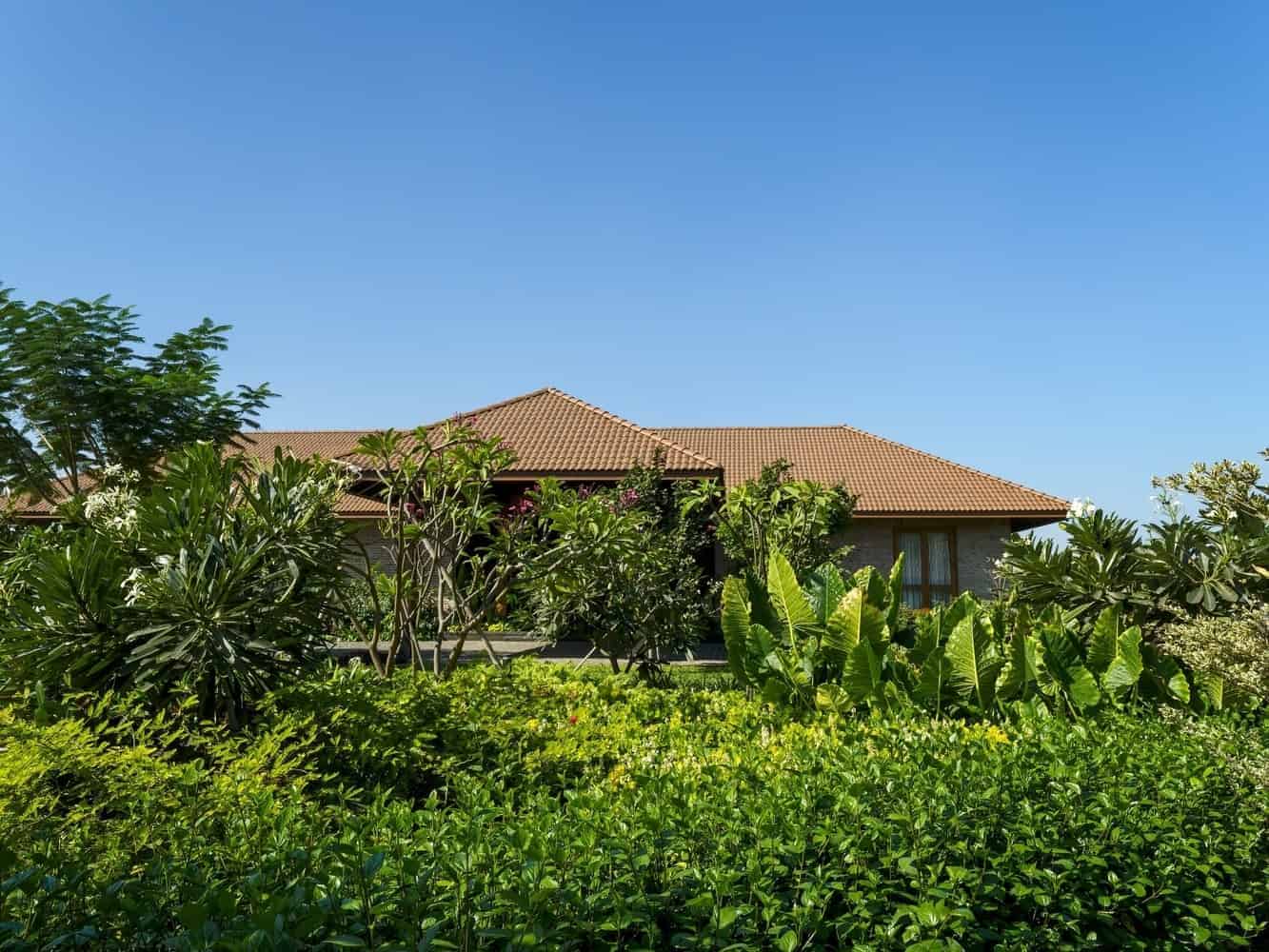
- Project: The House with Two Courts
- Architect: Studio mahajani + mahajani
- Location: India, Phaltan, Maharashtra
- Year: 2023
- Area: 1200 m2
- Photography: Hemant Patil
Nestled within the agricultural landscape of Phaltan, Maharashtra, The House with Two Courts is a weekend home that bridges tradition and contemporary design. Studio Mahajani + Mahajani conceive the house as an architectural dialogue between vernacular fabric and modern spatial flow. Two primary courtyards act as the organizing gesture, softening boundaries between interior and exterior, public and private. The built form is grounded yet expressive—stone, brick, pitched roofs, and framed voids combine to create a robust house rooted in place and memory.

Spatial Organization & Courtyard Logic
The architectural narrative revolves around dual courts that choreograph movement, microclimate, and daily life.
- Front Courtyard: A porous threshold that welcomes breezes and offers a layered transition from farm tracks and fields to the life of the home.
- Rear Courtyard: A more private nucleus that connects living zones, bedrooms, and terraces, gathering family activity around sky and shade.
Rooms ring these courts so every space receives light, ventilation, and open sky. The plan reads as gently radial: movement arcs through the house, revealing moments of enclosure, green glimpses, and framed vistas. Sloping roofs echo the rural skyline and temper rain, sun, and scale. Thick stone and brick walls anchor the volume, while gabled eaves and generous overhangs calibrate light and shade.


Materiality & Architectural Expression
True to context, the palette prioritizes local textures and construction tradition:
- Stone masonry & sun-baked brick for mass, thermal inertia, and regional identity.
- Exposed mortar & rough finishes that celebrate craft and weathering.
- Deep-revealed glazing to modulate light, glare, and privacy while framing views.
- Timber elements in ceilings, thresholds, and roof framing for warmth and rhythm.
The result is a composition that feels weathered yet resilient, tactile yet precise—every surface speaking of craft, local labor, and regional resonance.


Light, Atmosphere & Sensory Journey
Walking through the home is a choreography of light and shade. The courts act as lighting lungs, drawing daylight into deep interiors and venting warm air. Sloped ceilings, clerestories, and generous openings sculpt shafts of light that soften corners and animate surfaces. Spatial sequences fold from open living to sheltered verandas to private sanctuaries. At dusk, the masonry glows gently—the house reads at once as grounded and lantern-like.


Environmental Response & Performance
Beyond atmosphere, performance is embedded in the architecture:
- Thermal buffering: Thick stone/brick walls and courtyard mass stabilize indoor temperatures.
- Solar control: Overhangs and pitched roofs shade openings and shed monsoon rain.
- Ventilation: Cross-breezes are orchestrated via aligned apertures between the two courts.
- Material ecology: Local sourcing reduces embodied energy and enhances durability.
Comfort arises from form, orientation, and material—technology by way of tradition.

Daily Life Between Two Courts
Morning light filters through the front court as doors slide open to fields; afternoons settle in the rear court under long eaves; evenings gather on verandas that hold the day’s warmth. The plan supports quiet routines and generous hosting with equal ease.


Craft & Detail
At the scale of the hand, the project reveals its making: exposed mortar, crisp timber junctions, and sun-baked brick courses telegraph how the house stands. Deep reveals and stone plinths register time—shadows lengthen, surfaces patina, and the building ages with dignity.


Evening Atmosphere & Farmland Context
As dusk falls, the masonry’s hue deepens and the courts glow like lanterns. The house settles back into the fields—solid and light at once—echoing the rural cadence of work, rest, and gathering.


A Rural Home of Dignity & Continuity
The House with Two Courts / Studio Mahajani + Mahajani / India is more than a retreat—it is architecture that speaks to place, lineage, and landscape. By melding vernacular sensibilities with spatial rigor and material presence, the home feels both grounded and poetic. Here, tradition is a living vocabulary; modernity is an invitation. It is a house made of courtyards, earth, and quiet light—timeless ground for gathering, rest, and reflection.
