
- Project: Sitish Parikh Farmhouse
- Architect: Dipen Gada and Associates
- Location: India, Vadodara
- Year: 2023
- Area: 4200 m2
- Photography: Tejas Shah
Set on the outskirts of Vadodara near Aampad village, the Sitish Parikh Farmhouse by Dipen Gada and Associates (DGA) is a study in restraint, craft, and climate intelligence. Conceived as a second home for a prominent local developer, the single-storey residence turns a squarish orchard plot into a serene retreat where brick, shade, breeze, and filtered sun choreograph daily life.
Site, Brief, and Strategy
With a generous plot and a modest program—two bedrooms, living-dining, kitchen—the design leverages horizontal sprawl rather than vertical stacking. DGA embraces the archetype of the countryside house, specifying exposed brickwork, sloping roofs, and Mangalore tiles to temper heat, shed monsoon rain, and sit quietly in the agrarian setting.
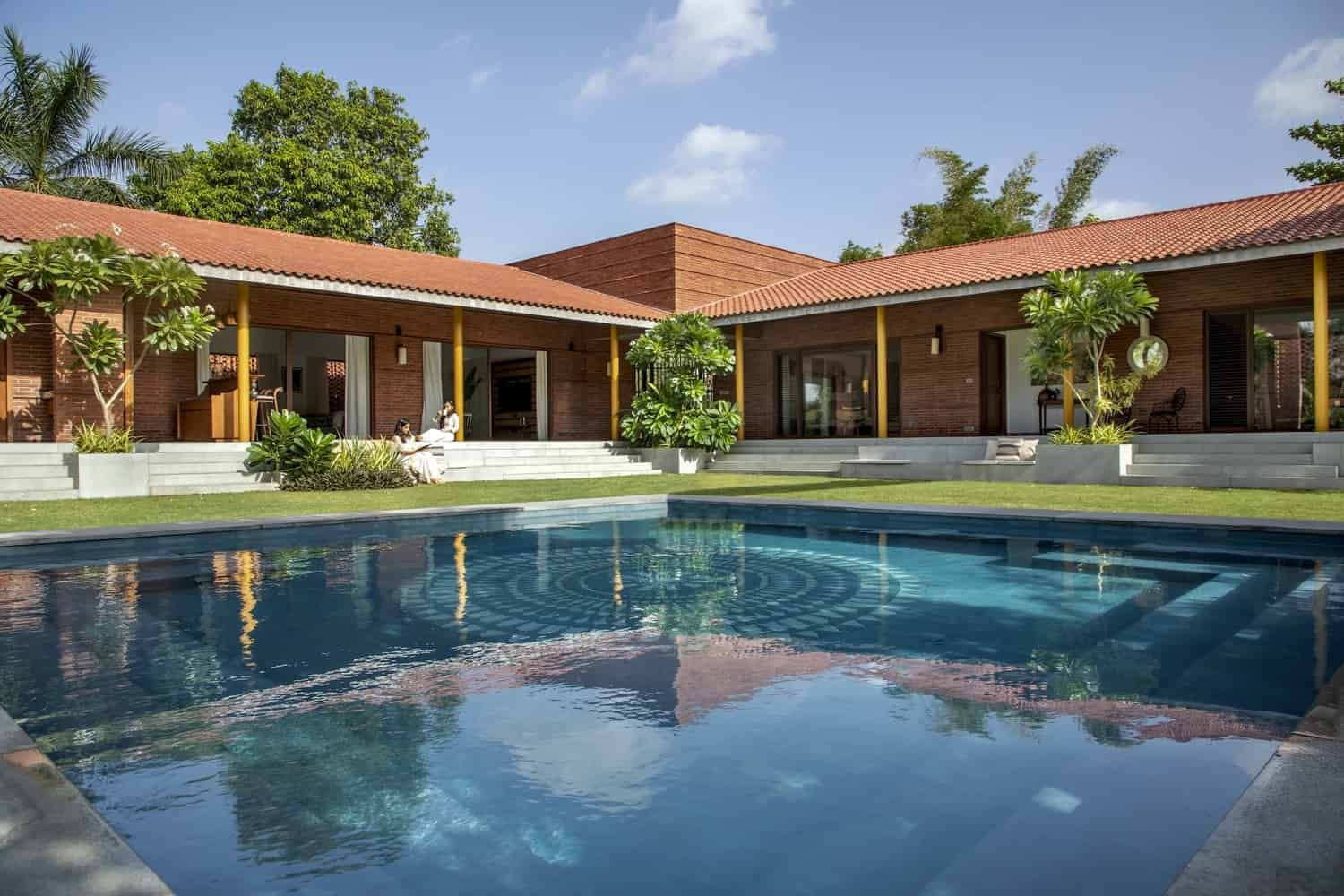
An L-shaped plan separates public and private wings and embraces a courtyard whose corner holds a blue-tiled swimming pool. This inward orientation produces intimacy, while curated openings frame orchard views and draw prevailing breezes across shaded verandas.
Arrival as Narrative
Approach is choreographed as a sequence of veils and reveals:
-
A tall concave brick jaali forms the first screen, casting cinematic sciography across the cobbled forecourt.
-
Turning the curve, visitors meet a delicate entry foyer—a cast antique-patterned jaali box—signalling a transition from rough landscape to refined domesticity.
-
Beyond, ambulatory corridors under sloped roofs flank the courtyard, where the stark blue pool anchors a composition of green, brick, and shadow.
This high-low rhythm—from porous mass to light enclosure—sets a calm, almost monastic tone for the interiors.
Courtyards, Jaali, and the Sun
A defining USP of the project is its dialogue with the sun. DGA orchestrates dynamic perforated screens and semi-covered courts to filter light, ventilate naturally, and animate spill-out spaces with moving shadows throughout the day. Retractable or openable edges expand rooms into shaded thresholds, multiplying usable area without mechanical overhead.
Material & Detail: Indigenous, Tactile, Enduring
Interiors are soothing white, allowing material textures to read:
-
Lime-plastered walls and exposed brick provide thermal mass and breathable surfaces.
-
Cane, terrazzo, and timber add tactility and local familiarity.
-
Muted, monochrome palettes are punctuated by occasional bursts of color—art, upholstered chairs, or the pool’s blue—maintaining composure while avoiding austerity.
Each bedroom and the living-dining opens to a semi-covered courtyard on one side and to the exterior ambulatory on the other, ensuring cross-ventilation and a constant connection to greenery.
Planning That Serves Everyday Life
The L-shape smartly zones the home:
-
Public wing: arrival, living-dining, and social spill-outs oriented to pool and court.
-
Private wing: bedrooms with intimate courts and quieter garden outlooks.
-
Edges as rooms: verandas and ambulatories are treated as programmed thresholds—for reading, tea, or barefoot walks at dusk.
Across the garden, small episodes—a circular seating nook in the orchard, a Terminalia court, and a jogging track on the perimeter—extend daily rituals into the landscape.
Climate Responsiveness, Not Style for Style’s Sake
While the farmhouse photographs beautifully, its performance is fundamentally climatic:
-
Deep eaves + pitched Mangalore tile roofs reduce solar gain and harvest shade.
-
Perforated brick screens (jaali) moderate glare and invite breeze.
-
Courtyard microclimate cools adjacent spaces; semi-open rooms lengthen comfort hours.
-
Local materials limit embodied energy and blend with context.
The outcome is a home that stays cooler, quieter, and more breathable, aligning pleasure with prudence.
A Quiet Architecture of Trust
Backed by a client brief grounded in simplicity and faith, DGA exercises restraint: there’s no formal bravado, only well-judged proportions, honest materials, and light handled with care. The farmhouse reads as timeless—a place to unwind, to watch shadows move, to live slowly.


